The Washington DC paycheck calculator estimates resident wage withholding using D-4 allowances, the District’s graduated rate schedule, federal withholding and FICA. Start by confirming DC residency: a job located in the District does not automatically make a nonresident’s wages subject to DC income-tax withholding.
Our resident example earns $102,960 in 2026, receives 24 semi-monthly payments and has one supported D-4 allowance. Its checked DC withholding is $282.75 each payment. Employer paid-family-leave tax is not deducted from this employee cash result.
Confirm which residency path applies first
A DC resident ordinarily supplies Form D-4 to their employer. A qualifying nonresident instead uses D-4A to establish nonresidence for withholding. Those are different questions from how many allowances a resident claims.
The agency’s D-4A instructions describe the permanent-residence and 183-day conditions, and tell an employee who becomes a DC resident to provide D-4 promptly. Military-spouse situations have their own requirements.
The current OTR forms directory marks D-4 and D-4A as under review. Check the latest official version or ask payroll before submitting an older saved copy.
The calculator does not decide domicile, count days, file D-4A or automatically calculate a commuter’s home-state tax. This guide’s numbers apply to a full-year DC resident, not to someone whose only DC connection is the office address.
Enter $102,960 with 24 semi-monthly payments
In the free Washington DC paycheck calculator, choose 2026, annual wages of $102,960 and Semi-monthly. Each assumed payment is $4,290.
Choose federal Single, leave multiple jobs unchecked and set the federal dollar adjustments to zero. Enter one D-4 allowance and no extra DC withholding. Keep annual local and other cash amounts at zero for the initial calculation.
Assume one ordinary private-sector employer and equal gross, federal, DC, Social Security and Medicare wages. There are no benefit exclusions, irregular bonuses or midyear certificate changes.
Use the allowance count actually supported by the certificate and payroll records. The tool starts at zero allowances; a prefilled value is a calculation starting point, not a recommendation for your certificate.
Semi-monthly means 24 assumed payments. Selecting biweekly would use a different period count and smaller gross per payment for the same annual salary. Match the employer’s schedule before comparing individual checks.
Understand where the $4,300 allowance amount comes from
OTR Tax Notice 2022-08 addresses the difficulty of producing withholding tables after federal tax changes and directs taxpayers to the District’s rate schedule and federal allowance amount.
The calculator uses a $4,300 annual allowance reduction. The 2026 IRS withholding publication retains that annual dollar value in its allowance-based calculation. This does not mean a modern federal W-4 asks for an allowance count.
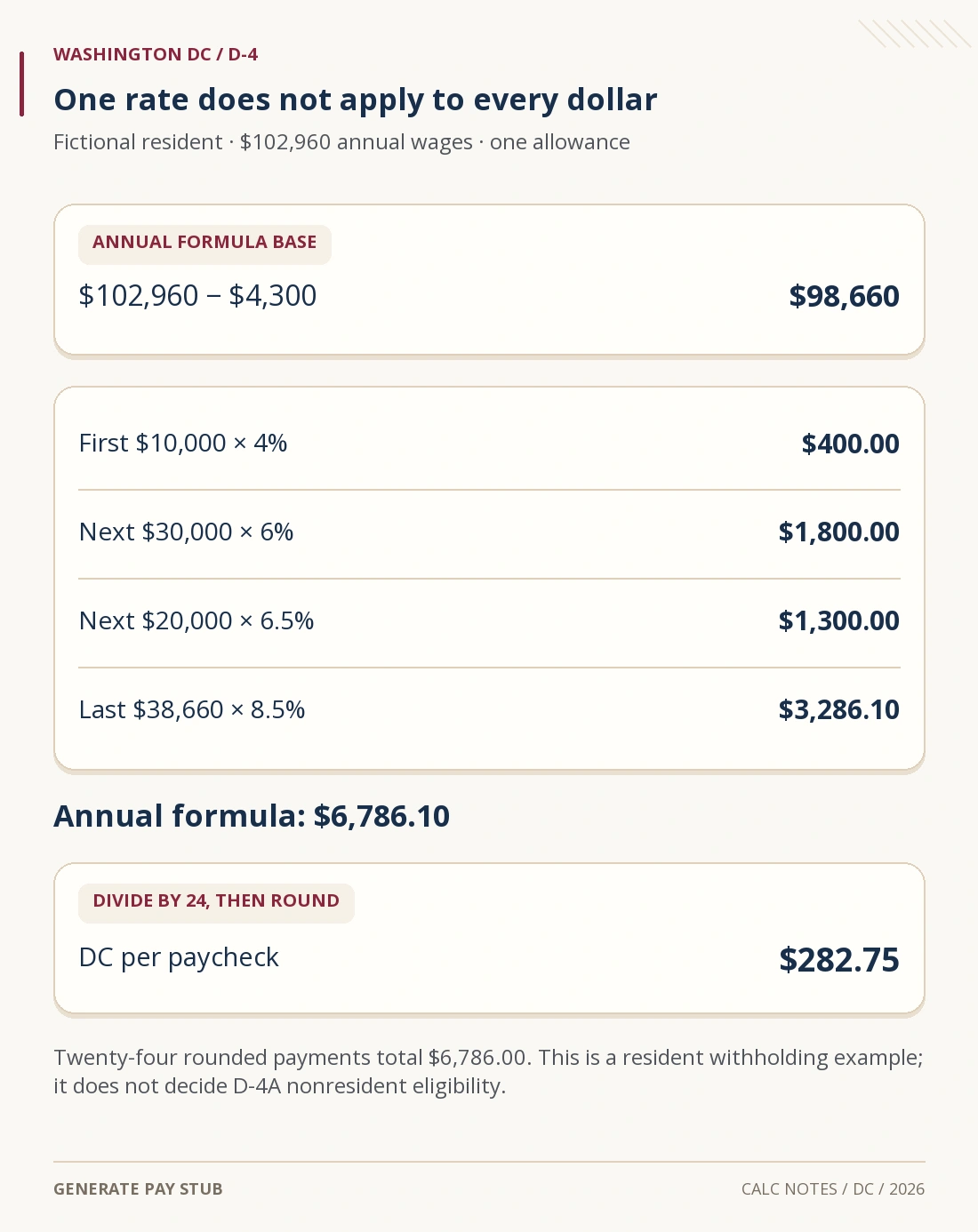
For our assumed one-allowance D-4, the annual formula base becomes $102,960 − $4,300 = $98,660. A D-4 allowance is not $4,300 off the tax bill.
Do not subtract a second return standard deduction on top of the tool’s allowance method. The worked estimate traces payroll withholding, rather than preparing a DC individual return with every deduction and credit.
Trace the four rate layers without taxing everything at 8.5%
The current OTR rate schedule applies progressively. At a $98,660 formula base, the first $10,000 produces $400; the next $30,000 produces $1,800; and the next $20,000 produces $1,300.
Only the remaining $38,660 is in the 8.5% layer: $38,660 × 0.085 = $3,286.10. Total annual formula withholding is $6,786.10.
Equivalently, the schedule gives $3,500 plus 8.5% of the excess above $60,000. Dividing $6,786.10 by 24 gives $282.754166…, rounded to $282.75 per payment.
The tool’s year contains 24 rounded payments, so annual DC withholding is $6,786.00. The ten-cent difference from the annual formula is a rounding effect.

Match the live cash ledger
| Wage or employee withholding | Per payment | Twenty-four payments |
|---|---|---|
| Gross wages | $4,290.00 | $102,960.00 |
| Federal income-tax withholding | $575.88 | $13,821.12 |
| DC income-tax withholding | $282.75 | $6,786.00 |
| Employee Social Security | $265.98 | $6,383.52 |
| Employee Medicare | $62.21 | $1,493.04 |
| Cash with other amounts unentered | $3,103.18 | $74,476.32 |
For one payment, $4,290 − $575.88 − $282.75 − $265.98 − $62.21 = $3,103.18. Annual amounts in the ledger sum the rounded deductions, rather than silently replacing them with unrounded annual calculations.
An actual deposit can be lower if premiums, retirement savings or other deductions are present. Compare the gross amount and each line in the employer’s gross-to-net reconciliation before assuming the state tax caused the entire difference.
Test an agreed $13 extra on every payment
Keeping the same wages and allowance, a second live run enters $13 of extra DC withholding per paycheck.
| Result | No state extra | $13 extra each pay |
|---|---|---|
| DC withholding per payment | $282.75 | $295.75 |
| Annual DC withholding | $6,786.00 | $7,098.00 |
| Annual projected cash | $74,476.32 | $74,164.32 |
The annual change is $13 × 24 = $312. Federal withholding and FICA stay the same. Entering $13 into an annual cash field would represent a different amount and would not update the DC withholding line.
Additional withholding is still a tax prepayment, not a fee. Whether it helps meet the year’s liability depends on household income, other jobs and the completed return.
Keep employer program costs outside employee net pay
DC’s Paid Family Leave agency describes its tax as employer funded. Its employer toolkit specifically says contributions cannot be deducted from worker payments.
Likewise, DC unemployment law prohibits wage deductions to pay the employer’s unemployment contributions. Their absence from the employee ledger does not mean the employer has no payroll costs.
This ordinary annual wage tool does not establish paid-leave eligibility, calculate leave benefits or model a self-employed election. A pension distribution, nonresident refund or part-year move also needs its applicable rules.
Washington DC paycheck calculator questions
Does a DC office address prove I owe DC wage withholding?
No. Establish residence and the appropriate certificate first.
Does one allowance reduce my tax by $4,300?
No. It reduces the annual calculation base.
Is every dollar taxed at the highest bracket reached?
No. The rate schedule applies in layers.
Does this free tool create proof of income?
No. It estimates a fictional or user-entered wage scenario and does not verify earnings or file a certificate.
DC sources, current form-directory notice and three actual calculator runs reviewed November 6, 2026.