Tennessee has no state income tax on earned wages, but federal withholding and employee FICA can still reduce a paycheck. When using the 2026 Tennessee calculator, distinguish its annual estimate, monthly average and average per check. A monthly average is not a deposit promised for every calendar month.
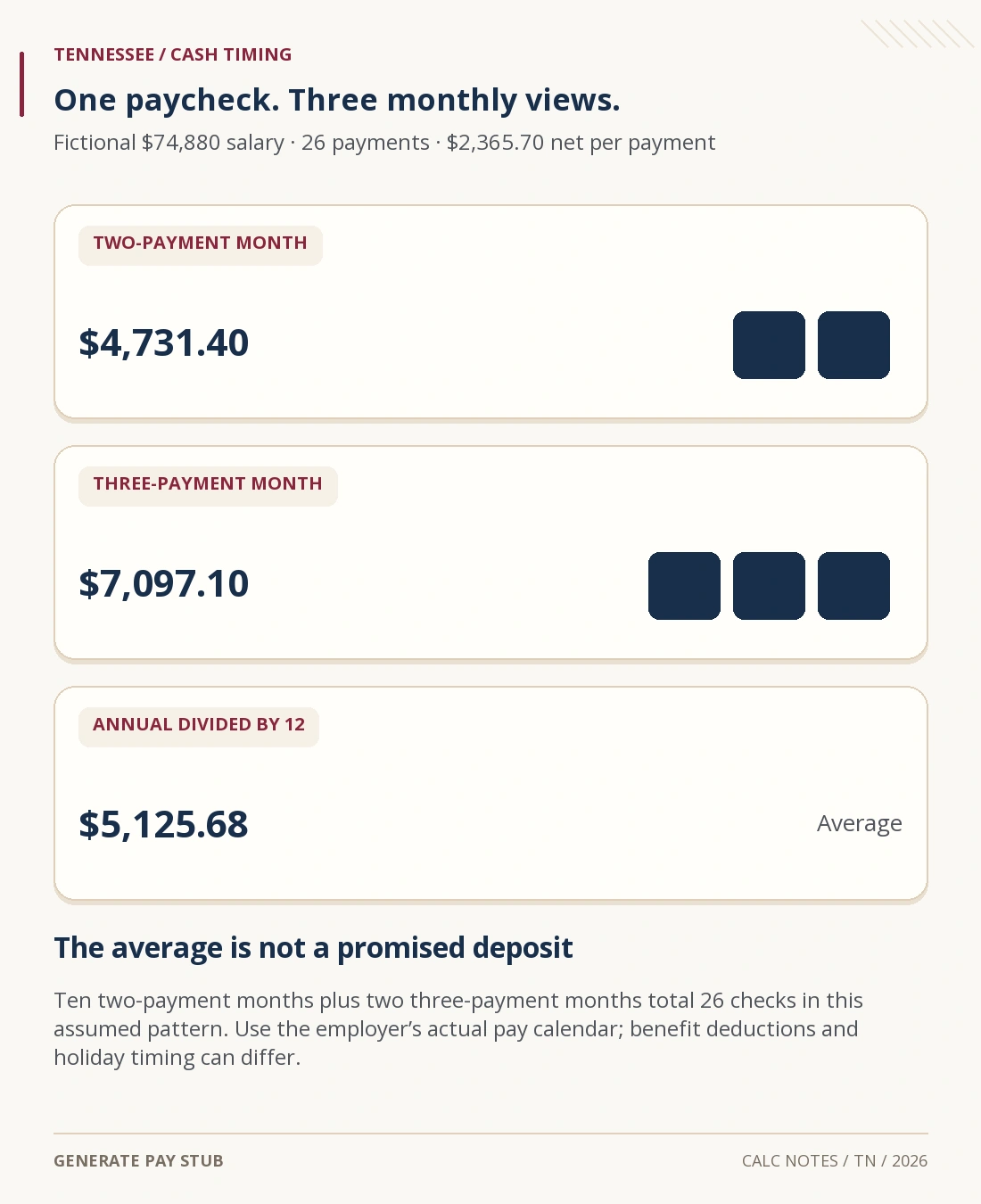
Our fictional $74,880 salary produces $2,365.70 of cash per biweekly payment before benefits and other omitted items. Two such payments total $4,731.40; the annual cash divided by twelve is $5,125.68. Both numbers are useful, but they answer different budgeting questions.
Understand why the Tennessee income-tax line is zero
Tennessee Revenue’s income-tax withholding guidance states that Tennessee does not tax earned income and has no state income-tax withholding requirement for it. The guidance also notes the Hall income tax’s repeal from January 1, 2021.
A historical Hall tax rate does not belong in a 2026 wage estimate. Neither does the absence of a state income-tax line remove federal wage deductions.
The IRS Social Security and Medicare guidance lists employee rates of 6.2% and 1.45%. The ordinary salary used here remains below the 2026 Social Security wage limit and below the employer’s Additional Medicare withholding threshold.
This guide assumes Tennessee residence and work. A person living or working across a state border needs the relevant other-state rules before deciding that no state withholding applies to the entire arrangement.
Enter a $74,880 salary paid every two weeks
Use the Tennessee paycheck calculator with 2026 selected. Enter $74,880 as annual wages and choose Every Two Weeks. The model uses 26 payments, each with $2,880 gross.
For this checked run, federal status is Single. The multiple-job option is off; federal annual credits, other income, deduction adjustments and extra withholding are all zero. Known annual local and other deductions are also zero.
Assume constant ordinary wages from one private employer for the full year, no benefit exclusions, and equal gross, federal taxable and FICA wages. We are modeling an uncomplicated wage stream so the cash timing can be seen clearly.
The calculator’s 26-payment convention must be checked against the employer’s calendar. Do not assume that selecting a frequency imports actual pay dates, holiday adjustments or a company’s handling of an unusual payment count.
Reconcile one $2,880 gross payment
The live estimate gives $293.98 federal income-tax withholding, $178.56 employee Social Security and $41.76 employee Medicare. Tennessee state income-tax withholding is zero.
Cash is $2,880 − $293.98 − $178.56 − $41.76 = $2,365.70. Social Security separately checks as $2,880 × 6.2% = $178.56; Medicare is $2,880 × 1.45% = $41.76.
Federal withholding depends on the selected certificate settings; it is not a fixed Tennessee percentage. An employer’s different W-4 election or taxable benefit can change the result at the same headline salary.
Compare this cash result with the net payment on a statement after accounting for all deductions. Our take-home reconciliation guide explains the distinction between gross, taxable wages and the amount available for deposit.
Distinguish a two-payment month from an annual monthly average
| Question the figure answers | Cash amount |
|---|---|
| Two identical biweekly payments in a month | $4,731.40 |
| Three identical biweekly payments in a month | $7,097.10 |
| Annual $61,508.20 divided by 12 months | $5,125.68 |
Under a pattern of ten two-payment months and two three-payment months, the payment count is 10 × 2 + 2 × 3 = 26. This is an illustrative distribution, not a prediction of which months the employer will use.
The monthly average exceeds the two-payment amount by about $394.28. That extra average is supported by the year’s additional payments, rather than a third deposit appearing in every month.

For recurring bills, first map expected deposits to due dates. The annual average can support a yearly affordability comparison, while a two-payment baseline can show cash available in a lower-deposit month.
A third paycheck is part of annual compensation, not necessarily a bonus. Check whether insurance, retirement or other deductions are collected on that payment before allocating the entire estimate.
Check the annual wage ledger
| Year-level item | Amount |
|---|---|
| Annual gross wages | $74,880.00 |
| Federal withholding from 26 payments | $7,643.48 |
| Tennessee income-tax withholding | $0.00 |
| Employee Social Security total | $4,642.56 |
| Employee Medicare total | $1,085.76 |
| Cash before unentered payroll items | $61,508.20 |
The annual cash checks both ways: $74,880 − $7,643.48 − $4,642.56 − $1,085.76 = $61,508.20, and $2,365.70 × 26 gives the same total.
Dividing $61,508.20 by twelve gives $5,125.683333… . Displaying $5,125.68 is a rounded average. Multiplying that displayed average back by twelve can differ by a few cents; keep the annual amount when reconciling the total.
Add confirmed deductions without changing the wrong wage base
The IRS W-4 guidance ties federal withholding to the employee’s certificate. Annual adjustments and a per-payment extra have different units. Changing a calculator entry does not send a new certificate to payroll.
Known annual cash fields can represent verified amounts. For example, an after-tax deduction of $40 on each of 26 payments totals $1,040 annually. The evenly distributed cash effect would be $40 per modeled check.
That does not mean every employer collects an annual benefit cost evenly. Some use 24 deductions during 26 paydays, and some deductions vary with a wage percentage or payment type. Use the actual plan and collection schedule.
A pre-tax benefit may change one or more tax bases. Entering it solely as an “other” cash amount cannot calculate that treatment. Review pre-tax and post-tax wage effects before comparing a benefit-inclusive paycheck.
Compare the estimate with employer records
Tennessee Labor’s covered-employment explanation describes the employer paying the state unemployment premium. It is an employer expense, separate from the employee deductions in this wage example.
When cash differs, compare the actual gross payment, taxable wages, W-4 elections and benefit deductions. Check payment count and dates next. A midyear raise or a partial year should not be reconciled by repeating the old salary for every payment.
Neither the average nor the payment estimate establishes income earned, prepares a return or calculates a refund. Keep payroll statements and employer records for those separate purposes.
Tennessee paycheck calculator questions
Why are taxes withheld if Tennessee has no wage income tax?
Federal income tax and FICA are separate federal deductions.
Can I budget every month using $5,125.68 in this example?
It is an annual average. Check actual deposit dates and amounts for monthly bills.
Is a three-paycheck month an extra annual salary payment?
It is normally part of the assumed annual payment count, not an additional bonus.
Does the tool know my employer’s benefit schedule?
No. Enter confirmed amounts and review how they are collected.
Tennessee treatment, live wage estimate and monthly-view arithmetic reviewed November 6, 2026.