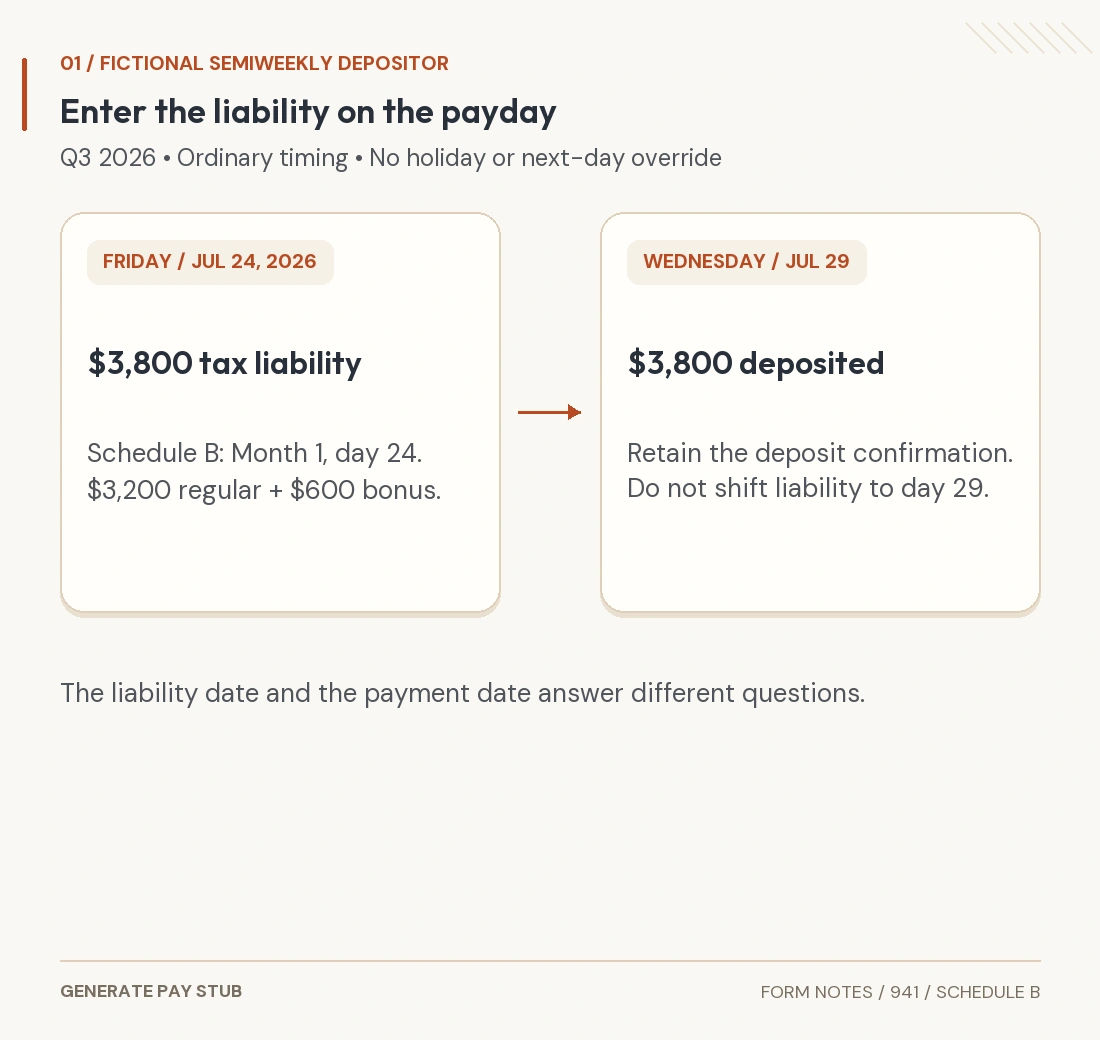
Schedule B for Form 941 reports daily federal employment-tax liabilities for qualifying semiweekly depositors. Enter the liability on the date wages were paid, combine items arising on the same date and reconcile the quarter's total to Form 941, Line 12. A bank or IRS deposit date belongs in the payment records, not in the liability calendar.
The schedule helps explain when the return's tax became due for deposit purposes. A correct quarterly total with amounts placed on the wrong days can still create a deposit-penalty problem.
Reviewed November 5, 2026. The current schedule is the March 2024 continuous-use revision, used here for a fictional Q3 2026 employer. The example assumes semiweekly status throughout the quarter, reviewed daily liabilities and no credits, special adjustments, prior-period corrections or next-day-deposit event.
What does Schedule B report?
It reports the employer's tax liability by wage-payment date. The official Schedule B original has three numbered monthly sections and a quarterly total. Each numbered space represents a day of the month, not a payment installment or employee number.
The liability includes federal income tax withheld and the applicable employer and employee Social Security and Medicare shares, along with properly handled adjustments and credits. Do not enter only the employee's pay-stub deductions.
Schedule B is not a second Form 941 or a list of electronic transfers. It supports the return's timing information. Our 2026 Form 941 preparation guide explains the return's taxable bases, tax components and deposit reconciliation.
Who needs to file Schedule B with Form 941?
Confirm the deposit schedule and the return's filing instructions. Under the Schedule B instructions, semiweekly depositors file it with Form 941. Employers that become semiweekly during a quarter must report the entire quarter on the schedule, including the earlier part.
Publication 15 for 2026 explains the ordinary lookback test and the $100,000 next-day rule. More than $50,000 of reported tax in the applicable lookback ordinarily gives semiweekly status. A qualifying $100,000 accumulation can change a monthly depositor's status.
Do not infer deposit status from the payroll frequency. A business paying wages monthly can be semiweekly for deposit purposes. Conversely, paying employees twice a month does not by itself require Schedule B.
The instructions say not to complete Schedule B when Form 941 Line 12 is below $2,500 for the quarter. Monthly depositors normally use the monthly liability entries on Form 941 where required. Specific penalty-correction situations have different instructions.
Schedule B also is not Form 944's annual liability schedule. A Form 944 filer needing the relevant daily annual report uses Form 945-A under its instructions.
Which records establish the correct daily entries?
Start with the payroll tax-liability ledger and actual pay dates. Keep payroll registers, supplemental-pay records, wage-base calculations and any allowed adjustment or credit work available.
The IRS employment-tax recordkeeping guide identifies both wage-payment dates and deposit confirmations as records to retain. Keep them connected without treating them as the same kind of date.
For a quarter-end preparation packet:
- Match employer name, EIN, year and quarter to the underlying return.
- Identify all paydays within that quarter.
- Combine regular, bonus and other relevant liabilities occurring on each day.
- Apply current-quarter adjustments or credits under the specific instructions.
- Sum the daily entries into each month's subtotal.
- Match the three-month sum to the related Form 941 total.
- Reconcile deposits separately using their actual dates and confirmations.
Use the date wages were paid rather than the period in which the work was performed. A payroll period spanning year-end can therefore belong in a different quarter from the one its work dates suggest. The pay-period versus pay-date guide explains that record distinction.
How does a same-day bonus appear? A checked Q3 2026 example
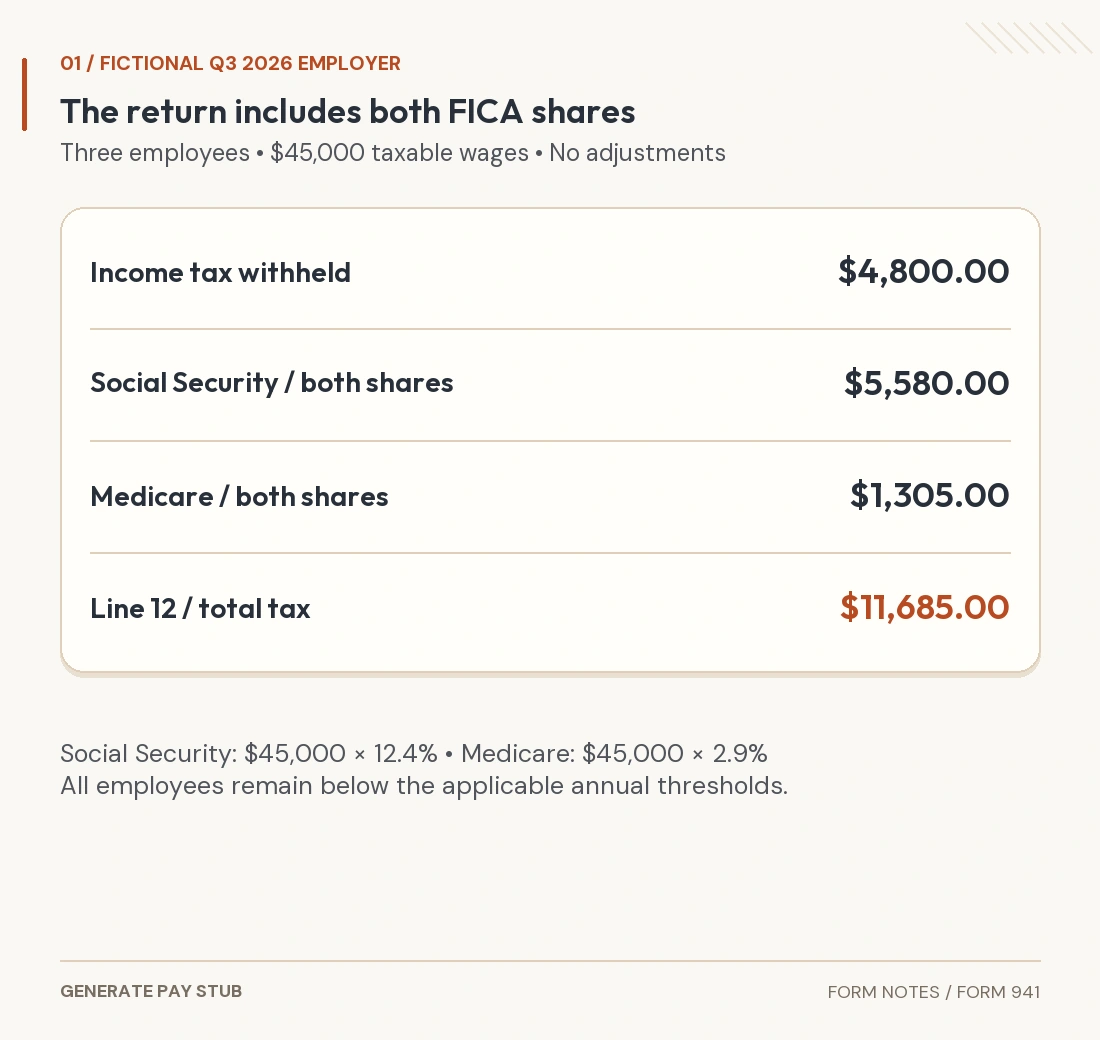
One date receives the combined liability arising that day. Assume a fictional employer's applicable lookback tax is $62,000, making it a semiweekly depositor throughout 2026 under the ordinary rule. The following are given, reviewed federal tax liabilities from its payroll records, including the applicable employee and employer shares.
| Actual payday | Entry on the schedule | Liability |
|---|---|---|
| July 10, 2026 | Month 1, day 10 | $3,200.00 |
| July 17, 2026 | Month 1, day 17 | $3,200.00 |
| July 24, 2026 | Month 1, day 24: $3,200 regular + $600 bonus | $3,800.00 |
| August 7, 2026 | Month 2, day 7 | $3,500.00 |
| August 21, 2026 | Month 2, day 21 | $3,500.00 |
| September 4, 2026 | Month 3, day 4 | $3,600.00 |
| September 18, 2026 | Month 3, day 18 | $3,600.00 |
The July 24 entry is $3,800, not two entries on different calendar days. It includes $3,200 from regular payroll and $600 from the same-day bonus. A separate payroll run does not create a different payment date when both were paid on July 24.
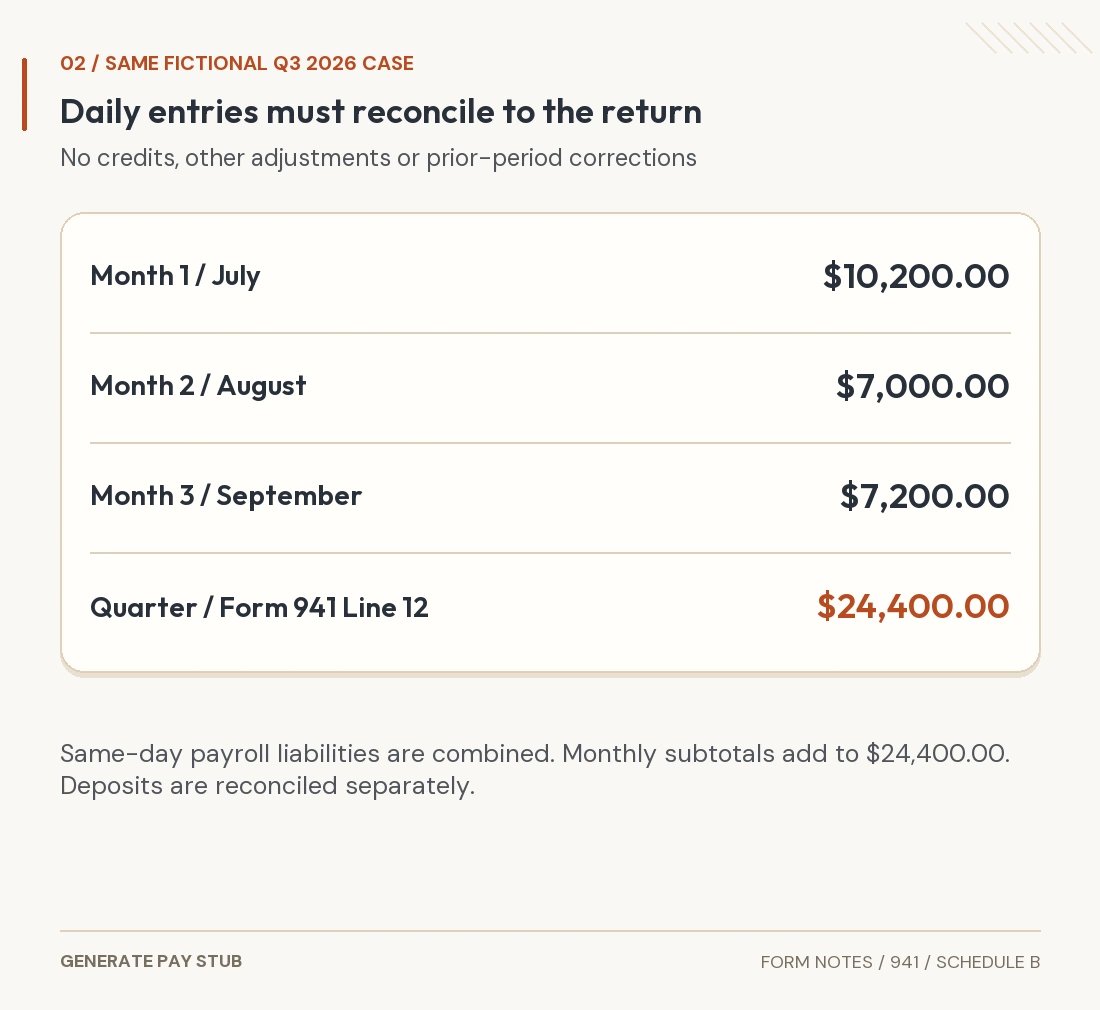
July totals $3,200 + $3,200 + $3,800 = $10,200. August totals $3,500 + $3,500 = $7,000. September totals $3,600 + $3,600 = $7,200. Their combined quarterly liability is $24,400.

How does the payday differ from the deposit deadline?
The liability remains on the payday even when the deposit is made later. IRS Topic 757 explains the distinction between payroll frequency, liability dates and deposit schedules.
Under ordinary semiweekly timing, liabilities from Wednesday through Friday wage payments are generally deposited by the following Wednesday; those from Saturday through Tuesday are generally deposited by the following Friday. Legal holidays and the next-day rule can change the applicable deadline.
In the fictional case, July 24, 2026 is Friday. Assume no special rule changes the ordinary deadline and the $3,800 is deposited Wednesday, July 29. Schedule B still records the liability on Month 1, day 24, not day 29.

For a bank transfer scheduled near a deadline, check the actual payment system's cutoff and effective-date instructions. A draft, saved voucher or scheduled transfer is not evidence that the tax was successfully paid.
Do not use this one Friday-to-Wednesday example as a rule for every date. Publication 15 describes the business-day requirements, including holidays and the $100,000 accumulation rule.
What should reconcile before the schedule is attached?
Check dates, subtotals and the quarter's return amount. In the example, the $24,400 Schedule B total must equal Form 941, Line 12, under the stated no-adjustment and no-credit assumptions.
If the totals differ, review missing off-cycle payroll, duplicate rows, same-day bonuses, omitted employer shares, credit treatment and any rounding work. Do not alter a random day's liability solely to make the final sum agree.
Also check the calendar. For Q3, Month 1 means July, Month 2 means August and Month 3 means September. The printed schedule provides 31 spaces for each month, but September still has only 30 days.
A complete deposit reconciliation is a separate test. An accurate Schedule B does not itself establish that every payment was timely. Likewise, the correct total deposited does not establish that liabilities were placed on the right days.
How should credits and earlier-quarter corrections be handled?
Use the relevant credit or correction procedure before entering the final liabilities. For the research payroll credit, Form 8974 determines the amount usable for the quarter. The Schedule B instructions explain how it affects particular employer tax liabilities over the payroll dates.
Do not spread a credit equally across all dates or deduct it from employee withholding just to produce a smaller deposit. Preserve the supporting computation and apply the specified ordering and limits.
Prior-period Forms 941-X or 944-X adjustments do not change the current quarter's liability calendar. If preparing a schedule for an amended return, follow the special instructions for that situation.
The instructions also describe correcting a misdated Schedule B when a failure-to-deposit penalty was assessed and the quarter's total does not change. An amended schedule may help the IRS recompute that penalty. A change to the underlying total requires the appropriate return-correction review, not merely a replacement date grid.
How do you prepare, review and attach Schedule B?
Use the same employer and reporting period as the underlying return. The Schedule B document overview opens the Schedule B builder, which currently offers 2025 and 2026 calendar-year selections on the continuous-use original.
Enter reviewed liabilities by actual payday. The tool combines multiple rows with the same date and reconciles monthly subtotals against your entered return liability. Check that no deposit date was accidentally entered as a payday.
Inspect employer identity, year, quarter, all daily positions, monthly totals and the complete one-page output. The underlying Form 941 or applicable Form 941-X remains separate. Schedule B has no independent taxpayer signature line.
Attach it to the correct return and follow that return's filing and signing requirements. Preparing the schedule does not transmit it or make a deposit. Keep the reviewed schedule, return, filing confirmation and separate payment records together.
General U.S. federal employment-tax information. The example uses given reviewed liabilities and ordinary 2026 semiweekly status. Credits, status changes, holidays, penalties and corrections require their specific instructions.