Schedule F reports the income and deductible expenses of a farming business. Prepare it from the farm's accounting records, separate raised products from purchased resale items, and keep asset sales and special elections on their proper reporting paths. Net farm profit is an input to further tax calculations, not the tax itself.
The most useful starting point is a reconciled farm ledger. A list of deposits may mix sales, borrowed money and transfers, while a list of purchases can mix current expenses, resale costs and depreciable equipment.
Reviewed November 5, 2026. The linked builder currently offers the final 2025 Schedule F; all form locations and example amounts below refer to that U.S. edition. The fictional example assumes an individual proprietor with one cash-method farm, material participation, fully supported eligible current expenses and no applicable loss limitation, crop-payment election or other special adjustment.
Who uses Schedule F, and when is another form appropriate?
Use the farming schedule for the farming activity it actually describes. The 2025 Schedule F instructions explain its use with individual and certain other returns. The applicable underlying return and entity classification matter.
Do not put every farm-connected receipt in this schedule. Separate support-service businesses can have a Schedule C route; the Schedule C activity-code instructions distinguish crop and animal support activities from the principal farming activity. Certain sales of equipment, breeding or dairy livestock and other business assets use Form 4797 instead of ordinary farm-sales entries.
The IRS Form 4835 overview identifies a different situation: a landowner or sub-lessor receiving crop- or livestock-based farm rent without materially participating for self-employment-tax purposes. Flat-charge land rentals also require their proper rental review.
An LLC's name does not determine its federal tax return by itself. Spouse-owned farms can involve partnership, qualified-joint-venture or community-property rules. Check the actual arrangement rather than combining everything under one spouse by default.
Our Schedule E guide explains rental and pass-through records, while the Schedule C guide follows a service business.
Which records should you gather before preparing Schedule F?
Organize the evidence around the transactions that the return needs to explain. The IRS recordkeeping guide describes books and supporting documents for income, purchases, payroll and other activity.
- Sales records distinguishing products raised from items purchased for resale.
- Acquisition cost or other basis records for the resale items actually sold.
- Cooperative statements, agricultural-program records and relevant information forms.
- CCC loan and election records, if applicable.
- Crop insurance and disaster-payment details, including any election statement.
- Expense receipts, worker payments and supporting business-use allocations.
- Asset records showing cost, service date, prior deductions and disposals.
- Inventory records required by the accounting method.
- Prior-year carryovers, limitation forms and other relevant schedules.
Keep a short reconciliation beside unusual entries. For instance, an equipment-loan deposit should remain identifiable as financing rather than being silently included in product sales. A feed purchase included in an applicable resale basis calculation should not be repeated in another expense subtotal.
The aim is a packet another reviewer can follow: source document, ledger entry, adjustment explanation and destination on the draft. Keep original records available instead of relying only on a document builder's saved totals.
How do the cash and accrual paths differ on Schedule F?
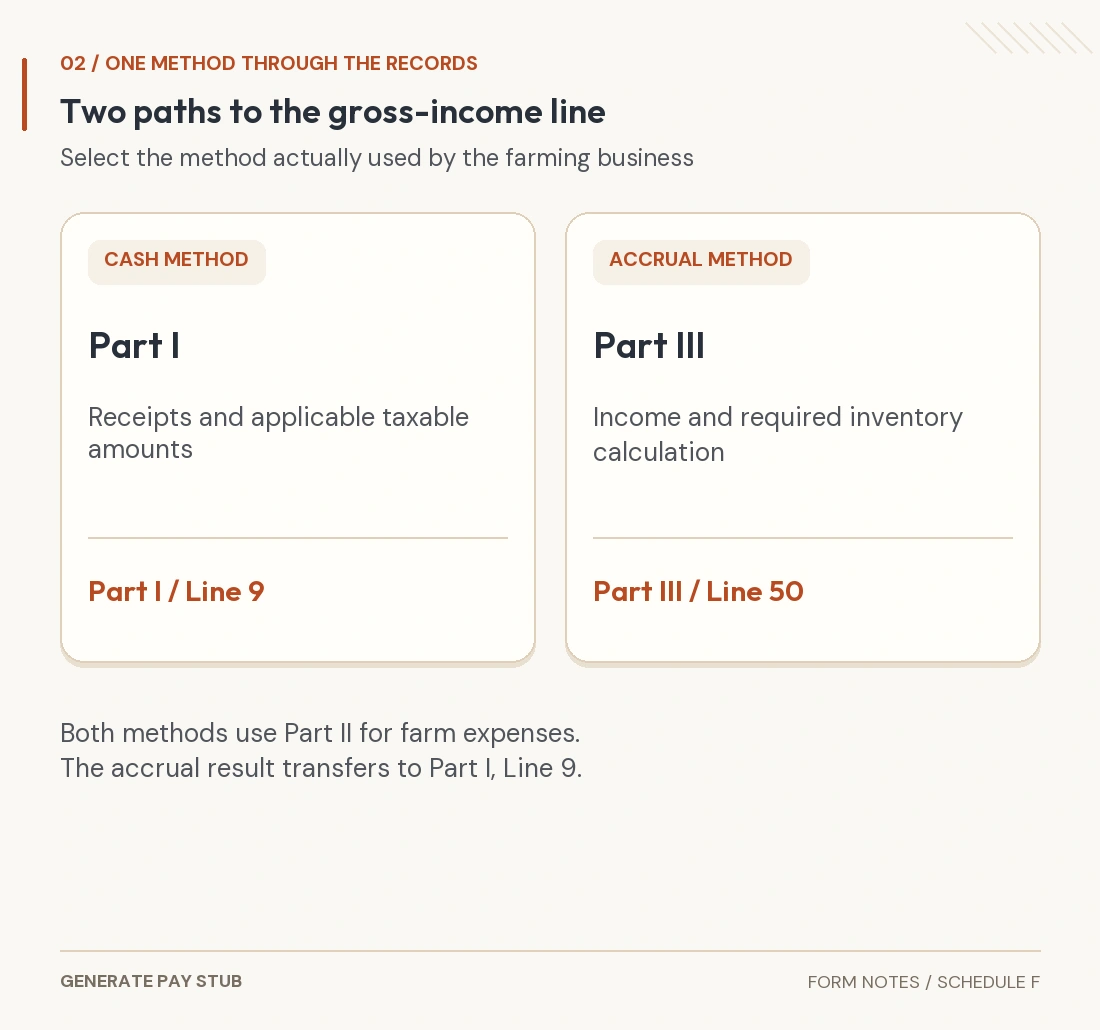
Use the method actually maintained for the farm; do not switch methods simply to obtain a preferred result. The 2025 original Schedule F separates the cash-method income section from the accrual-method income calculation.
Cash-method filers complete Part I and Part II. Accrual-method filers use Part III and Part II, then transfer the Part III gross-income result to Part I, Line 9. Part III includes its required inventory calculation.
Publication 538 explains accounting-method principles and changes. Recognition can involve more than the invoice date or the day a bank feed imported a transaction. Prepayments, capitalization and special farm rules require their own review.

How should you separate farm income?
Follow the category and taxable-amount fields rather than entering one unexplained bank total. Raised-product sales and purchased resale items have different entries. Cooperative distributions, agricultural payments, CCC items, crop payments and other receipts also have their own review points.
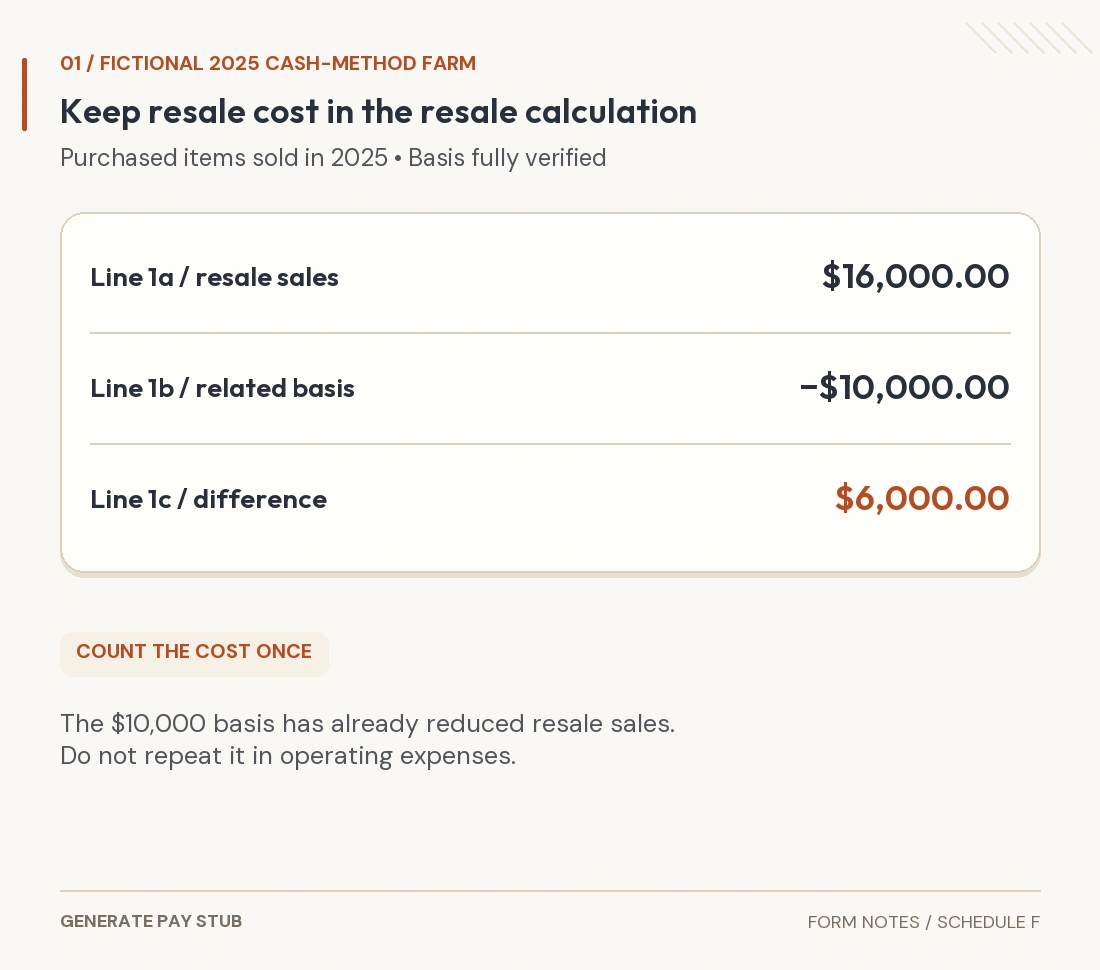
For purchased resale items, subtract the relevant cost or other basis through the resale calculation. Do not also deduct that same amount as an operating cost. A statement showing both a gross and a taxable amount should not be counted twice.
Check what an information form represents and reconcile it with the ledger. Two documents can describe the same payment. Income reporting also is not limited to transactions for which someone sent an information return.
What does a checked 2025 cash-method farm example look like?
Start with the income components, then total the eligible expenses separately. Assume these fictional 2025 amounts:
| Source | Calculation or treatment | Income included |
|---|---|---|
| Products raised on the farm | Sales received | $65,000.00 |
| Purchased items resold | $16,000 sales less $10,000 verified basis | $6,000.00 |
| Custom-hire machine work | Qualifying farm income received | $3,000.00 |
| Agricultural program payments | Assumed fully taxable amount | $2,000.00 |
| Gross farm income | No other income or elections in this example | $76,000.00 |

The income sum is $65,000 + $6,000 + $3,000 + $2,000 = $76,000. Assume the following expense amounts are eligible for the year, entirely business-related, supported and not counted in the resale calculation or another category.
| Expense | 2025 Schedule F entry | Amount |
|---|---|---|
| Seeds and plants | Line 26 | $4,200.00 |
| Feed | Line 16 | $6,300.00 |
| Fertilizers and lime | Line 17 | $3,800.00 |
| Gasoline, fuel and oil | Line 19 | $2,100.00 |
| Labor hired; no credit adjustment assumed | Line 22 | $8,000.00 |
| Land rent | Line 24b | $6,000.00 |
| Current repairs and maintenance | Line 25 | $1,800.00 |
| Utilities | Line 30 | $1,200.00 |
| Business insurance other than health | Line 20 | $900.00 |
| Separately reviewed depreciation | Line 14 | $5,000.00 |
| Total assumed deductible expenses | Line 33 | $39,300.00 |
Those entries total $39,300, including a given $5,000 depreciation amount from separate asset work. There are no other adjustments in the example. Gross farm income of $76,000 less $39,300 produces $36,700 net farm profit on Line 34.
The assumed depreciation is not a blanket deduction for every farm. Nor does the example authorize a deduction merely because a listed payment occurred. Eligibility and timing must be established before entering the amounts.
Which expense mistakes are especially easy to make?
Review the nature of each cost and where it has already been counted. Keep personal living costs and owner withdrawals outside deductible farm expenses. Payments to the proprietor are not hired-worker wages.
Separate current supplies and repairs from assets, improvements or other capital costs. IRS Topic 703 explains basis as the investment in property used for depreciation and gain-or-loss calculations. A tractor's purchase price and its allowed annual deduction are different figures.
Use an appropriate vehicle business-use calculation, with separate records and required forms. Separate borrowed principal from deductible interest. Check employer-benefit, retirement and health-insurance treatment rather than putting all owner-related amounts in the employee expense lines.
Prepaid farm supplies can be subject to a 50% limitation measured against other deductible farm expenses, with specified exceptions. Prepaid feed has additional requirements. See Publication 225 for 2025 before assuming a year-end purchase is fully deductible immediately.
What changes for crop payments, elections or a farm loss?
Special treatment needs its own eligibility check and documentation. An eligible cash-method farmer may elect to postpone certain crop-damage proceeds. The IRS requires specific conditions, including the normal practice of recognizing more than half the income from the damaged crops in a later tax year. Price-decline proceeds are not automatically eligible.
Keep the damage, crop, payment and normal-practice evidence with the required election statement. Do not defer a whole insurance payout simply because part of it relates to physical damage. Also identify previously deferred amounts taxable in the current year.
For a loss, review at-risk and passive-activity rules, released carryovers and any excess-business-loss restriction. Publication 925 explains at-risk and passive limitations. Form 6198 or Form 8582 may be required, and a computed loss can differ from the currently allowed loss.
Large transactions, conservation costs, government programs and business-property dispositions can require additional calculations. Keep those items identifiable for review instead of forcing them into a convenient general expense entry.
Where does Schedule F profit go, and when are taxes paid?
For the ordinary individual-proprietor situation, Line 34 connects to Schedule 1, Line 6, and Schedule SE, Line 1a. The underlying return and applicable exceptions can change the route. The IRS self-employed tax center distinguishes business profit, income tax, self-employment tax and estimated payments.
Farmers and fishers can have special estimated-tax timing when farming or fishing supplies at least two-thirds of total gross income in the current or preceding year. IRS Topic 416 explains the March 1 filing-and-full-payment route or January 15 estimated-payment route, including weekend and holiday adjustments. These are conditional rules, not a deadline available to every small business.
As of this review, ordinary 2025 filing dates and these early-2026 dates are past. Use the appropriate late, amended or relief procedure where relevant. Do not read a 2025 guide as a 2026 estimated-payment calendar.
How do you prepare and review the Schedule F document?
Enter the reviewed farm records, inspect both original pages and assemble the remaining return materials. The Schedule F overview opens the Schedule F builder, currently offering the final 2025 edition.
Review the proprietor or entity identity, underlying return, activity code, accounting method, participation and information-reporting answers. Compare resale basis, taxable payment amounts, expense totals and any allowed-loss input with the supporting work.
The main return, depreciation forms, limitation forms and election statements remain separate where required. Schedule F has no separate taxpayer signature line. A prepared PDF is not an IRS filing, tax payment or determination that every entered deduction is allowed.
General U.S. tax information. The fictional example excludes special crop elections, losses, entity allocations and other complex situations. Refer to the complete year-specific instructions and appropriate professional guidance for your facts.