
Gross monthly income from pay stubs is a monthly measure of earnings before payroll taxes and deductions. For steady wages, convert the pay frequency to a monthly average: annual salary ÷ 12, weekly gross × 52 ÷ 12, or biweekly gross × 26 ÷ 12. For changing hours or irregular earnings, start with a clearly defined history instead of projecting your largest paycheck.
First decide which number you need: an average monthly earning level, the gross wages actually paid in a particular month, or the income a lender or other recipient will accept under its own rules. Those can be different amounts. This U.S. guide explains the arithmetic and documentation, with fictional examples and official guidance checked in September 2026.
Which pay-stub figure should you start with?
Use the earnings line that matches the question being asked. A current-period gross amount describes one payment; a YTD amount is a running total. Neither is automatically a monthly figure. Read the pay date, work-period dates, earnings breakdown, and column headings before multiplying anything.
| Field | What to use it for | Common mistake |
|---|---|---|
| Current gross earnings | Check the amount for one pay period; separate base wages from extras. | Treating a weekly or biweekly amount as monthly income |
| YTD gross earnings | Check accumulated earnings against the payments included in the total. | Adding YTD totals from several stubs together |
| Net pay | Understand cash left after payroll withholding and deductions. | Using the bank deposit as gross income |
| Taxable wages | Review the base used for a particular tax. | Assuming federal taxable wages equal cash gross earnings |
For example, a stub with $2,100 gross and $1,650 net has two useful amounts, but multiplying the deposit cannot recover gross pay reliably. Different benefits, tax withholding elections, and other deductions can produce different deposits from the same gross wages. Our pay stub versus bank statement guide explains that distinction.
Check whether the stub’s gross display includes noncash benefits or other special entries. The IRS’s 2026 W-2 instructions require certain taxable benefits in annual wage reporting and exclude certain elective deferrals from Box 1. Consequently, W-2 Box 1 divided by 12 is a monthly average of that tax-reporting figure, not necessarily your current cash salary before deductions. See our guides to gross versus taxable wages and imputed income on a pay stub when those items appear.
How to convert steady pay to gross monthly income
These formulas express a regular annual earning rate as a monthly average. They assume the stated base pay continues throughout the year, without an unpaid gap or a change in rate. The weekly and biweekly calculations use the standard 52-week and 26-period conventions; twice-monthly pay uses 24 periods. Freddie Mac’s current Seller/Servicer Guide uses these conversions for base non-fluctuating employment earnings.
| Pay basis | Monthly-average calculation | Fictional example |
|---|---|---|
| Annual salary | Annual base salary ÷ 12 | $54,600 ÷ 12 = $4,550 |
| Monthly | Use one full month’s regular gross pay | $4,550 = $4,550 |
| Twice monthly / semi-monthly | Regular gross per payment × 2 | $2,275 × 2 = $4,550 |
| Every two weeks / biweekly | Regular gross per payment × 26 ÷ 12 | $2,100 × 26 ÷ 12 = $4,550 |
| Weekly | Regular weekly gross × 52 ÷ 12 | $1,050 × 52 ÷ 12 = $4,550 |
Do not multiply weekly pay by four to estimate an annual monthly average. Four weeks × 12 months accounts for only 48 weeks. Likewise, biweekly pay × 2 represents two payments, whereas 26 ÷ 12 is about 2.167 payments per month on average. The arithmetic explains why a steady worker can have a monthly-average income higher than the total gross of a typical two-check month.
Confirm the schedule with payroll: “twice a month” and “every two weeks” are different. For salaried workers, a verified annual salary is often the clearest starting point. A calendar can occasionally contain an extra weekly or biweekly payday, and the employer’s salary-allocation method matters. Use the actual payroll calendar when counting payments received; do not automatically multiply a fixed annual salary’s per-check amount by an extra payday and assume the salary increased. Our semi-monthly pay stub guide covers the schedule distinction.
A three-paycheck month does not necessarily mean a raise
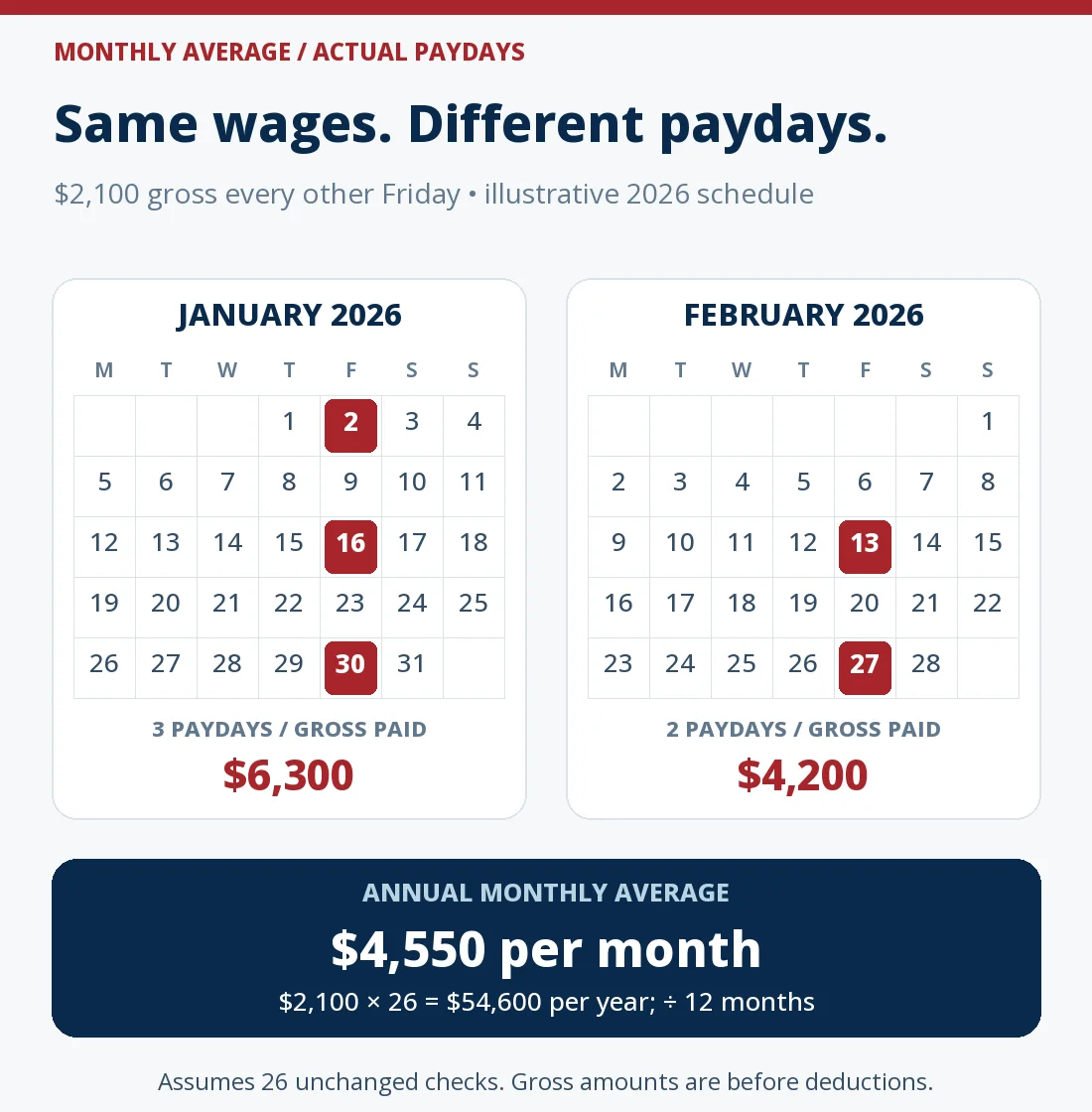
Suppose a fictional employee receives $2,100 gross every other Friday, starting January 2, 2026. The 26-payday schedule produces $54,600 for the year and a $4,550 monthly average. January has payments on January 2, 16, and 30: $6,300 gross paid. February has payments on February 13 and 27: $4,200 gross paid. Neither month’s receipt total equals the annual monthly average.
For a question about wages paid in January, add the January-dated payments. For a question about a steady monthly earning rate, the annual conversion answers a different question. For a spending plan, use the actual net amounts and their arrival dates, because gross income is not money available after deductions. Holiday adjustments, off-cycle payments, or unpaid time would change this fictional schedule.
How do you calculate monthly income from an hourly rate?
If both the rate and hours are reliably fixed, calculate weekly straight-time wages first. For example, $28 per hour × 37.5 paid hours per week = $1,050 per week. Under the assumption of 52 paid weeks at that same rate and schedule, $1,050 × 52 ÷ 12 = $4,550 as an annualized monthly estimate. Do not assume 40 hours if the documented schedule is 30, 35, or variable, and use documented paid hours rather than automatically treating every hour on site as paid work.
If overtime applies, calculate the actual weekly earnings correctly before averaging them. Under the federal FLSA, covered nonexempt workers generally receive at least one and one-half their regular rate for hours worked beyond 40 in a workweek, subject to applicable exceptions. The workweek matters; a monthly average is not an overtime test. The Department of Labor’s overtime guidance explains the federal rule. State requirements and special compensation arrangements can differ.
Changing hours require a different approach from a guaranteed schedule. Keep the rate and hours history with the stubs so you can explain whether a change came from more work, a raise, an overtime payment, or a correction. One busy week should not become a claim that every week will be identical.
For variable wages, calculate a defined historical average
Choose the period before choosing the denominator. A simple descriptive average is the total gross wages for a stated period divided by the months it covers. It describes that history; it is not automatically a forecast or an amount accepted for a loan.
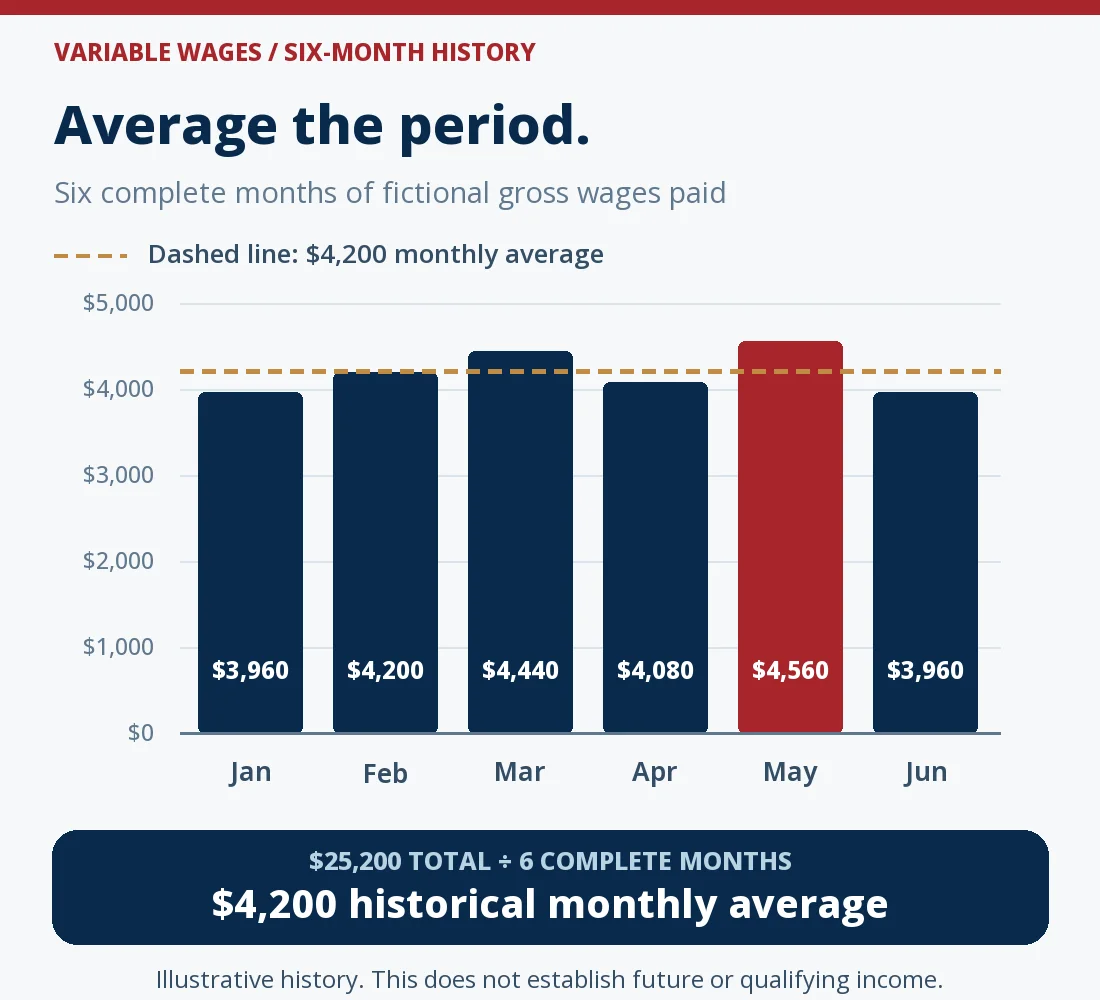
Here is a fictional worker whose wages fluctuate. Assume the records include all cash gross wages paid from January 1 through June 30, with six complete months and no duplicate payments. The monthly totals are:
| Month | Gross wages paid |
|---|---|
| January | $3,960 |
| February | $4,200 |
| March | $4,440 |
| April | $4,080 |
| May | $4,560 |
| June | $3,960 |
| Six-month total | $25,200 |
The calculation is $25,200 ÷ 6 = $4,200 per month for that recorded period. Using only May would instead project $4,560, overstating this six-month average by $360. A June 30 YTD gross total can cross-check the sum if its definition and payment coverage match; do not add each stub’s cumulative YTD column to get the total.
A partial-year or partial-month record needs an explicit boundary. If someone started in April, dividing their earnings by nine months in September answers a different question from averaging the months they worked. If the newest stub covers only part of September, “YTD ÷ 9” can also obscure the incomplete month. Keep both the employment dates and payment dates, and ask the recipient how it wants partial periods handled. When hours or rates have recently changed, label the historical average separately from the current expected rate.
What about bonuses, tips, commissions, or more than one job?
Keep recurring base pay and variable extras separate in your worksheet. A one-time bonus can inflate the current stub. If you annualize that whole stub and then add the bonus again, you count it twice. A documented $1,800 bonus received once in a full year averages $150 per month arithmetically; whether it is likely to recur or qualifies for an application is another question.
Fannie Mae’s March 2026 guidance on bonus, commission, overtime, and tip income illustrates why a lender may evaluate income history and trends rather than accept one large payment. It recommends two years of history, allows certain shorter histories of at least 12 months, and treats declining income differently. Those are that mortgage program’s requirements, not a rule for every landlord, lender, or personal worksheet.
For multiple jobs, prepare a separate calculation for each employer, with its own pay frequency and dates, before adding amounts that belong to the same monthly measure. Do not add one employer’s YTD total to another employer’s current paycheck. For benefits, rental receipts, or other non-wage income, use the relevant documents and the recipient’s definitions; an employment pay stub cannot establish every income source.
Why an application’s accepted income can differ from your estimate
The CFPB explains debt-to-income ratio as monthly debt payments divided by gross monthly income and notes that limits differ by loan product and lender. A fictional $1,365 in monthly debt payments divided by $4,550 gross monthly income equals 30%. That ratio alone does not determine approval, and a lender must first decide what income it can use.
The distinction between fixed and fluctuating earnings matters. Fannie Mae’s base-income guidance distinguishes fixed salary or fixed-rate work with guaranteed hours from variable base income. A simple annual conversion is therefore not a substitute for review when hours fluctuate. Ask the recipient which categories, history, and supporting documents it requires rather than treating this guide’s arithmetic as a universal eligibility rule.
Self-employment is also different from employee wages. Business revenue is not automatically personal wage income. The IRS Schedule C instructions distinguish gross receipts, expenses, and net profit for a sole proprietor. A self-prepared pay statement does not turn client receipts into employer-verified salary or establish a lender’s qualifying income. Preserve invoices, business records, and applicable tax documents; follow the specific application’s self-employment requirements.
A practical worksheet before submitting a monthly-income figure
- Write the exact question. Is the recipient asking for current base monthly income, a historical average, gross wages paid during a named month, household income, or net cash?
- Identify the earnings field. Separate cash base wages, variable extras, noncash entries, taxable wages, and net pay. Resolve unclear payroll labels with the employer.
- Record frequency and dates. Confirm weekly, biweekly, twice-monthly, or monthly payment, plus the period represented by the records.
- Choose the matching calculation. Convert stable pay to a monthly average, or sum wages for an explicitly defined historical period. State any assumption of continuous paid work.
- Cross-check the total. Use the payroll register, employer-issued stubs, and appropriate YTD records. Remove duplicates and account for reversals or corrections.
- Keep the explanation with the documents. Note the formula, period, included earnings, excluded items, and source records. Ask the recipient to resolve any special income category or partial period.
A calculation note makes a figure easier to verify; it does not replace the employer’s records. Our Pay Stub Help 101 guide helps you trace the underlying earnings and YTD columns. If a source stub is wrong, request a payroll correction instead of changing the document to fit the desired monthly result.
Common questions
Is gross monthly income before or after tax?
For the wage measure discussed here, it is before payroll taxes and deductions. Net pay is the amount after those deductions. Read the recipient’s instructions if its form uses a more specific definition.
Can I multiply a biweekly paycheck by two?
That gives the gross total of two such checks. For a standard annual monthly average of steady biweekly pay, use gross per check × 26 ÷ 12. A particular calendar month can have two or three paydays.
Can I divide YTD gross by the current month number?
Only if the coverage and purpose justify that denominator. Confirm complete months, the date through which payments are included, any job start or unpaid gap, and the earnings categories. An incomplete latest month or recent raise can make that shortcut misleading.
Should I subtract retirement or health deductions first?
Not when calculating cash wage income before payroll deductions. Those amounts matter for net pay and sometimes taxable-wage bases. Keep those measures separate, and follow any special definition on the application.