Utah’s 2026 paycheck calculator asks when the pay period begins because revised withholding schedules apply to periods beginning June 1, 2026 or later. Its ordinary method rounds schedule lines to whole dollars and subtracts a phased-out base allowance from tax. That allowance is not a personal allowance count deducted from wages.
Our fictional married-joint example earns $57,600 annually, paid monthly. The earlier schedule produces $184 state withholding per payment; the revised schedule produces $175. This guide traces the revised $175 and explains how to compare a year containing both schedules.
Choose the schedule by the beginning of the pay period
The cover of the current Publication 14 PDF says the revised tables apply to pay periods beginning on or after June 1, 2026. The publication is revised April 2026.
That is a pay-period start rule. A period that starts May 15 and ends June 14 begins before the change. A period starting June 15 begins after it. Looking only at a June payday could select the wrong schedule.
The calculator labels its two choices accordingly. The preceding Publication 14, effective June 1, 2025, documents the earlier schedule used for this comparison.
One selection is repeated throughout the tool’s annual projection. It does not read actual pay dates or automatically divide 2026 between old and new schedules.
Match Utah’s status group rather than entering an allowance count
The Publication 14 reference bases ordinary wage withholding on federal W-4 status and its state schedules. The calculator groups Single, married separately and Head of Household together; Married filing jointly uses the Married group.
No personal state allowance count is subtracted from wages. The schedule’s “base allowance” instead reduces tax after its wage-based phaseout. A federal dependent-dollar entry is a different concept.
Use the group supported by the employee’s certificate. A lower estimated deduction is not evidence that a filing status is appropriate.
Federal W-4 adjustments remain available in their own section. The Utah model does not automatically copy federal credit dollars or a federal extra amount into the state calculation.
Enter the $4,800 monthly wage case
Open the Utah paycheck calculator with 2026 selected. Enter $57,600 annual wages and Monthly, producing twelve $4,800 payments.
Choose federal Married filing jointly, with multiple jobs off and federal annual adjustments and additional withholding at zero. Select the Married group in the Utah state settings and June 1 or later for the pay-period beginning.
Keep known annual local and other cash deductions at zero. Assume a valid W-4 on file, one full-year employer, ordinary wages, Utah residence and work, and no pre-tax benefits. Gross and the relevant taxable wage bases are equal.
Record the result, then choose Before June 1 without changing the salary, frequency or elections. This isolates the schedule revision.
Trace the revised schedule’s whole-dollar calculations
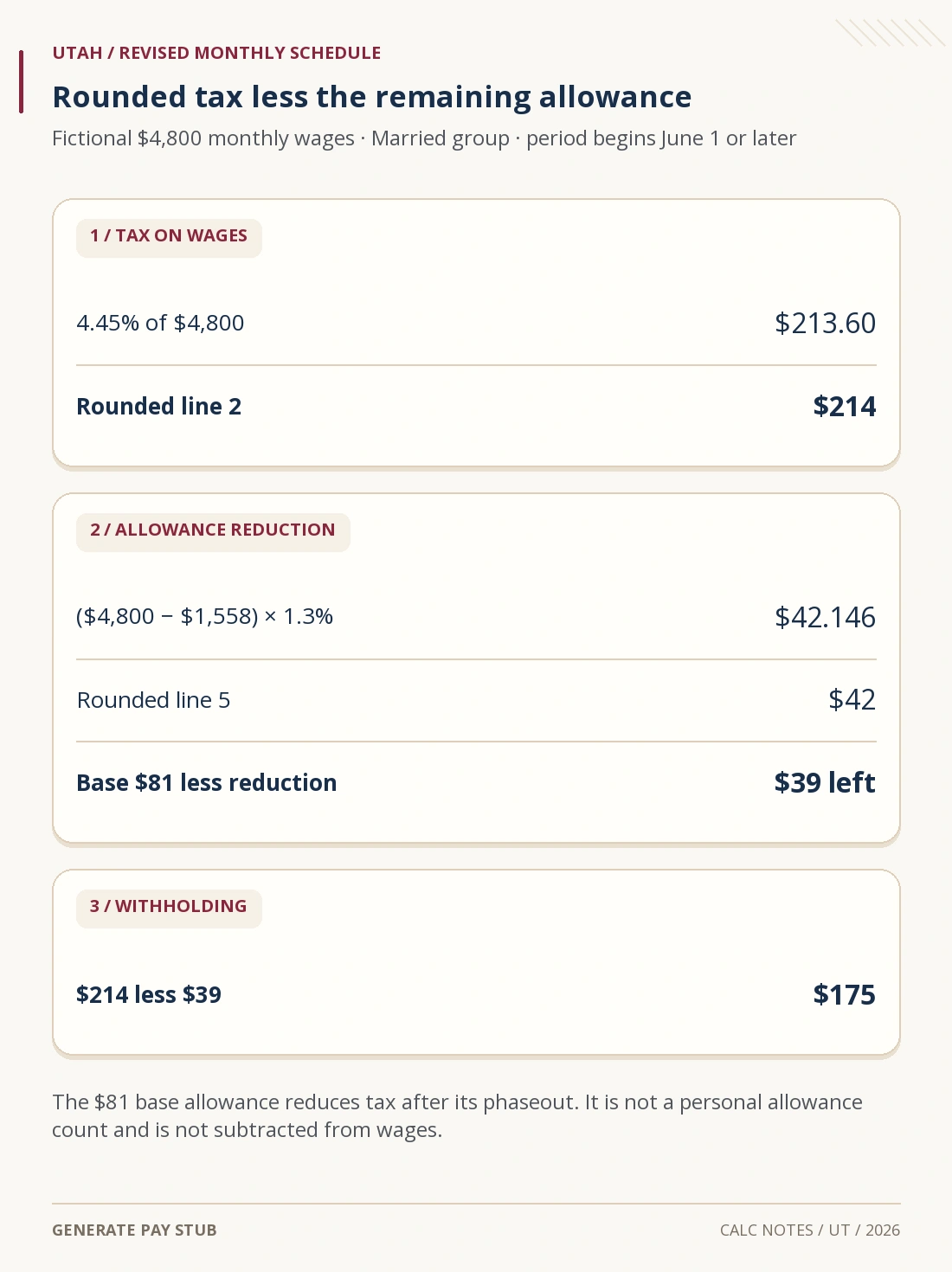
In the revised Monthly/Married schedule, line 2 starts with $4,800 × 4.45% = $213.60, rounded to $214.
The base allowance is $81. Wages above the $1,558 phaseout threshold are $4,800 − $1,558 = $3,242. Multiply by 1.3% to get $42.146, rounded to $42 on line 5.
Remaining allowance is $81 − $42 = $39. Withholding is then $214 − $39 = $175. The schedule floors a negative remaining allowance or final withholding at zero.

The result is lower than 4.45% of gross because a portion of the base allowance remains. At larger wages the allowance can be fully phased out; at other wages the rounding can change a dollar of withholding.
Use the appropriate payment-frequency schedule directly. Annualizing a separately rounded annual schedule and dividing back may not reproduce the Monthly schedule.
Compare the earlier and revised schedule results
The preceding Monthly/Married schedule uses 4.50%, a $75 base allowance and a $1,518 threshold. For $4,800 wages: tax on wages is $216, and ($4,800 − $1,518) × 1.3% = $42.666 rounds to $43.
Its remaining allowance is $75 − $43 = $32, leaving $184 of withholding. The $9 difference from the revised result reflects more than just the headline rate change.
| Selected-schedule result | Before June 1 | June 1 or later |
|---|---|---|
| State deduction for a payment | $184.00 | $175.00 |
| Cash for a payment | $4,036.13 | $4,045.13 |
| State total if repeated 12 times | $2,208.00 | $2,100.00 |
| Cash total if repeated 12 times | $48,433.56 | $48,541.56 |
Federal withholding is $212.67 each month in both runs. Employee Social Security is $297.60 and Medicare $69.60. Revised-schedule cash therefore checks as $4,800 − $212.67 − $175 − $297.60 − $69.60 = $4,045.13.
Reconcile a year using both Utah schedules
For a separate manual scenario, assume monthly periods begin on the first day of each month. Five periods begin before June 1 and seven begin on or after it. Salary and elections stay unchanged.
Combined state withholding is 5 × $184 + 7 × $175 = $2,145. This differs from both single-schedule annual projections above.
| Annual reconciliation item | Amount |
|---|---|
| Gross wages in twelve periods | $57,600.00 |
| Federal withholding on the checked wages | $2,552.04 |
| Utah withholding across both schedules | $2,145.00 |
| Employee Social Security | $3,571.20 |
| Employee Medicare | $835.20 |
| Cash in the assumed mixed-schedule year | $48,496.56 |
Cash can also be added as 5 × $4,036.13 + 7 × $4,045.13 = $48,496.56. This is a manual illustration using verified payment results. An employer’s actual period start dates, off-cycle pay or changed wages can produce a different split.
Review missing payroll facts before changing an input
A federal extra amount changes the federal deduction; it is not a state extra election in the supported Utah controls. Likewise, federal credit dollars should not be entered as a personal Utah allowance count.
Missing-W-4 and withholding-exemption cases are outside this ordinary certificate-on-file example. The state publication also lists special nonresident and employment exclusions that require their own conditions; the tool does not determine qualification.
Benefits can make taxable wages lower than gross, while some taxable fringe benefits can raise a base. The annual cash fields do not calculate those classifications. See the deduction tax-base explanation before comparing benefit-inclusive payroll.
The estimate does not calculate a final Utah return, submit a certificate or verify that the entered salary was paid. Use actual year-to-date records when reviewing a shortage or excess.
Utah paycheck calculator questions
Should I select the schedule using the payday alone?
No. The revised publication uses the beginning of the pay period.
Is the base allowance a number of dependents?
No. It is a schedule amount that reduces tax after a wage-based phaseout.
Why does multiplying gross by 4.45% miss the example result?
The remaining allowance reduces the rounded tax amount.
Does the later schedule’s annual figure reconstruct all of 2026?
No. One selected schedule repeats throughout that projection.
Utah’s current and preceding schedules, two live runs and mixed-period arithmetic reviewed November 6, 2026.