The Vermont paycheck calculator estimates 2026 income-tax withholding from an actual W-4VT election, alongside federal withholding and FICA. Its ordinary annual result does not automatically subtract Vermont’s Child Care Contribution. If an employer collects an employee share of that contribution, review it separately before treating the estimate as available cash.
Our fictional $78,000 monthly salary produces $5,098.01 cash per payment before that contribution and other unentered deductions. A separately confirmed maximum employee CCC collection would be $7.15 per month in this example. The guide explains both calculations without confusing the employer’s full contribution with an employee deduction.
Start with the actual W-4VT election
Vermont’s W-4VT FAQ recommends a state certificate so payroll can use suitable state allowances. The form is given to the employer, rather than filed with the individual tax return.
Federal W-4 credit dollars are not a Vermont allowance count. Vermont’s worksheet considers its own withholding circumstances, and spouses or multiple employers need coordination to avoid using the same allowances inappropriately.
The calculator has a Single/head-of-household/higher Single group and a Married/civil-union group, a state allowance count and additional state withholding per payment.
Use the group and count supported by the certificate. This article assumes two valid allowances without determining what a particular reader may claim.
Set the $6,500 monthly wage example
Open the Vermont paycheck calculator, select 2026 and enter $78,000 annual wages with Monthly selected. The ordinary projection has twelve equal $6,500 payments.
Choose federal Single with multiple jobs disabled and every federal dollar adjustment at zero. In the Vermont settings choose Single, two W-4VT allowances and zero additional state tax.
Initially leave known annual local and other deductions at zero. Assume one private employer, a full year living and working in Vermont, ordinary wages and no benefit wage exclusions. Gross, federal taxable, Vermont taxable and FICA wages are equal.
Our second check enters a separately determined annual employee CCC amount in the other-deductions field. That is an entered cash item, not a newly calculated tax program.
Trace the annualized Vermont income-tax calculation
Vermont publishes the 2026 withholding guide. The 2026 federal payroll implementation corroborates the $5,400 annual allowance amount and annual percentage-table values used here.
Two allowances reduce annualized wages by $10,800: $78,000 − $10,800 = $67,200. This falls in the Single band using $1,700.13 plus 6.60% of the excess above $54,675.
Annual formula withholding is $1,700.13 + ($67,200 − $54,675) × 0.066 = $2,526.78. Divide by 12 to get $210.565, which the live tool rounds to $210.57 per payment.
Twelve rounded deductions sum to $2,526.84. A period-table lookup may differ slightly because its period amounts are rounded. Check the employer’s method before treating a small difference as an error.
The payroll table already contains its specified offsets. Subtracting an additional return standard deduction from this formula would not reproduce the checked estimate.
Separate the Child Care Contribution from income-tax withholding
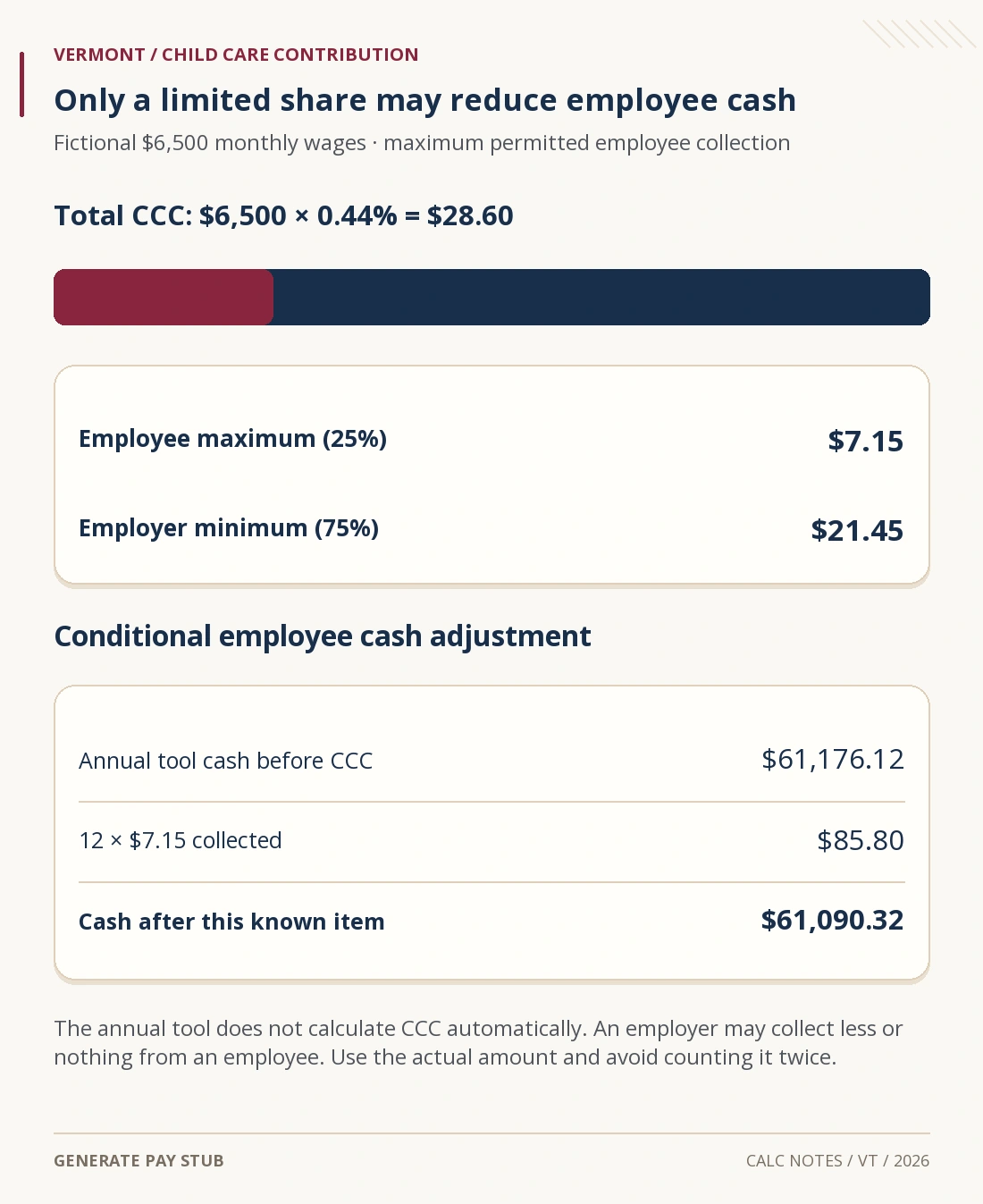
The Department of Taxes’ current CCC guidance sets a 0.44% payroll contribution on subject wages. Employers may collect up to one quarter of that contribution from an employee, equivalent to 0.11% of subject wages.
The employer may collect a smaller share or none. Employees do not automatically owe the full 0.44% through a paycheck deduction.
For $6,500 subject wages, total CCC is $6,500 × 0.0044 = $28.60. Maximum employee collection is $6,500 × 0.0011 = $7.15; the employer then covers at least $21.45.
This is separate from the $210.57 Vermont income-tax withholding. W-4VT allowances do not turn the CCC into an income-tax allowance calculation.

Apply a confirmed employee share, rather than inventing one
If payroll confirms $7.15 of employee CCC on every monthly payment, the annual amount is $7.15 × 12 = $85.80. Entering that known annual amount as another cash deduction changes the projection as follows.
| Result with the same wage and tax inputs | No CCC entered | $85.80 entered annually |
|---|---|---|
| Vermont income tax each month | $210.57 | $210.57 |
| Other cash amount across the year | $0.00 | $85.80 |
| Cash for a monthly payment | $5,098.01 | $5,090.86 |
| Cash across twelve payments | $61,176.12 | $61,090.32 |
Federal withholding and FICA do not change in this entered-cash comparison. The field does not determine the contribution’s legal wage base or the employer’s election; those facts must already be established.
Do not enter $28.60 as the employee’s monthly cost merely because it is the total contribution. Also check whether a deduction already entered includes CCC so the same cash item is not subtracted twice.
The agency defines covered CCC wages generally by federal income-tax withholding wages and the applicable Vermont withholding obligation. Cross-state work and benefit exclusions can change the analysis; our all-Vermont equal-base example does not resolve them.
Reconcile the ordinary annual result before CCC
| Earning or calculated employee deduction | Annual amount |
|---|---|
| Gross salary in the scenario | $78,000.00 |
| Federal income-tax withholding | $8,330.04 |
| Vermont income-tax withholding | $2,526.84 |
| Employee Social Security | $4,836.00 |
| Employee Medicare | $1,131.00 |
| Cash before CCC and unentered items | $61,176.12 |
Each monthly result is $6,500 − $694.17 federal − $210.57 Vermont − $403 Social Security − $94.25 Medicare = $5,098.01. Twelve payments total $61,176.12.
The conditional employee CCC adjustment reduces that annual cash by $85.80, to $61,090.32. Neither result includes an unknown health premium, retirement contribution or other payroll deduction.
Check federal fallback treatment and other payroll deductions
This guide assumes an actual W-4VT on file. The federal payroll bulletin separately discusses fallback treatment when federal certificate information is used, including a conditional state addition based on extra federal withholding.
The calculator does not implement that automatic fallback. Its explicit state extra is a separate per-payment input. Ask payroll what election and method it is using rather than assuming any federal extra will transfer to Vermont.
A state extra of $9 monthly would add $108 over twelve payments. An annual $9 cash amount has a different effect. Keep the input units and the purpose of each adjustment clear.
Benefits, a voluntary insurance arrangement or a garnishment need actual records. Some items change taxable wages while others change cash only. Our payroll deduction comparison explains that distinction.
Do not use this ordinary wage estimate for pensions, a partial-year allocation or self-employment without the relevant method. It does not file W-4VT, determine a final return or verify earnings for an application.
Vermont paycheck calculator questions
Is the Child Care Contribution included in the ordinary annual total?
No. Review an actual employee collection separately.
Must every employee lose 0.44% of wages for CCC?
No. Employee collection is optional for the employer and limited to 0.11% of subject wages.
Can I use federal W-4 credit dollars as Vermont allowances?
No. Use the state certificate’s supported count.
Does entering a known CCC amount make the tool calculate coverage?
No. It only reflects an amount already determined from payroll facts.
Vermont 2026 sources, actual tool scope and both cash-entry runs reviewed November 6, 2026.