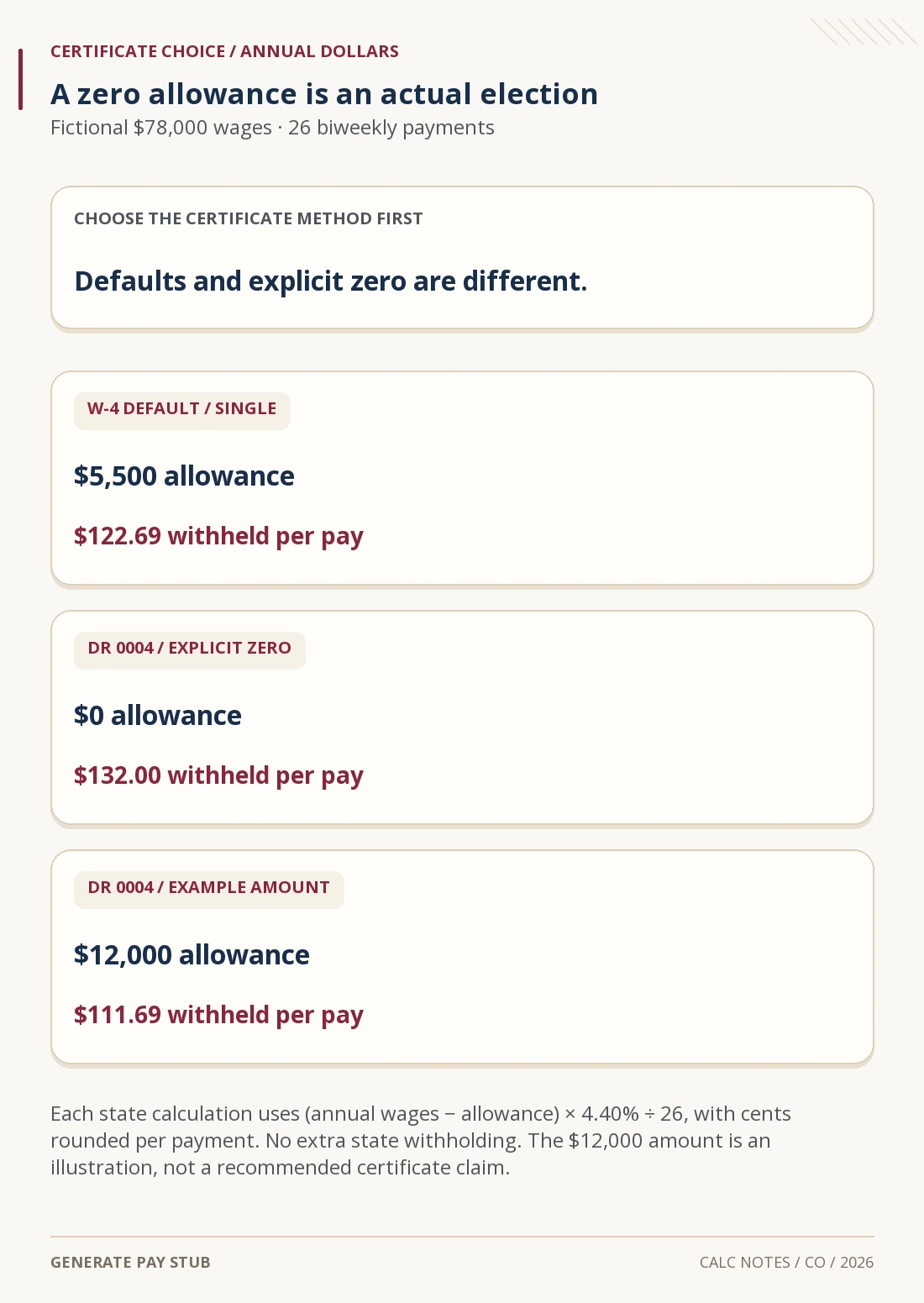
In Colorado’s paycheck calculator, an explicit $0 annual allowance is different from using the W-4 default. Select the correct certificate method before entering dollars. A zero allowance does not mean zero state withholding: it leaves more wages in the withholding calculation.
This 2026 guide compares three certificate assumptions on the same fictional $78,000 salary. It follows the DR 1098 worksheet, checks the cash effect of each election and includes the separate standard employee FAMLI contribution.
Choose the certificate method before typing an allowance
The Colorado paycheck calculator offers a W-4-based method and a custom DR 0004 annual-allowance method. The annual allowance input is used only with the custom selection. Leaving a zero in an unused custom field does not turn the W-4 default into a zero allowance.
The official 2026 DR 1098 worksheet uses $11,000 for a W-4 Married Filing Jointly or qualifying-surviving-spouse default and $5,500 otherwise. When DR 0004 line 2 supplies an amount, including zero, the worksheet uses that amount instead.
For an actual certificate, a blank DR 0004 line 2 follows the prescribed W-4-based default. An explicitly entered zero is an election. That difference can be lost if a reader looks only at the numeric input and ignores the method selector.
The Department’s DR 0004 employer resources explain how the optional state certificate fits with W-4. Trying a custom allowance on this website does not file a certificate or determine the allowance the employee should claim.
Set up a $3,000 biweekly payment
Choose 2026, $78,000 annual gross wages and Biweekly. The projection uses 26 payments of $3,000. Keep federal Single, no multiple-jobs adjustment and zero for all federal dollar adjustments and extra withholding.
Set known annual local withholding and other cash deductions to zero. Leave Colorado FAMLI at standard employee coverage. Assume one employer all year, Colorado residence and work, ordinary covered wages and no benefit adjustments separating the wage bases.
Run these three state settings while holding everything else fixed: W-4 Single/default method; custom DR 0004 with a $0 annual allowance; and custom DR 0004 with a fictional $12,000 annual allowance. State additional withholding stays zero throughout.
The $12,000 value is a controlled illustration of the input’s effect. It is not a recommendation, tax deduction determination or substitute for the state certificate’s instructions.
Follow the three annual-allowance calculations
The worksheet annualizes wages, subtracts the applicable allowance, applies 4.40%, converts back to the payroll period and adds any requested extra state withholding. The ordinary example is above zero after subtraction.
With the Single W-4 default, ($78,000 − $5,500) × 4.40% = $3,190 before period rounding. Divide by 26 to obtain $122.692307… and round to $122.69 per payment.
With custom zero, ($78,000 − $0) × 4.40% ÷ 26 = $132. With a custom $12,000 allowance, ($78,000 − $12,000) × 4.40% ÷ 26 = $111.692307…, rounded to $111.69.

Compared with the default, custom zero increases withholding by $9.31 per payment. The $12,000 illustration reduces it by $11. More allowance means less withholding under this formula; the allowance itself is not cash removed from the worker’s pay.
The reported annual projection adds rounded payment amounts. For the default, $122.69 × 26 = $3,189.94, six cents below the unrounded annual worksheet amount. The custom $12,000 result similarly totals $2,903.94 from rounded payments.
Compare the live results while keeping the other deductions fixed
All three checked runs have $320.38 federal withholding, $186 Social Security, $43.50 Medicare and $13.20 standard employee FAMLI per biweekly payment.
| Certificate assumption | State withholding/pay | Estimated net/pay | Annual net |
|---|---|---|---|
| W-4 default: $5,500 allowance | $122.69 | $2,314.23 | $60,169.98 |
| DR 0004 custom: $0 allowance | $132.00 | $2,304.92 | $59,927.92 |
| DR 0004 custom: fictional $12,000 allowance | $111.69 | $2,325.23 | $60,455.98 |
The default cash check is $3,000 − $320.38 − $122.69 − $186 − $43.50 − $13.20 = $2,314.23. The annual amount is $2,314.23 × 26 = $60,169.98.
A smaller withholding amount leaves more current cash, but it does not prove a smaller final Colorado tax bill. The complete return can include other income, deductions, credits and payments outside this wage projection. The calculator neither selects a household allowance nor forecasts a refund.
Include the employee FAMLI contribution as a separate line
The Colorado Department of Labor’s official December 2025 FAMLI bulletin sets the 2026 total premium at 0.88% and says the employer/employee contribution structure remains unchanged.
The state auditor’s description of that structure explains that up to half the premium may be deducted from employee wages. Combining the unchanged half-share structure with the 2026 rate gives a maximum standard employee share of 0.44%.
At $3,000 covered wages, $3,000 × 0.44% = $13.20, or $343.20 over this sample year. This is not part of the 4.40% income-tax withholding formula and should not be merged with the DR 0004 allowance.
The small-employer exception concerns the employer share; it does not automatically remove the employee contribution. A private plan or employer-paid employee portion needs its own coverage records. Use the calculator’s standard selection only when it fits the actual arrangement.
Check annual allowance dollars and extra tax per payment
Form DR 0004 for 2026 calls line 2 an annual withholding allowance and line 3 additional withholding per pay period. They use different units and affect different parts of the worksheet.
A $12,000 annual allowance belongs in the custom annual field; entering $12,000 as extra withholding would request that amount from each payment. Conversely, $10 extra state withholding means $260 across 26 modeled payments, without changing the annual allowance.
Extra federal withholding is a separate W-4 choice. Do not assume that its dollar value is automatically requested again for Colorado. Use the appropriate state certificate field and reconcile the actual records.
The DOR withholding FAQ addresses why federal and state results can differ. Keep a copy of the relevant certificate and follow the employer’s submission process for real changes.
Review local taxes, wage bases and timing before relying on net pay
The sample’s zero local input does not determine whether an occupational or other local deduction applies. The calculator does not choose a Colorado locality and calculate its employment tax. Include a separately supported known annual cash amount when appropriate.
Likewise, the simplified wage model does not construct every benefit adjustment. Pre-tax retirement or insurance treatment can make federal, FICA, state and program-covered wages differ. The other-deductions input reduces cash without establishing those tax-base rules.
The selected year’s rules are applied to a complete sequence of regular payments. Midyear starts, changed certificates, irregular wages and cross-state employment need additional facts. Do not use an annual average to reconstruct every historical check where coverage or a wage limit changed.
The 2026 worksheet’s prescribed 4.40% is used here for withholding. It should not be confused with a complete final-tax determination. For the federal inputs, see our W-4 calculator guide; for a real statement mismatch, use the gross-to-net checking guide.
Colorado paycheck calculator questions
Does zero in the annual allowance mean zero tax withheld?
No. In the custom method, it leaves no allowance subtraction. This sample’s state withholding is $132 per payment.
Why does zero in the unused custom field still give $122.69?
The selected W-4 method uses its prescribed default. The custom number becomes active only when the custom certificate method is selected.
Is the $12,000 illustration an exemption count?
No. It is an annual dollar amount. The state certificate’s annual allowance is not a count of dependents or federal credits.
Can I deduct the full 0.88% FAMLI premium as employee tax?
Do not treat the total premium as the standard employee amount. This example uses the employee half-share of 0.44%.
Colorado 2026 primary sources and three live calculator runs checked November 6, 2026. The custom allowance is fictional and does not establish eligibility.