If you work two jobs, or file jointly with a spouse who also works, your W-4 should account for the combined job income. Otherwise, each employer may calculate federal income-tax withholding as though its wages were the household’s only wages. The result can be too little total withholding even when each pay stub looks internally correct.
This U.S. federal withholding guide was reviewed October 26, 2026 and uses the 2026 Form W-4. It explains employee wage withholding, not a personalized tax calculation. State certificates, self-employment tax and certain special situations require additional review. The examples use fictional amounts and stated assumptions.
Does Step 2 include your spouse’s job and a second part-time job?
Count simultaneous jobs relevant to the anticipated federal return. The 2026 Form W-4 instructions apply Step 2 when an employee holds multiple jobs at once, or when a married couple expects to file jointly and both spouses work. A separate certificate goes to each employer. Two part-time jobs can require the same coordination as two full-time jobs.
For example, one employee earning an assumed $60,000 at one job and $36,000 at another has $96,000 of annual job income before considering wage-base adjustments or other return items. Neither employer automatically knows the other job’s wages. Likewise, one spouse’s two jobs plus the other spouse’s one job means three jobs in the jointly filing household, not two jobs merely because there are two people.
A job switch with no overlap differs from holding two jobs simultaneously, but year-to-date wages and withholding still matter. A form completed in October cannot recover earlier underwithholding by pretending every recommended annual adjustment will operate for an entire year. Use the actual history and remaining paydays.
Gather the latest statements for all relevant jobs, expected bonuses, retirement and benefit adjustments, the expected filing status and other income information. The IRS Tax Withholding Estimator information page lists the records needed, including a spouse’s statements for anticipated joint filers. Do not send the other employer’s payroll records to an unrelated employer unless there is a reason to do so.
Should you use the estimator, worksheet or two-job checkbox?
Step 2 provides alternative methods; do not automatically stack them. The current form identifies the estimator, the Multiple Jobs Worksheet and the checkbox for only two jobs total. The IRS redesigned-W-4 FAQs explain the common method and privacy questions; use the current 2026 form for this year’s fields and dollar instructions.
| Approach | When it is useful | Important check |
|---|---|---|
| IRS estimator, Step 2(a) | Changes during the year, varying pay, more complex income or a more precise estimate | Use current YTD figures and follow the resulting form recommendations |
| Multiple Jobs Worksheet, Step 2(b) | A worksheet-based estimate using the applicable wage ranges and pay frequency | Enter the calculated extra amount as instructed; avoid duplicating it at every job |
| Two-job checkbox, Step 2(c) | Only two jobs total; the current form gives a relative-pay comparison | If chosen, check it on both jobs’ forms; it is not a fixed extra tax percentage |
The 2026 form says the checkbox method is generally more accurate than the worksheet when the lower-paying job pays more than half as much as the higher-paying job. Similar-pay jobs are the natural use case; unequal pay can produce excess withholding. This comparison does not guarantee an exact annual tax result, especially with partial-year employment or changing income.
If using the checkbox approach, changing only one job’s certificate leaves the setup incomplete. Conversely, an estimator-generated recommendation can handle multiple jobs without using that box. Follow its instructions rather than adding a worksheet amount and checking the box simply to be “extra correct.” Keep a record of which method was chosen.
The worksheet’s calculation and pay-frequency conversion must be read together. A biweekly job and a semimonthly job do not have the same standard annual paycheck count. Use the pay frequency of the job receiving the particular adjustment; our pay-frequency guide explains that distinction.
Are Step 3 credits and Step 4(c) extra withholding both annual amounts?
No. Step 3 generally uses an annual credit amount; Step 4(c) requests additional tax for each pay period. Step 4(a) concerns annual other income that is not job income, and Step 4(b) uses the Deductions Worksheet result. They do not all use the same unit or move withholding in the same direction.
The 2026 IRS Publication 15-T shows how payroll applies these entries. In the multiple-job setup, the form directs Steps 3 through 4(b) to one certificate, generally for the highest-paying job, with those fields blank at the other jobs. Repeating a full household credit at each job can understate total withholding.
Consider a separate fictional full-year payroll with 26 equal pay periods. Assume an otherwise appropriate $2,600 annual Step 3 credit and enough calculated income tax for the full credit adjustment to apply. Its annual-to-period conversion is $2,600 ÷ 26 = $100. That generally reduces calculated federal income-tax withholding by $100 per check under these assumptions; it is not $2,600 less every payday.
By contrast, $100 entered in Step 4(c) requests $100 of additional withholding each payday, or $2,600 over 26 paydays. The matching numbers do not make the fields interchangeable. This example makes no claim that a particular employee is entitled to a $2,600 credit, and withholding cannot simply be reduced below zero by an unused credit amount.

Do not enter the second job’s full wages in Step 4(a) just because the second employer does not know them. That field expressly addresses other income, not jobs. Coordinate job wages through the appropriate Step 2 method. Likewise, a deduction amount in Step 4(b) is not a direct dollar-for-dollar tax credit.
How do you spread an estimated shortfall over the remaining paydays?
Use the remaining target and actual remaining payments, not an assumed full-year count. The 2026 IRS Publication 505 explains withholding adjustments and estimated-tax considerations. A fresh estimate should incorporate tax already withheld at every job and the wages still expected.
Suppose a fictional review finds that an additional $1,200 of federal withholding is needed over ten remaining regular paydays at one selected job. Assume the estimate already accounts for the household’s other wages and withholding, every payment can support the deduction, and nothing else changes. The illustrative extra amount is $1,200 ÷ 10 = $120 per payday.
| Item | Calculation or assumption | Amount |
|---|---|---|
| Additional remaining target | Assumed result of a fresh review | $1,200.00 |
| Extra per remaining payday | $1,200 ÷ 10 | $120.00 |
| Usual withholding on one sample check | Assumed, not calculated from IRS tables | $185.00 |
| Revised withholding on that sample check | $185 + $120 | $305.00 |

This is an arithmetic demonstration, not a recommendation for every two-job household. If there are only eight paydays left, $120 would add $960 and miss the assumed target by $240. An unpaid period, changing bonus, delayed implementation or another W-4 change can also alter the outcome.
Extra withholding reduces the employee’s take-home pay; it does not reduce gross earnings, erase taxable wages or become an employer business expense. If gross and all other deductions stay fixed, an extra $120 federal withholding reduces that payment’s net by $120. See our net-pay explanation for the reconciliation.
When should a revised W-4 affect the pay stub?
A signed, valid new form must reach the employer and be implemented in payroll. The 2026 IRS employer guide describes the general outside deadline: the beginning of the first payroll period whose end falls on the thirtieth day after receipt or later. Earlier implementation is allowed. It does not require rewriting earlier wage payments.
Confirm the receipt date, payroll period and effective paycheck. An online form marked saved may still need submission or acceptance. Keep the completed certificate or payroll confirmation and compare the next affected statement. If an employer has an IRS lock-in instruction, special restrictions can override an employee’s attempted reduction; request the explanation rather than assuming the employer ignored the form.
Do not confuse a changed earning period with the payment on which a new withholding setting applies. Our pay-period versus payday guide helps identify the relevant fields. A late-year change also should be rechecked for the next year instead of silently carrying a catch-up assumption forward.
What should you compare on the pay stubs from both employers?
Compare the federal income-tax line and its YTD total, not total deductions alone. Social Security, Medicare, state withholding, insurance and retirement contributions are separate items. Federal withholding can change while these other amounts remain the same.
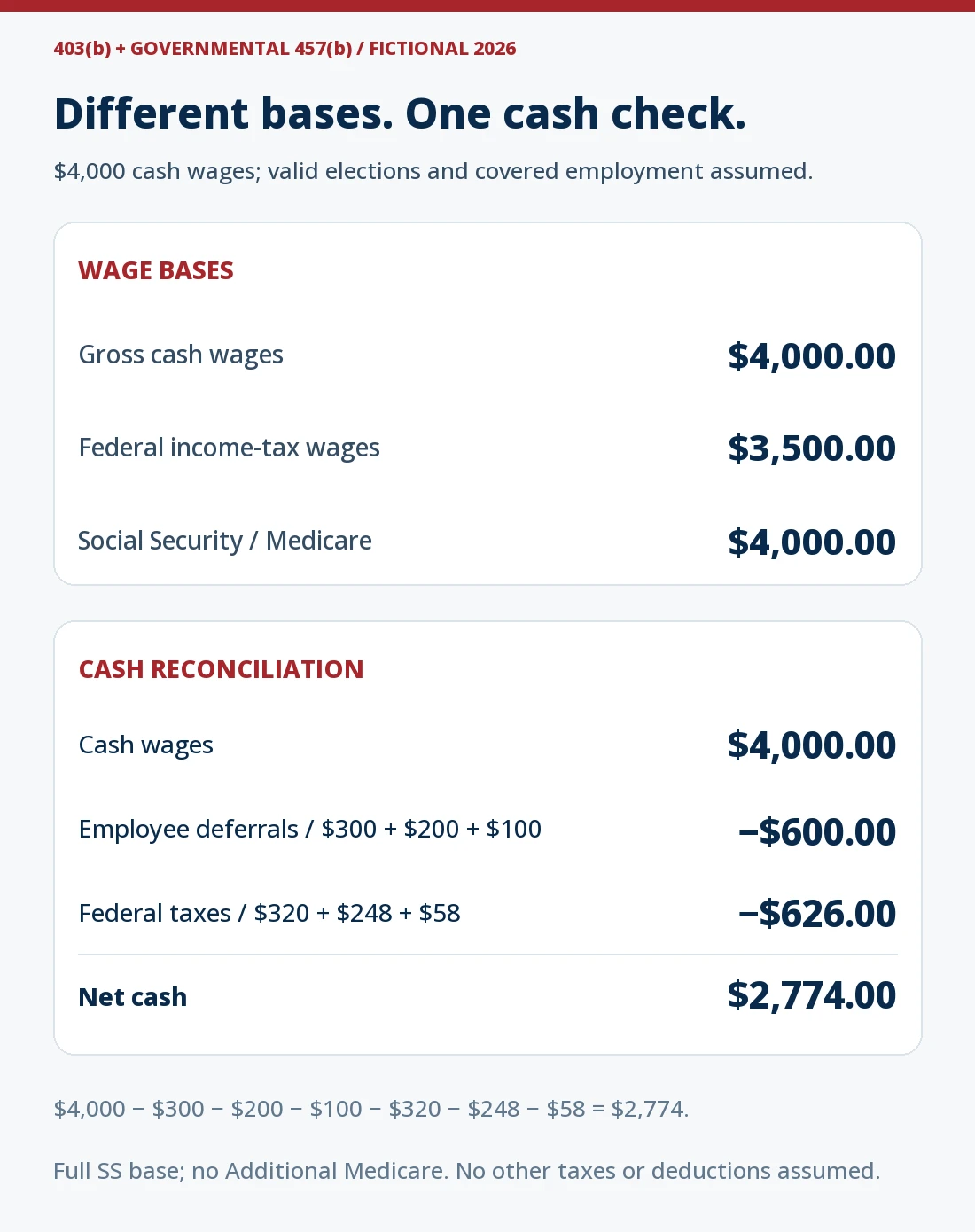
For each employer, retain current and YTD taxable wage information, current and YTD federal income tax, pay frequency, payment date and any bonus or supplemental payment. A gross-wage number may differ from federal taxable wages because of qualifying payroll benefits. An otherwise correct withholding comparison can fail if it uses the wrong wage base.
After implementation, reconcile the YTD increase to the actual current withholding. A new $305 federal line should ordinarily add $305 to that employer’s prior federal-withholding total, absent another adjustment. Compare the relevant histories without adding an old statement’s YTD amount to a newer statement’s YTD amount. The YTD guide explains why that would double count earlier payments.
Does Step 2 fix Social Security, Medicare, state tax or side-work tax?
Form W-4 principally directs federal income-tax withholding; it is not a universal payroll-tax reset. Separate unrelated employers ordinarily apply Social Security withholding to their own covered wages. Excess employee Social Security withheld across multiple employers can require an individual-return review, rather than asking the second employer to stop solely because another job withheld tax. See our Social Security guide.
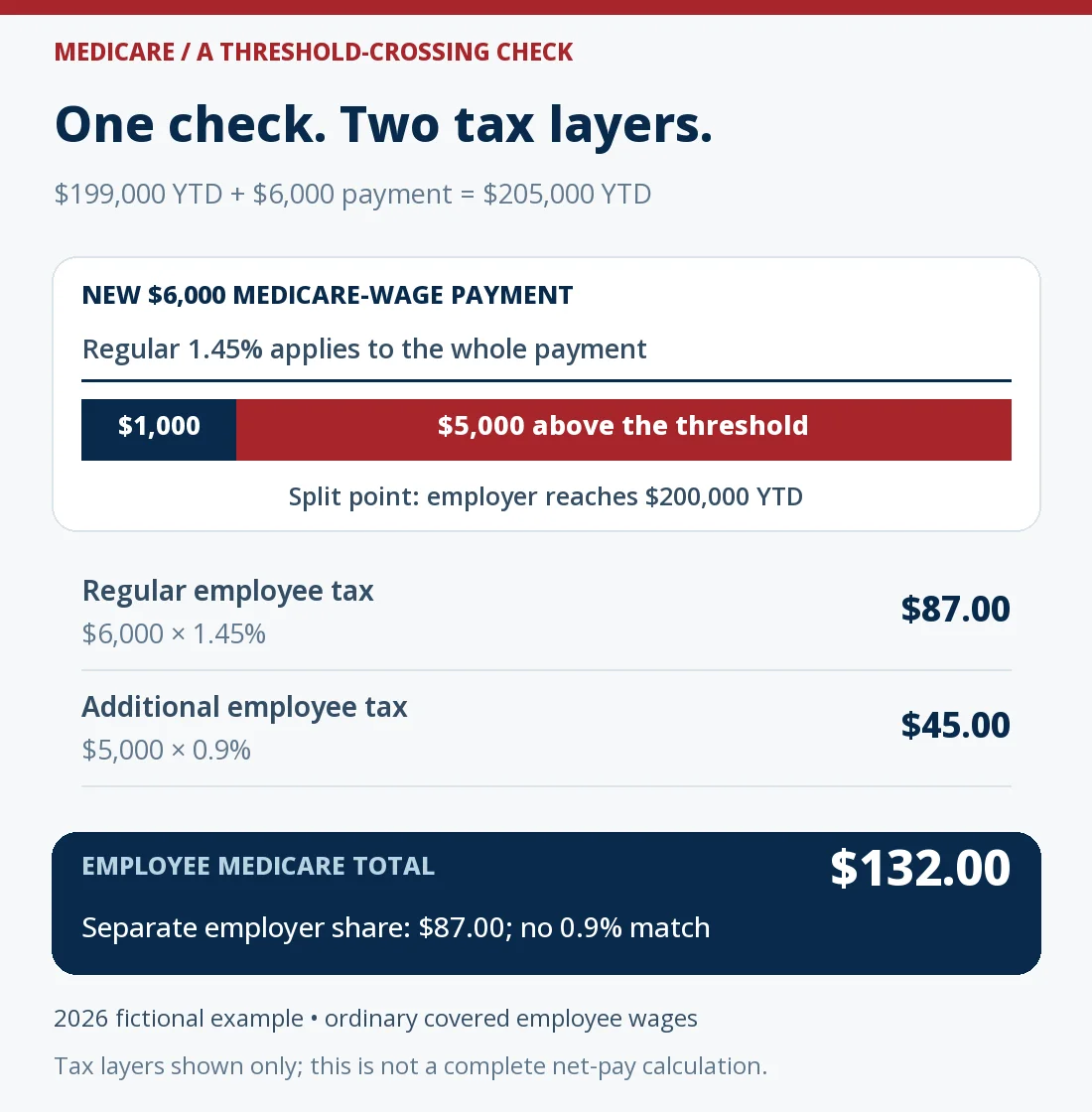
The employer’s Additional Medicare withholding threshold also differs from the ultimate household tax calculation. The IRS Additional Medicare questions and answers explain the distinction and how additional income-tax withholding can help cover an anticipated liability. Changing Step 4(c) does not relabel the extra amount as ordinary Medicare withholding.
State income tax generally requires the applicable state form and rules. Self-employment introduces both income-tax and self-employment-tax questions; the W-4’s checkbox is not a calculation of contractor tax. Use the estimator or appropriate estimated-tax procedure with complete facts. Nonresident aliens should use the special IRS instructions rather than assuming the ordinary resident example fits.
How do you fix a multiple-job withholding discrepancy?
- Rebuild the household picture. Identify simultaneous jobs, anticipated filing status, other income and changes during the year.
- Choose one coherent Step 2 approach. Preserve its assumptions and avoid duplicating worksheet or estimator adjustments.
- Check the units. Separate annual credits and deduction entries from per-payday extra withholding.
- Confirm implementation. Match the valid form’s receipt and effective payroll to the affected paycheck.
- Review actual results. Reconcile each employer’s current withholding and YTD history, then update the estimate when facts change.
Use the pay-stub correction guide if the accepted setting does not match the payment. Generate Pay Stub should display verified payroll amounts; creating a statement cannot submit a W-4 to an employer or prove that the household’s tax is fully paid. Keep the source statements and the withholding review together.