
Medicare tax on a pay stub is usually the employee’s federal Medicare payroll-tax deduction. For covered wages in 2026, the regular employee rate is 1.45%, and the employer pays a separate 1.45% share. Some checks also include 0.9% Additional Medicare Tax. The deduction should be checked against Medicare-taxable wages and the employer’s calendar-year wage history, rather than against the bank deposit.
This U.S. guide shows how to examine the line, calculate a check that crosses the additional-tax threshold, and reconcile the annual record. It uses fictional figures and IRS guidance checked in September 2026. The focus is ordinary employee wages subject to Medicare tax; special employment categories and self-employment require their own rules.
Identify the deduction and its wage base first
Payroll systems use different labels: “Medicare,” “MED,” or “FICA-Medicare” may identify the regular employee deduction. The additional amount may appear as “Additional Medicare,” “Addl MED,” or within a combined Medicare line. Ask payroll what a label includes before treating two displayed lines as duplicate charges.
The IRS’s Social Security and Medicare withholding explanation identifies these taxes as components of FICA. Medicare is a payroll tax, so a separate health-insurance premium, medical-benefit deduction, or employer-contribution column should not be substituted for the employee tax figure.
| Pay-stub field | Question it answers |
|---|---|
| Current Medicare wages | Which earnings are subject to Medicare tax for this payment? |
| Current employee Medicare tax | How much regular tax was taken from this check? |
| Additional Medicare withholding | Was extra employee tax withheld after the employer’s threshold was crossed? |
| YTD Medicare wages and tax | What has accumulated over the calendar year? |
| Employer Medicare contribution | What separate payroll-tax cost belongs to the employer? |
Some stubs do not show a separate Medicare-wage column. In that case, request the payroll calculation or wage register; do not assume the federal income-tax wage column is equivalent. Our gross pay versus taxable wages guide explains why one payment can have several wage bases.
Regular Medicare withholding: use 1.45% of covered wages
For a straightforward check, current Medicare wages × 0.0145 gives the regular employee deduction before any necessary cent rounding. The IRS confirms the 2026 employee and employer rates and that Medicare has no annual wage ceiling. The employee does not ordinarily pay both shares through the pay-stub deduction.
Suppose current Medicare wages are $3,360, with no additional-tax withholding applicable. The employee calculation is $3,360 × 1.45% = $48.72. The employer’s separate regular contribution is also $48.72. Together they equal $97.44, but the employee deduction in this example is $48.72. Looking at the combined payroll remittance and expecting that entire amount on the employee’s stub would double the employee share.
This is a tax-line calculation, not a complete net-pay calculation. Federal and state withholding, other payroll taxes, retirement contributions, benefit premiums, and other deductions must be checked separately. Dividing Medicare tax by net pay produces a percentage with the wrong denominator.
Why your Medicare wages can differ from gross or federal taxable pay
A deduction described as “pre-tax” may reduce one tax base without reducing another. The IRS’s retirement-contribution guidance explains that employee salary deferrals to a traditional 401(k) generally remain subject to Social Security and Medicare taxes even when excluded from current federal income-tax wages.
Consider a fictional check with $3,360 cash gross and a $240 traditional pre-tax 401(k) deferral. Assume all cash wages are otherwise taxable and there are no other adjustments. Federal income-tax wages are $3,120, but Medicare wages remain $3,360, giving the same $48.72 regular Medicare deduction. Applying 1.45% to $3,120 would give $45.24 and create an apparent $3.48 discrepancy caused by the wrong wage base.
Other benefits can have different treatment. Certain qualifying health benefits under a cafeteria plan can be excluded from Medicare wages, while a taxable noncash benefit can increase them. Exclusions depend on the benefit and applicable conditions; the 2026 IRS fringe-benefit guide sets out those distinctions. A payroll deduction’s name alone does not establish its tax treatment. See our imputed-income explanation if taxable wages rise without an equivalent cash payment.
The paycheck that crosses $200,000 needs a split calculation
Under the IRS’s Additional Medicare Tax guidance, an employer starts withholding the additional 0.9% in the payment period when its calendar-year Medicare wages paid to the employee exceed $200,000. It applies to the portion above that threshold. The regular 1.45% still applies to all covered wages, and the employer does not match the additional tax.
For an ordinary wage payment with no reversals or special predecessor-employer treatment, the newly exposed amount can be checked as:
Additional-tax wages for this check = max(0, Medicare YTD after payment − $200,000) − max(0, Medicare YTD before payment − $200,000).
Multiply that difference by 0.009. If YTD wages are already above the threshold, the whole new covered payment is exposed. If YTD remains below or exactly at the threshold, the extra amount is zero. The employer uses actual covered wages paid, rather than starting additional withholding in January solely because annual salary is projected to exceed $200,000.
Here is a check that straddles the threshold. Assume the employer has paid $199,000 in Medicare wages before the check and pays another $6,000. Afterward, YTD is $205,000. Of the new payment, $1,000 reaches the threshold and the remaining $5,000 exceeds it.
| Component | Calculation | Amount |
|---|---|---|
| Regular employee Medicare | $6,000 × 1.45% | $87.00 |
| Additional employee Medicare | $5,000 × 0.9% | $45.00 |
| Total employee Medicare withheld | $87.00 + $45.00 | $132.00 |
| Separate employer Medicare share | $6,000 × 1.45%; no additional match | $87.00 |
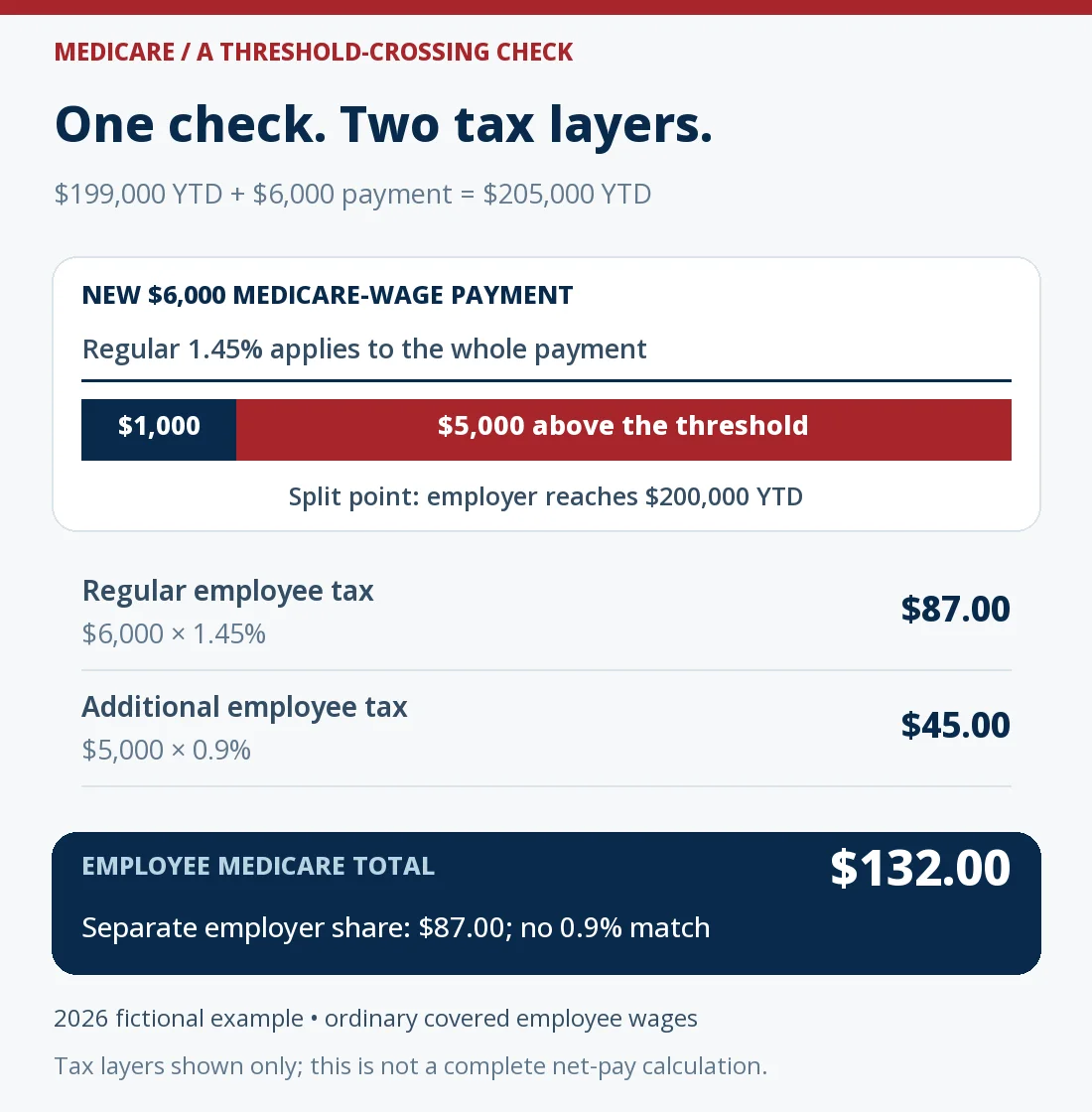
If the next payment is also $6,000 in Medicare wages, with no correction or other change, it is entirely above the employer threshold: regular tax $87 plus additional tax $54 equals $141. The difference between $132 and $141 is explained by the threshold crossing, even though both checks have the same wage amount.
Payroll withholding and final Additional Medicare Tax are different tests
The employer’s $200,000 trigger does not vary with the employee’s marital filing status. The tax-return calculation does. The IRS Form 8959 instructions specify the following thresholds for Additional Medicare Tax:
| Filing status | Threshold for the return calculation |
|---|---|
| Married filing jointly | $250,000 |
| Married filing separately | $125,000 |
| Single, head of household, or qualifying surviving spouse | $200,000 |
The currently available Form 8959 instructions are for 2025; these threshold rules are also confirmed in the IRS’s current Additional Medicare Tax guidance and are not indexed for inflation. Use the appropriate tax-year form when filing. The following wage-only illustrations assume no self-employment income, railroad compensation, unreported tips, or other adjustments.
Example: withholding occurs, but the wage-only additional tax is zero
One spouse receives $228,000 in Medicare wages from one employer; the other spouse has no Medicare wages. On a joint return, their wage-only total is below $250,000, so Additional Medicare Tax on these wages is $0. The employer nevertheless withholds ($228,000 − $200,000) × 0.9% = $252. That does not make the employer’s withholding incorrect.
Example: neither employer withholds, but the joint return has additional tax
Two spouses each receive $144,000 in Medicare wages from their respective employers. Neither individual crosses an employer’s $200,000 trigger. Their combined wages are $288,000, producing wage-only Additional Medicare Tax of ($288,000 − $250,000) × 0.9% = $342 on a joint return. A blank additional-tax line on both stubs therefore does not prove the household has no liability.
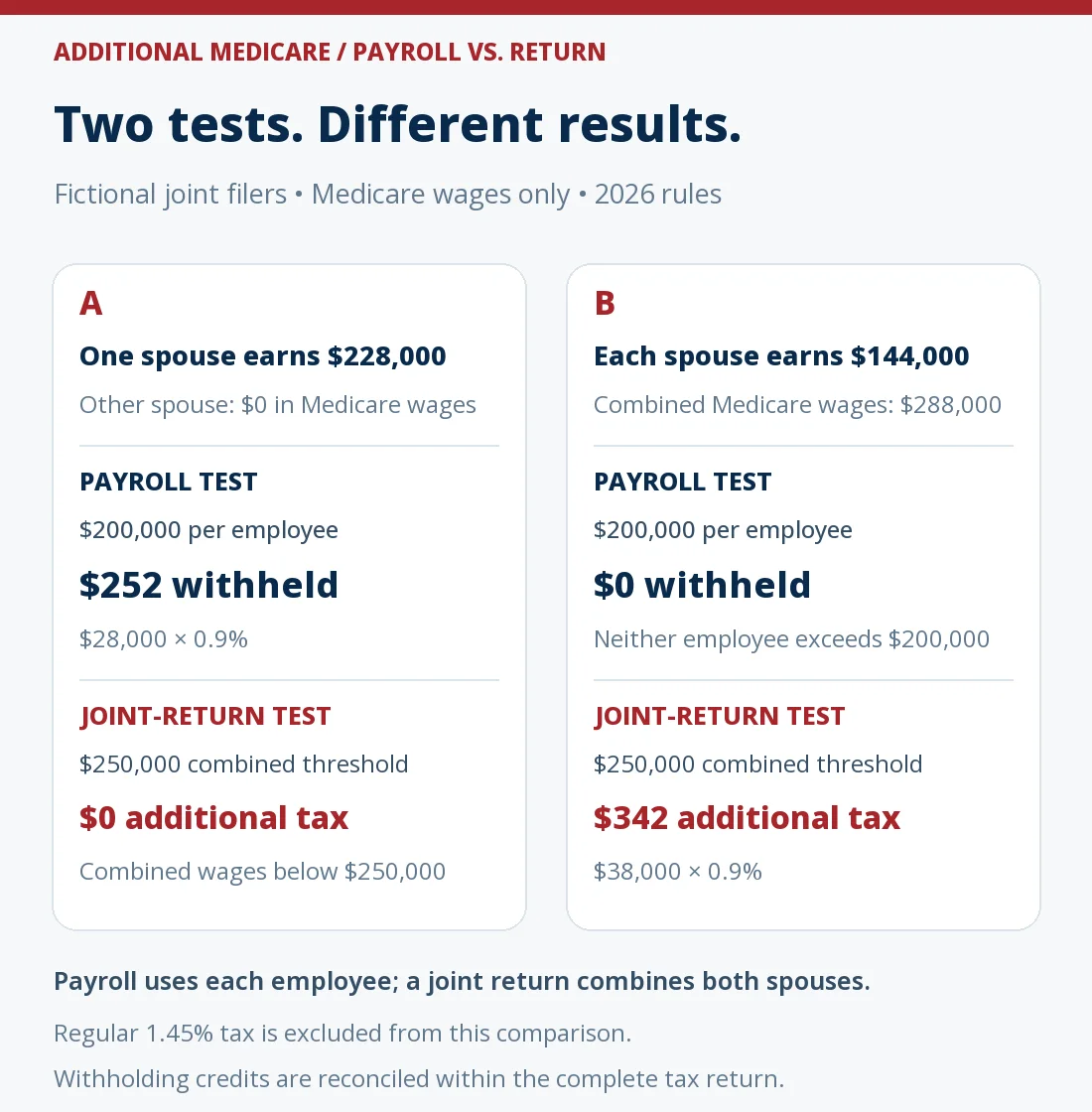
The IRS Additional Medicare Tax FAQs explain that an employer cannot stop required withholding because a joint filer expects no final additional tax. They also explain how someone expecting a shortfall may request extra federal income-tax withholding through Form W-4 or make estimated payments. An employee cannot request a separate voluntary Additional Medicare Tax withholding amount. Plan against the full return, rather than assuming the additional-tax line alone settles it.
Changing jobs and special records require extra care
For ordinary unrelated employers, each applies the withholding trigger to wages it pays that employee. A single filer with $122,000 from one employer and $118,000 from another has $240,000 combined Medicare wages. Neither employer individually crosses $200,000, but the wage-only additional tax is $40,000 × 0.9% = $360. Keep both wage records. Do not discard an earlier employer’s wages when estimating the return calculation.
Some acquisition and successor-employer arrangements require predecessor wages to be carried into the payroll threshold test. Publication 15 describes that exception. Payroll can also contain reversals, wage repayments, taxable fringe-benefit entries, or tax adjustments. Those cases need the underlying register and applicable correction rules; the simple two-YTD formula above should not be used to override a legitimate adjustment.
Coverage exceptions exist for particular services or workers. A zero Medicare line is not automatically an error, but it should have a documented explanation when covered wages would otherwise produce tax. Ask payroll to identify the coverage category using Publication 15’s employment-tax table. Form W-4 controls federal income-tax withholding; its income-tax exemption does not establish Medicare coverage.
Why Medicare may continue when Social Security stops
For 2026, Social Security’s annual wage base is $184,500; Medicare has no comparable cap. The IRS rate and wage-base summary makes the distinction explicit. On an ordinary one-employer payroll, a worker may stop seeing Social Security withholding after reaching that base while continuing to see regular Medicare tax—and later additional Medicare withholding.
Check the relevant wage bases independently. Do not use the Social Security cap as the reason to erase the Medicare line or cap Medicare YTD wages. When reviewing a late-year check, the different behavior of the two deductions can be expected rather than a payroll inconsistency.
Reconcile the annual Medicare record with Form W-2
The IRS’s 2026 W-2 instructions assign Medicare wages and tips to Box 5 and employee Medicare tax withheld, including Additional Medicare Tax, to Box 6. Box 6 excludes the employer’s share. A combined Box 6 amount can therefore be greater than 1.45% of Box 5 without being wrong.
For the simple one-employer $205,000 year-to-date example above, assume there are no special adjustments or uncollected taxes and that this is the final payment. Regular employee tax is $205,000 × 1.45% = $2,972.50; additional withholding is $5,000 × 0.9% = $45. The expected combined employee tax is $3,017.50. Compare the payroll year-end record and W-2 to those components, allowing for legitimate cent-rounding differences. Our pay-stub rounding guide explains why cents sometimes need a separate reconciliation.
Do not simply add the YTD tax figures from every check: each is cumulative. Sum current-period amounts, including corrections, and compare that sum with the final YTD figure. If totals differ, identify missing checks, off-cycle payments, reversals, or reporting adjustments. The final pay stub versus W-2 guide provides a broader wage reconciliation workflow.
Form 8959 calculates Additional Medicare Tax and reconciles withholding. Filing can be required when the tax is owed or the employer withheld it, even if the final wage-only additional tax is zero. A credit for excess withholding is part of the overall tax return; the $252 in the earlier example is not a promise of a $252 cash refund regardless of other taxes owed.
A six-step check before asking payroll for a correction
- Identify the exact line. Record whether it is regular employee tax, additional employee tax, a combined amount, or employer information.
- Find current Medicare wages. Obtain the wage breakdown if the stub displays only cash gross or income-tax wages.
- Verify the ordinary calculation. Multiply the covered current wages by 1.45%, then compare cents using the payroll rounding method.
- Check the employer’s YTD before and after payment. If $200,000 is crossed, calculate only the newly exposed portion at 0.9%.
- Inspect adjustments and coverage. Ask about corrected wages, noncash items, uncollected tax, predecessor records, or a documented exemption.
- Separate payroll correction from return planning. A wrong wage base needs payroll review. A filing-status or multiple-employer difference may need tax-return reconciliation instead.
For a concrete inquiry, send payroll the check date, current Medicare-wage amount, relevant YTD figures, recorded withholding, and your calculation. Ask it to explain or correct the underlying record. Editing a generated pay statement does not change actual employer withholding or IRS reporting.
Common questions about the Medicare line
Do bonuses use a different regular Medicare rate?
A covered bonus uses the same regular Medicare rate. It can also push YTD Medicare wages beyond the additional withholding threshold. Do not confuse a supplemental federal income-tax withholding method with the Medicare calculation.
Does a 401(k) contribution remove Medicare tax?
A traditional employee salary deferral generally does not. In the $3,360 example, subtracting the $240 deferral from Medicare wages produced the wrong result. Confirm the contribution type and benefit treatment with payroll.
What if I am self-employed rather than an employee?
The IRS self-employment tax guidance describes a 2.9% Medicare component calculated through the self-employment rules, rather than the ordinary 1.45% employee deduction. Covered self-employment income can also affect Additional Medicare Tax. A contractor invoice or self-created statement does not establish employer payroll withholding; use the applicable tax records and forms.
Is there a separate state Medicare rate to add?
The Medicare payroll tax discussed here is federal. Review state income tax or other state payroll-program deductions separately; a similarly named benefit or medical deduction is not evidence of a second federal Medicare charge.