The Alaska paycheck calculator includes an employee unemployment insurance contribution even though its Alaska income-tax withholding line is zero. For 2026, the standard employee UI rate is 0.50% on the first $54,200 of covered wages. Those are separate concepts: no state income-tax withholding does not mean every state-related payroll deduction is absent.
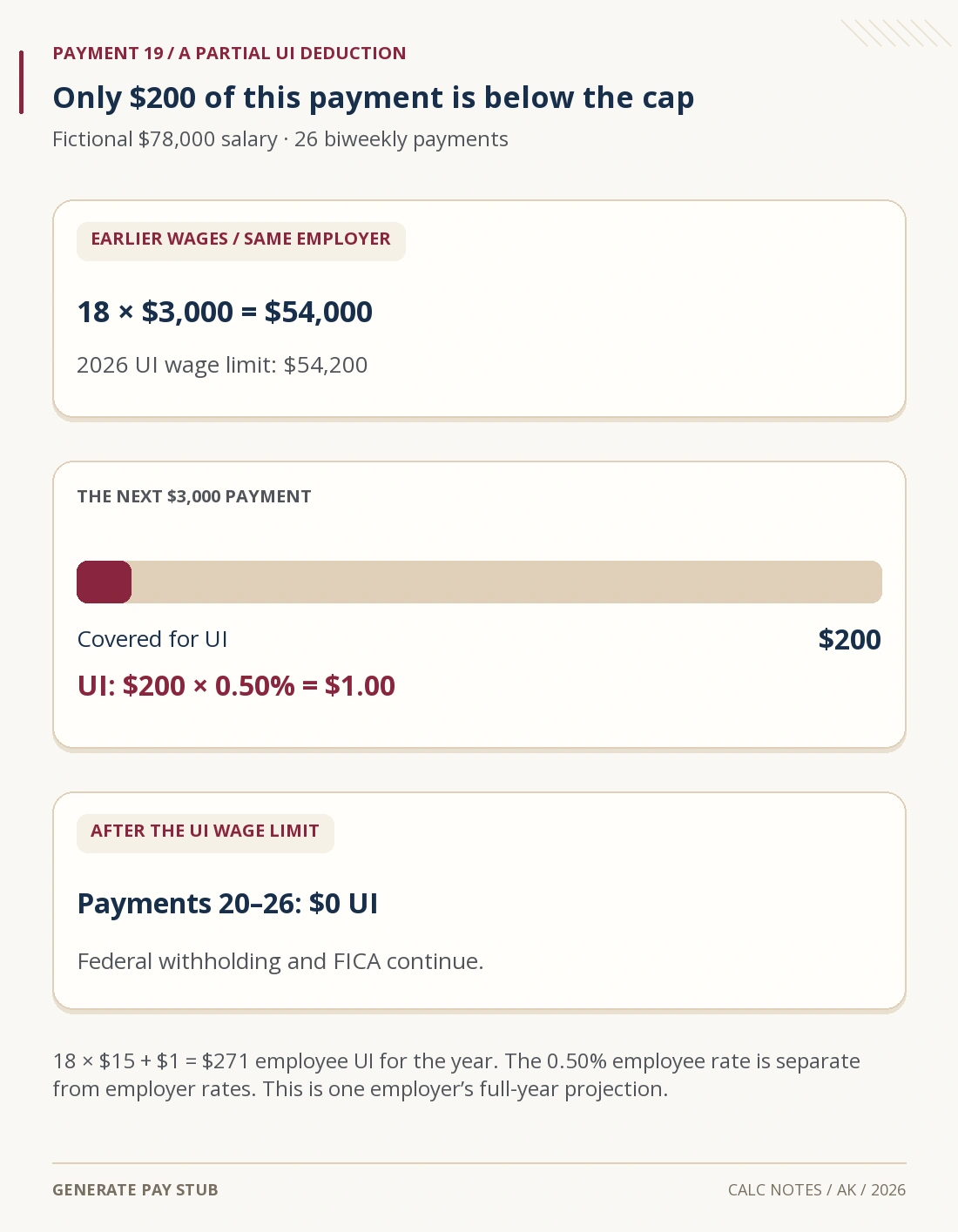
Follow a fictional $78,000 salary paid biweekly to see the difference. The nineteenth payment has only $1 of employee UI, because just $200 remains below the annual wage limit. That is also why an annual-average net estimate does not match every individual payment.
Enter a full-year Alaska salary and the actual schedule
Open the Alaska paycheck calculator. Select 2026, $78,000 annual gross wages and Biweekly. The modeled year contains 26 payments of $3,000.
Use federal Single, with the multiple-jobs adjustment off and all W-4 dollar inputs at zero. Keep the Alaska UI program at standard employee coverage. Known annual local withholding and other cash deductions are zero in the example.
Assume one covered employer for the full year, Alaska residence and work, regular wages and no benefit deductions changing taxable or program-covered wages. This controlled setup is not a reconstruction of a midyear start, seasonal work pattern or changing deduction history.
There is no Alaska income-tax exemption count to enter in the reviewed state controls. The Alaska Department of Revenue’s state revenue discussion describes the absence of a personal income tax. The UI contribution below is administered through the Department of Labor and is a different payroll item.
Read the employee column and the applicable calendar year
The Department of Labor’s 2026 UI rate publication gives a $54,200 taxable wage base and a 0.50% employee rate. It shows employer and total rates separately. Do not use an employer rate or the combined total as the employee’s paycheck deduction.
The employee factor is 0.005 in decimal form. A fully covered $3,000 payment below the limit has $3,000 × 0.005 = $15 withheld. The annual employee maximum for this standard example is $54,200 × 0.005 = $271.
The official wage-base history shows why the year matters: 2025 used $51,700 and a $258.50 employee maximum, while 2026 uses $54,200 and $271. The unchanged 0.50% rate alone does not make the two years’ contribution limits interchangeable.
This rate-and-limit check does not determine coverage for every worker. Before changing the program treatment, establish the actual employment arrangement. A website selection cannot itself approve a contribution exemption.
Calculate the payment that crosses the UI wage limit
Eighteen $3,000 payments total $54,000. Subtract that amount from the 2026 $54,200 limit and only $200 remains subject to UI on payment 19. The rest of that payment is above the UI wage base.

| Stage | Wages subject to UI per payment | Employee UI per payment |
|---|---|---|
| Payments 1–18 | $3,000.00 | $15.00 |
| Payment 19 | $200.00 | $1.00 |
| Payments 20–26 | $0.00 | $0.00 |
The year’s UI contribution is (18 × $15) + $1 = $271. Reaching that limit ends this deduction for the remaining covered wages paid by the same employer in the modeled year; it does not end every deduction on the payment.
The sample’s Social Security remains $186 per payment, Medicare remains $43.50 and federal withholding remains $320.38. None of those changes merely because Alaska UI reaches its own wage limit. Federal wage-base and additional-tax thresholds must be tested separately.
Reconcile the three payment amounts with the annual result
Before employee UI, the cash remainder is $3,000 − $320.38 federal − $186 Social Security − $43.50 Medicare = $2,450.12. Subtract $15 on the first eighteen payments, $1 on payment 19 and zero on the final seven payments.
That gives $2,435.12, $2,449.12 and $2,450.12 respectively. These are the modeled amounts before any unentered benefit or other cash deduction.
| Component | Annual amount |
|---|---|
| Gross wages | $78,000.00 |
| Federal income tax withholding | $8,329.88 |
| Alaska income tax withholding | $0.00 |
| Employee Social Security | $4,836.00 |
| Employee Medicare | $1,131.00 |
| Employee Alaska UI | $271.00 |
| Estimated take-home pay | $63,432.12 |
The net reconciliation is (18 × $2,435.12) + $2,449.12 + (7 × $2,450.12) = $63,432.12. Dividing by 26 gives a rounded average of $2,439.70. That average is useful for an annual comparison, but it is not the amount of any of the three modeled payment stages.
For a recurring budget, use a payment amount that fits the actual point in the year and confirm all deductions. The net-pay checking article explains how to compare a statement with its corresponding deposit.
Do not carry another employer’s UI wage history into this projection
The Alaska Department of Labor’s rate FAQ addresses a worker who has already contributed through a previous employer. Each employer still has its own contribution responsibility. An employee who pays excess contributions across two or more employers may apply for a refund through the state’s process.
That is different from telling a new employer to stop UI withholding because another job has already used the wage limit. The calculator’s standard annual sequence represents one employer, rather than a combined multi-employer refund calculation.
A job change therefore needs the correct employer-specific covered wages, amounts actually withheld and coverage records. The annual-average figure cannot establish whether an overpayment exists or complete a refund request. Keep any refund review separate from an employer’s current withholding calculation.
Check the estimate’s limits before treating it as a payroll result
Federal withholding depends on the employee’s W-4 and household situation. A Single default is only a sample input, and zero federal adjustments should not be copied automatically when multiple jobs or other income exist. Our federal calculator example shows how to isolate W-4 changes.
The calculator assumes gross wages are also the relevant federal, FICA and UI-covered wages. Real benefit and retirement deductions can make those wage bases differ. Entering a cash amount in “other deductions” does not supply the correct pre-tax treatment.
It also projects a complete year of regular payments. Seasonal employment, uneven hours, bonuses, tips and a different actual number of biweekly pay dates require their own records. Choosing 26 payments here does not establish the employer’s real calendar.
The reviewed result identifies no additional excluded program, but that is a model-scope statement. Insurance premiums, retirement, union deductions, garnishments and other lawful cash deductions can still affect a real deposit. Employer UI contributions are a separate business cost and should not be subtracted again as an employee deduction.
The free tool estimates withholding and cash under selected assumptions. It does not issue a pay statement, determine final federal tax, file a refund claim or resolve cross-state residency and work questions.
Alaska paycheck calculator questions
Why is Alaska UI present when state income tax is zero?
UI is a separate employee contribution. It is not personal income-tax withholding.
Is 1.50% the employee rate for this example?
No. Use the 2026 employee column, which is 0.50%. Employer and combined rates answer a different question.
Does payment nineteen have another full $15 deduction?
No. Only $200 remains below the UI limit in this example, so that payment’s deduction is $1.
Does reaching the UI limit stop Social Security?
No. Social Security follows its own federal wage base. The sample’s federal deductions continue after Alaska UI stops.
Alaska official sources and the live 2026 calculator reviewed November 6, 2026. All wages and payment amounts in the example are fictional.