The Arkansas paycheck calculator uses DFA’s published 2026 Formula Method for regular wages, including a midpoint lookup and a personal tax credit for AR4EC exemptions. The exemption count reduces the calculated tax through that credit; it is not simply multiplied by a wage deduction.
This guide traces a fictional $50,400 salary to $114.83 state withholding per monthly payment. It also identifies an important source limitation: the selected electronic-payroll formula differs from figures in separately posted Arkansas tables and employer instructions.
Identify the exact 2026 source method before comparing amounts
The DFA 2026 Formula Method explicitly permits employers with electronic systems to use its formula instead of the withholding tables. It specifies a $2,470 standard deduction, the midpoint step and a 3.7% upper bracket with adjustments. Those are the values used in the reviewed calculator.
The separately posted 2026 employer instructions still state 3.9% in their introduction, and the regular-income tables are a different posted reference. A difference between methods should not automatically be dismissed as cents rounding.
A later USDA National Finance Center bulletin, published August 24, 2026, also uses the 3.7% formula and $367.16 bracket adjustment. Its effective pay period 15 is an NFC payroll implementation date, not evidence of a universal Arkansas legal effective date.
We therefore label the example by the exact published formula used. For a real employer discrepancy, identify the source, method and revision actually applied before deciding whether payroll is wrong.
Set up the fictional $4,200 monthly payment
In the Arkansas paycheck calculator, select 2026, $50,400 annual gross wages and Monthly. Use federal Single, no multiple-jobs adjustment and zero for the W-4 dollar inputs and extra federal withholding.
Set the AR4EC exemption total to one. Extra state tax is $0 per payment in this test, and no annual local cash amount or other cash adjustment has been supplied. These inputs describe uninterrupted ordinary work for one employer in Arkansas, with Arkansas residence and matching wage bases. Benefit-related pre-tax adjustments are absent.
The exemption claim is assumed to be supported by the certificate. The calculator does not decide eligibility or submit a new AR4EC to the employer. Its state control is a total exemption count, rather than a federal credit dollar amount.
Follow the midpoint lookup, rounding and personal credit
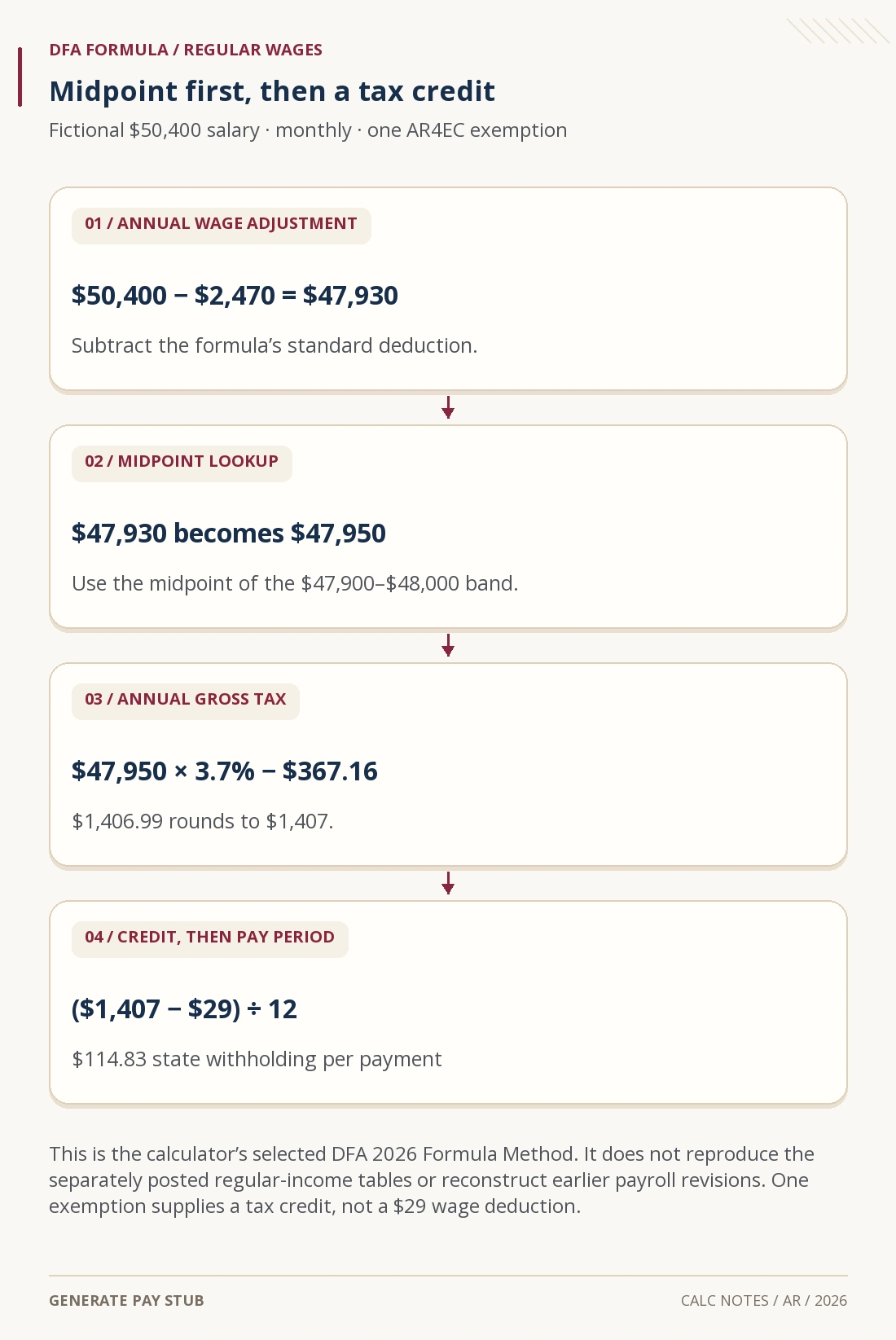
Start with $4,200 × 12 = $50,400 annual gross. Subtract the formula’s $2,470 standard deduction to obtain $47,930. This is below the formula’s exact-dollar threshold, so the midpoint step applies.
The applicable $100 band runs from $47,900 to $48,000. Its midpoint is $47,950. This is not ordinary rounding to the nearest $100, which would produce a different lookup value.
The selected bracket uses 3.7% minus $367.16: ($47,950 × 3.7%) − $367.16 = $1,406.99. Following the formula’s whole-dollar step makes annual gross tax $1,407.
One AR4EC exemption gives a $29 annual personal tax credit. Subtract that credit from the rounded gross tax: $1,407 − $29 = $1,378 annual net tax for the formula. Divide by twelve and round to cents: $1,378 ÷ 12 = $114.833333…, giving $114.83 per payment.

The annual payroll projection is the sum of twelve rounded $114.83 deductions, or $1,377.96. Its four-cent difference from the formula’s $1,378 annual amount comes from payment-level rounding. That small difference is separate from the larger differences possible between posted methods.
Compare one exemption with two without changing wages
For a second controlled run, assume the certificate supports two exemptions. Keep every other input unchanged. Two exemptions produce $58 of annual personal credit, leaving $1,407 − $58 = $1,349 before dividing by twelve.
| AR4EC count | Annual personal credit | State withholding/pay | Net/pay |
|---|---|---|---|
| One exemption | $29.00 | $114.83 | $3,441.54 |
| Two exemptions | $58.00 | $112.42 | $3,443.95 |
The second payment deduction is $112.42 after rounding. The displayed difference is $2.41 per month. Across twelve payments that is $28.92, while the unrounded additional annual credit is $29. Subtracting independently rounded payment results can produce that small mismatch.
The $29 is a reduction of annual tax within this method. Subtracting $29 from annual wages and then applying a percentage would not reproduce it. It is also not $29 less withheld from every payment.
Do not increase exemptions solely to obtain the larger net shown here. Use the actual certificate entitlement. The employer instructions also address allocation when an employee has more than one job; the same full set of claims should not be assumed automatically at each job.
Check the original gross-to-net result
For the one-exemption run, the live calculator returns $322.33 federal withholding, $260.40 Social Security and $60.90 Medicare each month. With $114.83 Arkansas withholding, the cash calculation is $4,200 − $322.33 − $260.40 − $60.90 − $114.83 = $3,441.54.
| Component | Annual amount |
|---|---|
| Gross wages | $50,400.00 |
| Federal income tax withholding | $3,867.96 |
| Arkansas income tax withholding | $1,377.96 |
| Employee Social Security | $3,124.80 |
| Employee Medicare | $730.80 |
| Estimated take-home pay | $41,298.48 |
The monthly net multiplied by twelve is $41,298.48. No other employee contribution appears in the reviewed standard result. That is a description of this model and example, rather than evidence that all real benefit or other deductions are zero.
The tool estimates cash and withholding under a selected method. It does not calculate final federal or Arkansas tax liability, claim eligibility, a refund or an employer’s complete payroll cost.
Understand the regular-income scope and unsupported cases
This state calculator implements the regular-income formula. It does not determine eligibility for separately elected low-income tables, an exempt certificate, Texarkana treatment, special employment rules or a supplemental-wage calculation. An ordinary exemption count cannot stand in for all those choices.
The selected formula is applied across the annual projection. It does not reconstruct checks processed earlier in 2026 under a different table or revision. A current formula result therefore cannot by itself validate every historical payment.
The example also assumes matching gross and taxable wages. Retirement, insurance and other benefit rules can change the relevant bases. A cash amount entered as an other deduction reduces net without calculating those tax effects.
Known local or other cash amounts must be supported separately. Zero inputs here isolate the formula; they are not findings about a real employee’s obligations. Part-year work, multiple employers and irregular pay require more detail than this one-employer projection supplies.
Investigate an actual difference in the right order
Collect the payroll date, gross and state-taxable wages, payment frequency, AR4EC claim, extra withholding and the employer’s source method. Confirm whether the comparison is with the formula or a wage-bracket table and whether a special certificate applies.
Then follow the annualization, standard deduction, midpoint, bracket adjustment, gross-tax rounding, personal credit and final period rounding in order. Comparing only a headline tax percentage skips most of the calculation.
Use the federal withholding guide for the W-4 part and the gross-to-net checking guide for the deposit reconciliation. Neither replaces confirmation from payroll or DFA when the governing method is uncertain.
Arkansas paycheck calculator questions
Is an exemption a $29 wage deduction?
No. The selected method uses $29 per exemption as an annual personal tax credit after calculating annual gross tax.
Is the midpoint the nearest multiple of $100?
No. For the sample’s $47,930 amount, the midpoint lookup uses $47,950.
Does this guide prove every 2026 table should give $114.83?
No. It explains the specific DFA formula used by this tool. Separately posted materials differ, and historical revisions are not reconstructed.
Does changing the count here update AR4EC?
No. Actual certificate changes must follow the employer’s process and the applicable eligibility instructions.
Arkansas official formula, related source differences and two live calculator runs reviewed November 6, 2026. Worked figures use fictional ordinary wages and the stated method.