Personal use of an employer-provided vehicle generally creates taxable compensation unless a specific exclusion applies. A pay stub may label it PUCC, auto fringe or imputed income. The amount can increase taxable wages without adding cash to the employee's deposit; a matching noncash offset does not necessarily mean the employer charged the employee that amount.
This U.S. payroll guide was reviewed November 3, 2026. It explains 2026 personal-use records, commuting valuation, an annual-lease-value example and the wage-to-cash reconciliation. State tax rules and specialized vehicles may differ. Fictional calculations assume the selected valuation method is permitted and correctly applied.
What is personal use of a company car on a pay stub?
It is compensation in the form of vehicle use, rather than an extra cash wage payment. Under the federal fringe-benefit valuation regulation, a taxable benefit must be valued using an applicable rule. The employee does not automatically report the entire purchase price of the car as one paycheck's income.
A code named AUTO or PUCC needs a payroll explanation: it could reflect current-period personal use, a periodic catch-up or an annual true-up. Compare the valuation period with mileage and availability records before treating it as a mysterious deduction. Our imputed-income guide explains the general difference between noncash compensation and take-home pay.
Is commuting business use because the employer owns the vehicle?
Ordinary travel between home and the regular workplace is generally personal commuting. Employer ownership, a company logo or a useful work purpose for having a car does not automatically turn every mile into excluded business use. Separate genuine business travel, commuting and other personal trips using the applicable rules.
The working-condition fringe regulation addresses exclusions for qualifying business use and substantiation. Certain qualified nonpersonal-use vehicles have special treatment; an ordinary passenger car or pickup is not automatically in that category merely because it carries work equipment.
For employer vehicle records, maintain the usage, dates, places and business purpose needed to substantiate the business portion. IRS Publication 463, currently the 2025 edition, explains recordkeeping principles. Its prior-year mileage figures should not be substituted for an applicable 2026 valuation rule. Wage-hour payment for travel time is a separate issue; see the travel-pay guide.
Can payroll choose any low amount for personal vehicle use?
No. Identify the valuation rule and whether the vehicle, use and employee qualify. Publication 15-B for 2026 explains fair market value and special vehicle rules. An employer's actual lease invoice is not automatically the taxable annual lease value, and a standard mileage rate cannot be chosen without meeting the special rule's requirements.
| Method | What is valued | Important boundary |
|---|---|---|
| General fair market value | Value of the taxable vehicle use under the general rule. | Not automatically employer cost or employee estimate. |
| Vehicle cents-per-mile rule | Personal miles under a permitted special valuation method. | Vehicle value, use, applicable rate and consistency conditions matter. |
| Commuting valuation rule | Qualifying one-way commutes at $1.50 each. | Requires business reasons, restricted use and employee eligibility. |
| Automobile annual lease value | Table lease value allocated to personal use; fuel can be separate. | FMV date, availability period, substantiation and consistency matter. |
The worked examples below illustrate two different methods for separate fictional cases. They do not authorize switching between methods each month to get the smallest taxable amount. The regulation and employer policy govern adoption, continuing use and changes.
When can payroll use $1.50 per one-way commute?
The special commuting rule has conditions beyond simply driving to work. The employer must provide the vehicle for its business and require commuting for bona fide noncompensatory business reasons. A written policy must restrict personal use to commuting and permitted minimal use, and actual use must follow that restriction.
Employee eligibility also matters, including the control-employee restriction for an automobile. Owners, directors, certain officers and highly paid employees can fall within that restriction; governmental employers have their own definition. Do not assume that a modest salary alone proves eligibility or that a company owner can always use this rule.
Assume all requirements are satisfied in a fictional 2026 case with 20 commuting workdays, one trip to work and one trip home each day. There are 40 one-way commutes, so the benefit value is 40 × $1.50 = $60. Counting each round trip as one commute would produce only $30 and understate this example by $30.
If multiple employees commute in the vehicle, the rule's value applies to each employee rather than dividing one $1.50 charge among everyone. Additional personal driving beyond the permitted minimal use can prevent this method from applying. The $1.50 is a valuation amount, not a general business-mile reimbursement rate.
How can a $60 noncash benefit change a fictional paycheck?
Add the taxable benefit to wage bases, then reconcile cash separately. Assume $2,200 cash wages and the valid $60 commuting benefit above. There is no employee reimbursement, other benefit adjustment or payroll deduction. Assume ordinary Social Security/Medicare-covered employment, the employee remaining below the Social Security ceiling after this benefit and not crossing the Additional Medicare withholding threshold.
The federal wage bases in this example are $2,260. With a given $200 federal income-tax withholding amount, employee Social Security is $140.12 and Medicare is $32.77. Federal employee taxes total $372.89. Cash paid is $1,827.11: $2,200 cash wages minus $372.89 taxes. The $200 is an assumption, not a calculated withholding-table result.

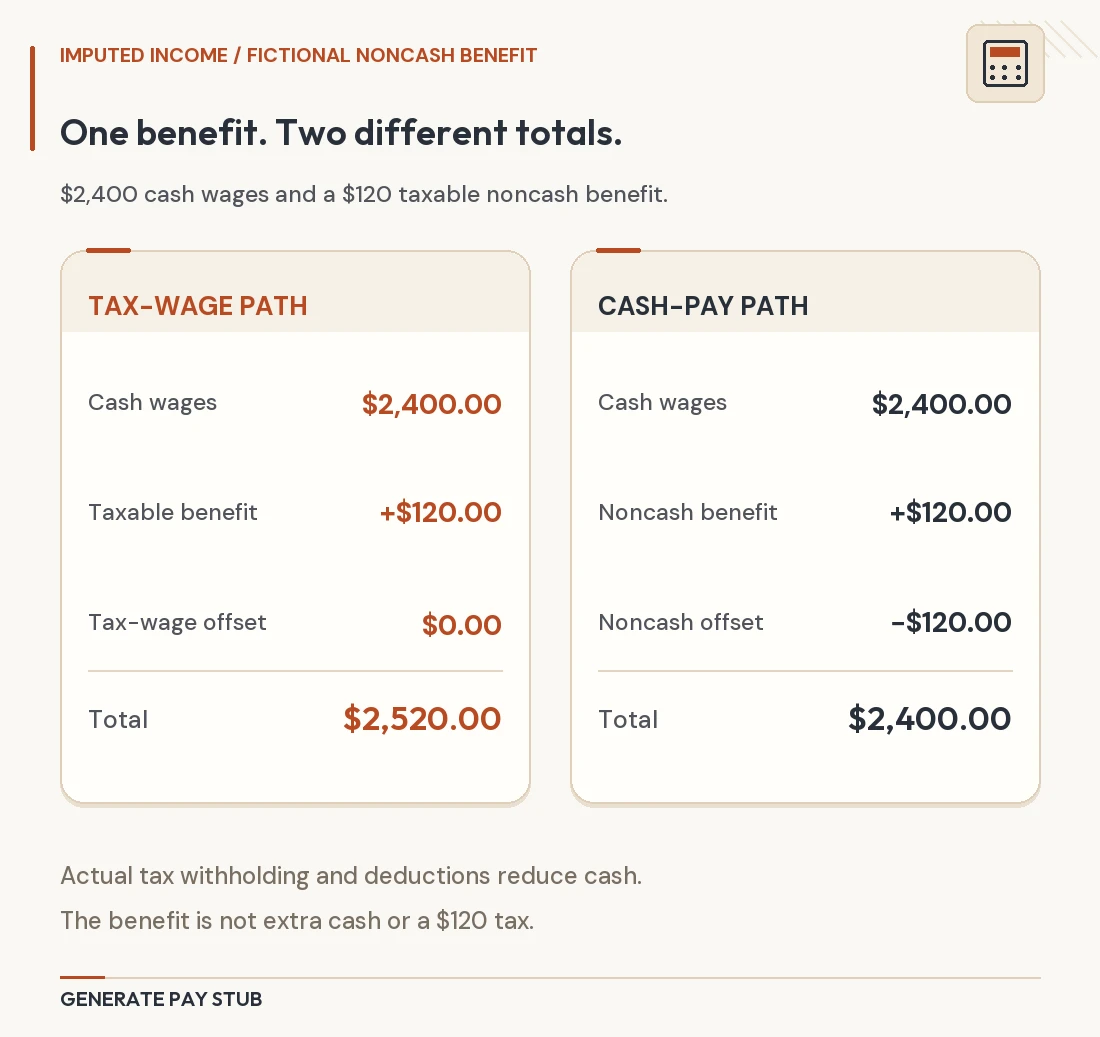
Some payroll layouts show $2,260 in total earnings, a $60 noncash offset and $372.89 tax deductions. That presentation still gives $1,827.11. The offset prevents a noncash benefit from being paid out as cash; it is not evidence of an additional $60 employee reimbursement.
An actual after-tax reimbursement or valid payroll deduction for vehicle use is a different transaction and needs documentation. Check the gross and taxable wages guide before comparing every earnings total directly with the net deposit.
How does annual lease value differ from commuting valuation?
It uses an IRS table value and a substantiated personal-use percentage. Consider a separate fictional full-year 2026 case. Assume the automobile had a properly established $30,000 FMV when the method first applied, was available for the full year and satisfies the method's adoption and consistency conditions. Actual business and personal miles are assumed fully substantiated.
Publication 15-B's annual lease value table assigns $8,250 to the $30,000–$31,999 FMV band. If annual miles are 10,000, with 8,000 business and 2,000 personal, the personal-use proportion is 20%. The personal-use lease value is $8,250 × 20% = $1,650.
Assume the employer directly provides fuel in kind for U.S. driving and validly uses the rule's 5.5-cent fuel valuation for the personal miles. Personal fuel value is 2,000 × $0.055 = $110, so the combined benefit is $1,760. Fuel is separate under this lease-value rule; actual reimbursements or fuel charged to the employer can require a different fuel valuation.
| Calculation component | Amount |
|---|---|
| IRS table annual lease value for assumed $30,000 FMV | $8,250.00 |
| Personal proportion / 2,000 of 10,000 miles | 20% |
| Personal-use lease value / $8,250 × 20% | $1,650.00 |
| Directly provided personal fuel / 2,000 × $0.055 | $110.00 |
| Benefit before employee reimbursement | $1,760.00 |
| Documented after-tax employee reimbursement | −$240.00 |
| Remaining taxable benefit under these assumptions | $1,520.00 |

The $240 example reimbursement is assumed actually paid and properly credited against the benefit, not merely a noncash display offset. Do not subtract it again from the earlier commuting paycheck: the two examples are independent. Partial-year availability, a changed vehicle or a different valuation period requires the relevant proration and consistency rules.
Why might there be no federal income-tax withholding on PUCC?
A specific employer withholding election can apply without making the benefit tax-free. Publication 15-B permits an employer to elect not to withhold federal income tax on personal use of an employer-provided highway motor vehicle, subject to written notice and reporting requirements. Applicable Social Security and Medicare taxes must still be withheld.
The notice generally must be provided by January 31 of the election year or within 30 days after the vehicle is first provided, whichever is later. The 2026 W-2 instructions and fringe-benefit guide explain wage and personal-use reporting. A separate employer statement may be relevant; a payroll code is not a replacement for required year-end reporting.
Noncash benefits can be included periodically, with permitted special accounting rules and a reconciliation of estimated to actual value. Do not assume a December true-up means all vehicle use occurred in December. The 2026 payroll tax guide provides general wage-tax context, while Publication 15-B supplies the specific fringe timing and withholding rules.
Which records should be checked before correcting the pay stub?
- Identify the vehicle and rule. Request the method, FMV date, availability period and eligibility basis.
- Reconcile actual use. Separate business, commuting and other personal use, with substantiation.
- Check components. Identify personal-use value, fuel, other services and genuine after-tax reimbursements.
- Trace payroll presentation. Distinguish noncash offsets, actual deductions, taxable bases and tax withholding.
- Match annual reporting. Review periodic estimates, true-ups and W-2 or accompanying statements.
A flat cash car allowance has its own wage and reimbursement analysis; it is not automatically the same noncash benefit. See our accountable-plan guide and year-end reconciliation guide. Generate Pay Stub can display verified vehicle-fringe amounts; it cannot establish an exclusion or authorize an unsupported valuation method.