A useful freelance invoice tells a customer what you supplied, what the agreed charges are, how much remains unpaid, and when and how to pay. Give it a unique reference, identify both parties, itemize the work, and show deposits or other adjustments clearly. Then send it through the customer's agreed billing process and retain a copy with your payment records.
You finished the work. The person approving your invoice may never have attended the project calls. Your document needs to carry enough context for that person to recognize the job and authorize the right payment. This guide builds that connection from source records to a reviewed PDF.
Reviewed November 5, 2026. The examples use U.S. dollars and hypothetical service businesses. This is a practical preparation guide, not a universal legal checklist: contract terms, sales-tax rules and freelance-payment protections depend on the transaction and jurisdiction.
What does a freelance invoice establish?
It presents a charge for an identifiable job, delivery or billing period. An estimate describes proposed pricing; a contract records the agreement; an invoice requests payment under that arrangement; a payment record or receipt documents money actually received. The names of these documents are less useful than the question each answers.
The IRS includes invoices among supporting business records and distinguishes records of gross receipts from records of purchases and expenses. Keep the invoice connected to the underlying transaction so someone reviewing your books can trace the amount. IRS: Supporting business records.
An invoice alone does not show that a customer paid, establish an employment relationship, or calculate your final personal income tax. For the payroll distinction, see our invoice versus pay stub comparison. For a client's request for taxpayer information, use the separate W-9 preparation guide.
What should you gather before creating an invoice?
Start with the agreement and evidence of what became billable. Bring together the accepted quote or contract, purchase-order reference if there is one, approved time or milestone records, customer billing instructions, and records of any deposits already received.
Check these four questions before choosing a design:
- What triggers billing? Completion, approval, delivery, a scheduled installment or the end of a recurring period?
- Which price applies? An agreed hourly rate, fixed project amount, unit price or approved change?
- Who processes payment? The customer contact, an accounts-payable team or a specified portal?
- What has already been paid? Confirm actual receipts rather than relying on a promise, pending transfer or deposit request.
If your time sheet says 12 hours but the agreed milestone fee is fixed, clarify the charge before multiplying hours by a rate. A design tool should express the deal accurately; it should not silently replace the deal with a different billing method.
What details should you put on a freelance invoice?
Include enough information to identify, review and pay the transaction. The following is an editorial preparation checklist. A particular customer, government contract or local tax regime may require more.
| Part of the invoice | Useful details | Question to resolve |
|---|---|---|
| Issuer and customer | Business names and appropriate billing contact details. | Can the customer identify the supplier and correct account? |
| Document reference | A unique invoice number; issue date; project or purchase-order reference. | Can both parties refer to the same charge? |
| Billable work | Specific descriptions, quantities, unit prices or agreed milestones. | Can the approver connect each charge to the agreement? |
| Adjustments and totals | Supported discount, applicable tax, actual payments already received and balance. | Is the outstanding amount clear without counting a payment twice? |
| Payment instructions | Agreed due date and accepted payment method or verified payment link. | Does the payer know the next action? |
A sequential reference such as AS-014 is an administrative identifier in the example, not a tax ID. You can use your own consistent numbering system. Avoid giving two different transactions the same reference; a customer searching its records should be able to distinguish them.
Describe a line as “Discovery workshop and written brief — 8 approved hours,” rather than simply “Work.” For recurring services, identify the billing period. For a fixed-price project, identify the milestone and agreed amount rather than inventing hours solely to fill a template.
What does a complete fictional invoice look like?
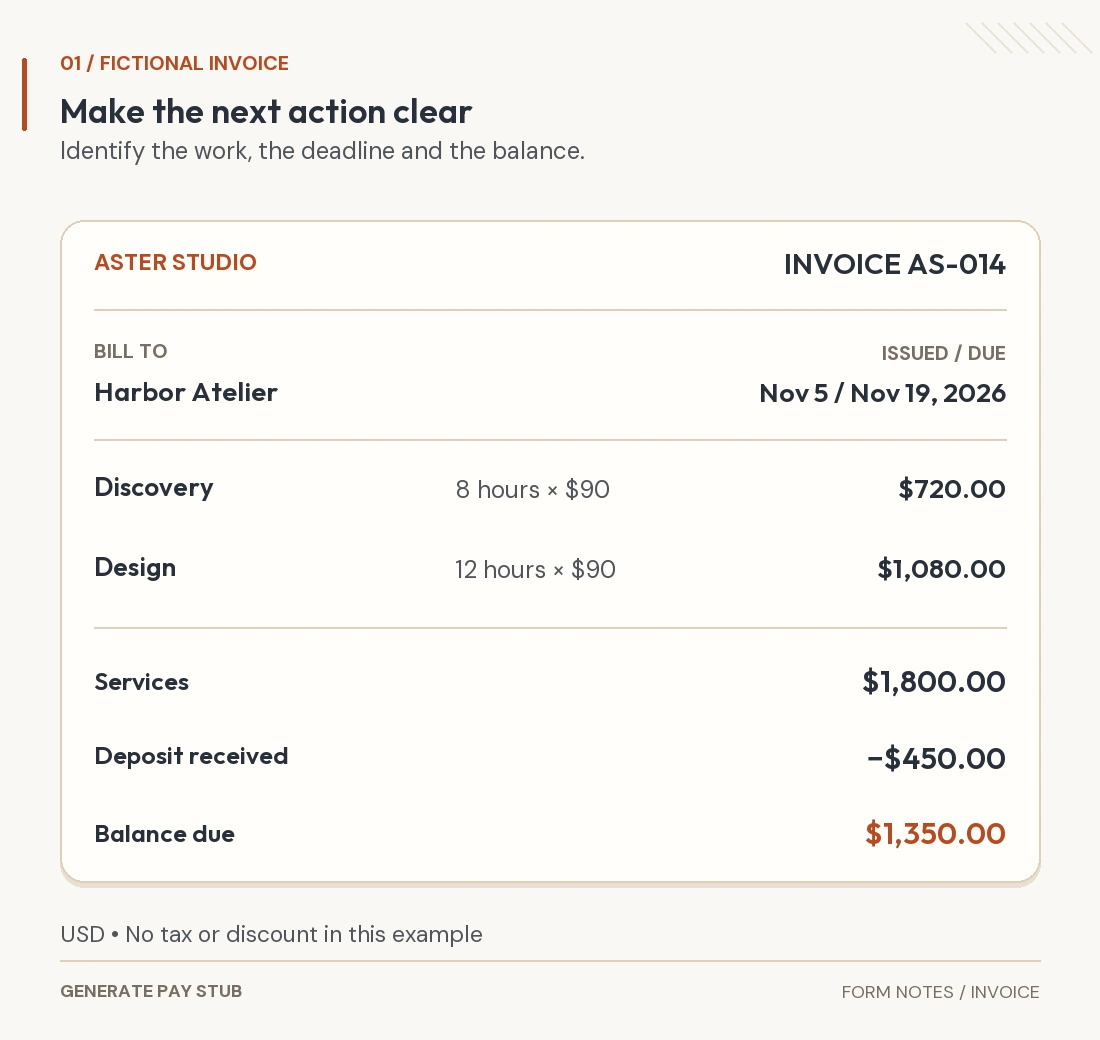
Separate the value of the work from the remaining amount to collect. Assume fictional Aster Studio bills Harbor Atelier for 8 hours of discovery and 12 hours of design, both at an agreed $90 hourly rate. Assume the work is billable, the time is approved, a $450 deposit was actually received, and no discount, sales tax or other adjustment applies.
The services total $1,800: $720 for discovery plus $1,080 for design. Applying the $450 deposit leaves $1,350 due. The invoice can show the full service total and credit the deposit without asking the customer to pay that deposit again.

The example uses November 5 as the issue date and November 19 as the agreed due date, fourteen calendar days later. Write the actual date so the customer does not have to infer whether “Net 14” means from issue, receipt or another event. If the agreement uses a different starting event, follow that agreement.
Do not put “Paid” across this example merely because the deposit arrived. A partially paid invoice still has a $1,350 balance. Conversely, an invoice that has been fully settled should not continue showing the original total as the amount the customer still owes.
How do an invoice discount, sales tax and a deposit interact?
Apply each adjustment to its proper base, then reconcile the balance. A commercial discount changes the agreed charge. Tax depends on the applicable law. A received payment reduces the unpaid balance; it does not automatically reduce the value of the sale or the tax base.
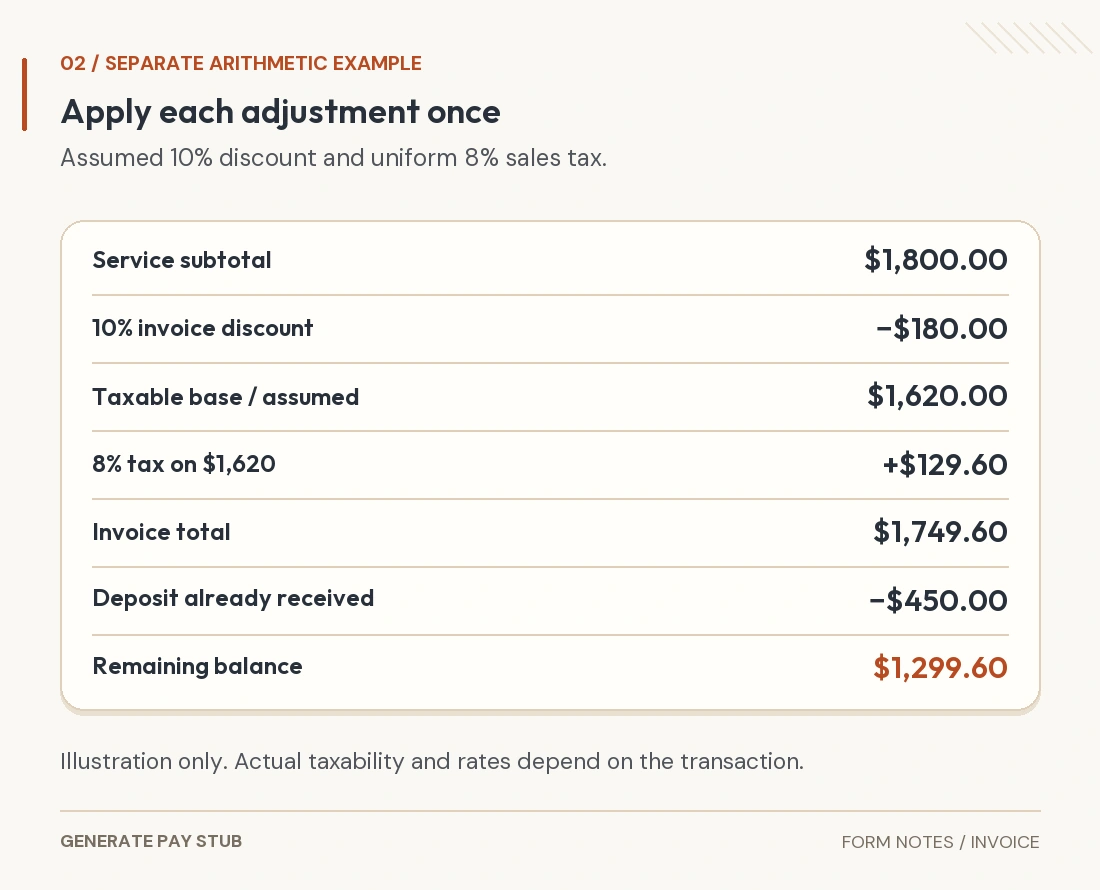
Consider a separate arithmetic illustration. Start with $1,800 in services, allow an agreed 10% invoice discount, assume the remaining amount is fully taxable at a hypothetical uniform 8% rate, and apply a $450 payment already received. These tax assumptions are only for demonstrating the calculation; they do not determine whether real design services are taxable anywhere.

The balance is $1,299.60, calculated as $1,800 − $180 + $129.60 − $450. Notice that the $450 payment is credited once, after the illustrated invoice total is established.
The Generate Pay Stub invoice builder applies the tax rate you enter to the subtotal after its invoice discount. That explains the tool's arithmetic; it is not a determination of taxability, nexus, exemptions or the legally correct tax base. Resolve mixed tax rates, exempt items or other special treatment before using a single-rate field.
An invoice discount also differs from a checkout coupon used to buy the PDF. The customer-facing charge and the document-preparation fee are separate transactions. A coupon for the builder does not reduce what your customer owes for your work.
How should you state a payment due date and late-payment terms?
Make the agreed payment event and date explicit. “Payment due November 19, 2026; reference AS-014” gives the payer a clear instruction. When approval or delivery determines the date, record the event and how the due date follows from it.
Do not assume an invoice can rewrite a signed contract or eliminate statutory protections. For example, New York City's rules for covered freelance work require payment by the contractual due date, or generally within 30 days of completion when the contract does not specify a payment date or a way to determine it. This is a jurisdiction-specific example, not a national “Net 30” rule. Check coverage and the complete guidance. NYC: Freelance Isn't Free Act FAQ.
Only include a late fee, interest charge or discount condition when it is supported by the agreement and applicable law. A line added after the work is finished is not a reliable substitute for agreed terms. If a customer asks you to accept less to obtain payment, retain the correspondence and review your contract and any applicable worker protections.
Where should you send an invoice, and what should the message say?
Use the agreed billing channel and make the attachment easy to recognize. Ask for the correct accounts-payable address, purchase-order reference and portal requirements before sending. A project manager's approval and an accounts-payable team's receipt can be different steps.
A concise fictional message could read: “Attached is invoice AS-014 for the approved discovery and design work. The $450 deposit has been applied, leaving $1,350 due November 19. Please confirm receipt and let me know if a billing reference is missing.” Do not promise that this wording guarantees prompt payment.
Verify changes in banking or payment instructions through a separate trusted channel. The FBI's Internet Crime Complaint Center recommends secondary-channel verification for account-information changes because business-email compromise can divert legitimate transfers. IC3: Business email compromise.
Keep personal tax identifiers out of a general project attachment when they are not needed for that invoice. If the customer needs a W-9, use a verified protected route for that separate document. Confirm permission settings on any shared link before including customer or payment information.
What should you do if an invoice is wrong or overdue?
Identify whether the problem is an incorrect charge, missing processing information or an unpaid valid balance. Those problems call for different records.
- Wrong item, quantity or rate: reconcile the agreement and issue a clearly identified correction through the customer's process. Preserve the original and explain what the replacement changes.
- Missing purchase order or recipient: provide the requested reference and confirm the invoice is now in the correct queue.
- Payment not matched: compare the actual received amount, payment reference and outstanding balance before sending a duplicate charge.
- Valid invoice overdue: send a factual reminder identifying the reference, due date, remaining balance and a request for payment status. Escalate disputes through the contract or an appropriate adviser.
Keep one clear audit trail. Sending the same charge with a new reference and no explanation can look like an additional invoice. Likewise, silently replacing a file makes it harder for either party to know which version was approved.
Which records should you keep with the finished invoice?
Retain the agreement, billing evidence, issued version, adjustments and payment trail together. The IRS says businesses can choose a recordkeeping system that clearly shows income and expenses and supports tax-return entries. Its guidance also treats electronic records as subject to recordkeeping principles. IRS: Business recordkeeping.
For the first example, a useful file connects the approved 20 hours, the $90 rate, invoice AS-014, evidence of the $450 deposit, and the eventual $1,350 settlement. The invoice balance is a collection figure; the timing and treatment of income on a tax return depend on your accounting method and other rules.
Keep the tool's private order or resume link secure, too. A private link may provide access to saved document details. Share the intended customer-facing document through your chosen channel rather than distributing administrative access unnecessarily.
How do you prepare the PDF in Generate Pay Stub's invoice builder?
Use the builder after the billing facts are settled. Its current workflow offers business and customer details, your invoice sequence, dates, itemized quantities and prices, optional discount, a tax-rate input and amounts already paid. The tool currently uses USD. Its invoice guide describes five designs, a preview and a paid PDF download.
Open the invoice generator, enter the verified details, choose a readable design and inspect every preview page. Check long descriptions, page breaks, customer information, due date and totals. Use the “amount already paid” field only for a supported receipt.
The builder does not automatically send the invoice or collect the customer's balance. Review its current download terms separately from your customer-facing amount. After downloading, open the actual PDF before sharing it and retain the version you issued.
The sample businesses, dates and figures are fictional. This article offers general U.S.-focused document-preparation information; obtain transaction-specific advice for sales tax, disputed contract terms, statutory payment rights or accounting treatment.