Use the Delaware paycheck calculator with your DE-W4 personal exemptions and your actual Paid Leave coverage. State income tax and Paid Leave are separate deductions. Selecting every leave component can overstate the employee contribution when the employer provides parental-only coverage.
We checked two fictional 2026 projections at $64,800 annual wages. With the same tax inputs, full public-plan employee contributions produce $4,254.32 estimated monthly net; parental-only contributions produce $4,267.28. The difference comes entirely from the assumed coverage.
Enter DE-W4 information separately from federal W-4
The state’s Delaware W-4 explanation distinguishes its exemption-based certificate from the modern federal form. A federal W-4 issued from 2020 onward does not replace the Delaware certificate for state withholding purposes.
In the Delaware paycheck calculator, choose the applicable state filing group, enter the DE-W4 personal exemptions and supply any additional state amount per payment. Use the completed certificate rather than treating a federal dependents dollar entry as a Delaware exemption count.
The fictional worker below uses the Single/Head of Household/Married Filing Separately group, one personal exemption and no additional state amount. One is an example assumption, not a recommendation for every employee.
Build a monthly salary estimate with known assumptions
Enter 2026, $64,800 annual gross wages and Monthly. That gives twelve $5,400 payments. The federal settings are Single, no multiple-jobs selection and zero W-4 dollar adjustments.
For this calculation, gross wages equal every relevant taxable or covered wage base. Assume a full year with one employer, Delaware residence and work, ordinary salary and no retirement or insurance adjustment. No annual local withholding or other cash deduction is entered.
These choices matter: a cross-border job, benefit election, midyear start or varying payroll history can require different wage bases or additional information. A year-long model is a budgeting scenario, not a reconstruction of an employer’s actual checks.
Trace the $244.65 monthly Delaware income-tax line
The Division of Revenue’s employer withholding guide describes the annualized formula, standard deduction, rate schedule and personal-exemption credit. Applying that method to this Single-group example:
- Annual wages of $64,800 minus the $3,250 standard deduction give $61,550.
- The applicable bracket is $2,943.50 plus 6.6% of income over $60,000: $2,943.50 + ($1,550 × 6.6%) = $3,045.80.
- One personal exemption supplies a $110 annual credit: $3,045.80 − $110 = $2,935.80.
- Divide by twelve: $2,935.80 ÷ 12 = $244.65 per payment.
The credit reduces calculated annual tax. It is not a $110 reduction to each payment’s wages. Additional state withholding, if requested, is added after the ordinary per-payment calculation.
That withholding projection is distinct from final Delaware tax liability, which can depend on other income, deductions, credits and residency facts absent from the tool.
Choose Paid Leave coverage from employer records
Delaware Paid Leave began collecting contributions in 2025, with benefits available beginning in 2026. Income-tax withholding and Paid Leave do different jobs; a DE-W4 exemption does not remove a covered leave contribution.
The agency’s employer guidance generally places employers with 10–24 Delaware employees in parental-only coverage and those with at least 25 in all three components. Smaller employers may opt in. Exceptions, approved private plans, employee work location and the statutory counting rules can change the answer.
The enacted contribution provisions for 2025 and 2026 set combined employer-plus-employee rates of 0.32% for parental leave, 0.40% for medical leave and 0.08% for family caregiving. Their sum is 0.80%; that is not automatically the employee’s deduction.
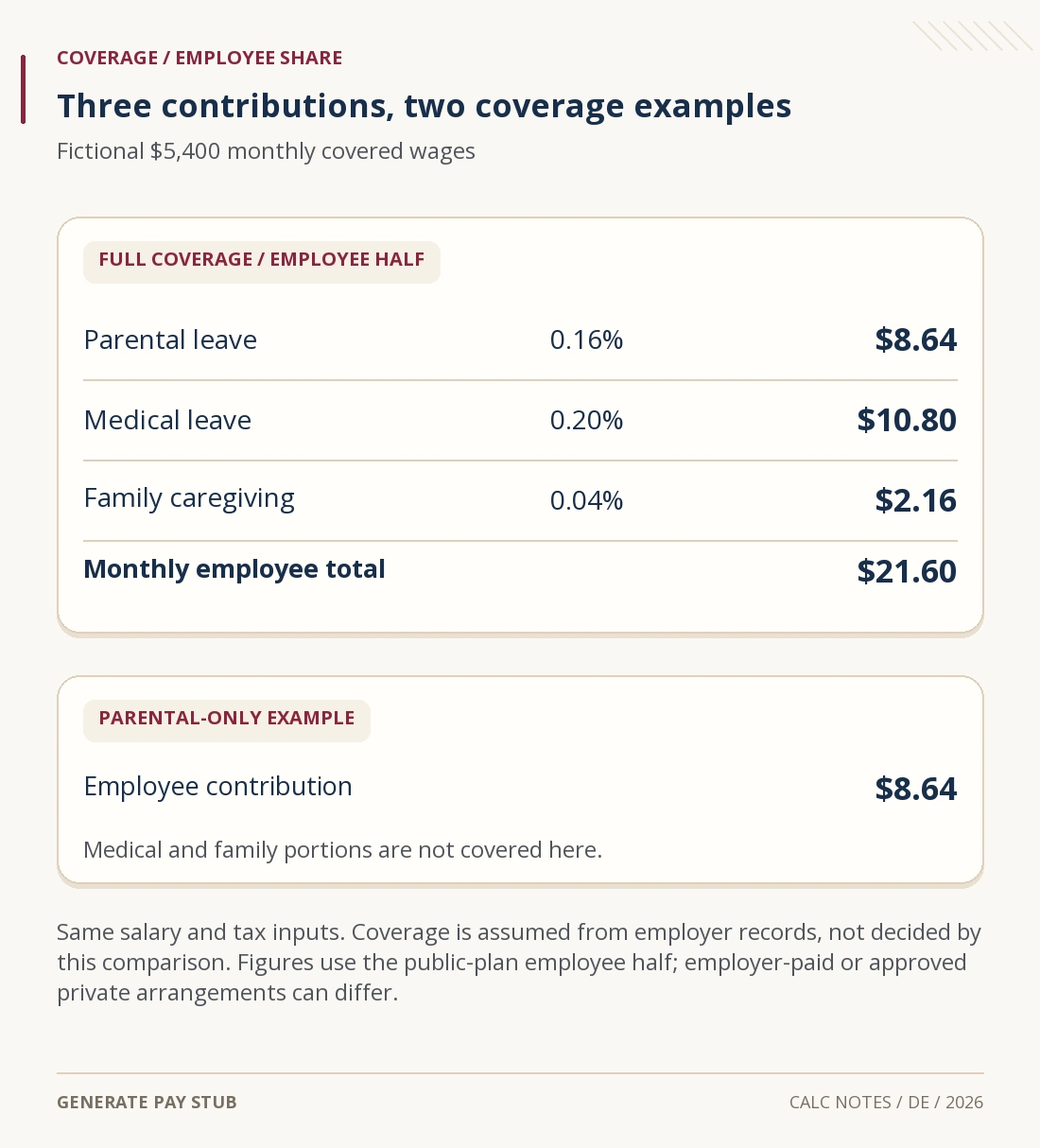
The agency employer and TPA guide explains that an employer may require employees to fund up to half. The reviewed calculator’s standard employee portions are therefore 0.16%, 0.20% and 0.04%, totaling 0.40% under full coverage. An employer can absorb the employee portion instead.
The program uses a wage limit linked to the Social Security base. Use the final 2026 SSA amount of $184,500, rather than an older projected figure in advance guidance. This example’s $64,800 covered wages stay below that limit.

Compare two controlled coverage assumptions
The calculator provides separate treatment controls for the leave components. It does not ask for employer headcount and decide mandatory coverage. Keep standard treatment only for the covered components that apply; do not select “not covered” merely to increase take-home pay.
For the second run, we changed medical and family caregiving to not covered while retaining standard parental treatment. That represents an assumed parental-only arrangement, not a determination that this fictional employer qualifies for it.
| Employee line | Full coverage | Parental only |
|---|---|---|
| Parental contribution | $8.64 | $8.64 |
| Medical contribution | $10.80 | $0.00 |
| Family caregiving contribution | $2.16 | $0.00 |
| Total Paid Leave contribution | $21.60 | $8.64 |
| Estimated monthly net | $4,254.32 | $4,267.28 |
| Estimated annual net | $51,051.84 | $51,207.36 |
All tax inputs remain unchanged. The contribution difference is $10.80 + $2.16 = $12.96 monthly, or $155.52 annually. Paid Leave benefits are not calculated by subtracting these contributions; a benefits claim has its own eligibility and payment rules.
Check every line in the full-coverage result
| Payroll component | Year-long amount |
|---|---|
| Gross earnings | $64,800.00 |
| Federal withholding | $5,595.96 |
| Delaware withholding | $2,935.80 |
| Employee Social Security | $4,017.60 |
| Employee Medicare | $939.60 |
| Employee Paid Leave total | $259.20 |
| Projected cash remaining | $51,051.84 |
The monthly check is $5,400 − $466.33 federal − $244.65 Delaware − $334.80 Social Security − $78.30 Medicare − $21.60 Paid Leave = $4,254.32. Annual totals add the rounded payment amounts used by the model.
If your paycheck differs, compare covered wages, certificate elections, leave treatment and omitted benefits before changing a rate. The pre-tax and post-tax deduction guide explains why subtracting cash is not always the same as reducing taxable pay.
Recognize local taxes and situations outside the model
The annual local-withholding field accepts an amount already known to you. It does not determine municipal liability or derive a local rate. Leaving it empty means this example supplies no local amount; it does not establish a local exemption.
Separate federal controls still govern federal withholding. Delaware’s certificate and Paid Leave selections do not automatically update federal W-4 elections. Use the federal input guide when reviewing that part of the result.
For nonresident wages, work in several states, special exemptions, private plans or actual year-to-date corrections, consult the relevant records and instructions. This full-year equal-payment scenario cannot resolve those facts. It also does not issue a pay statement, file a return or guarantee a refund.
Delaware paycheck calculator questions
Is 0.80% taken from every employee?
No. That is the combined full public-plan contribution rate. The example uses the permitted employee half, totaling 0.40%, and actual employer treatment can differ.
Does parental-only coverage remove Delaware income tax?
No. Both sample runs retain $244.65 monthly state withholding. Only the medical and family caregiving employee contributions change.
Can I enter annual extra withholding in the state extra field?
The reviewed field takes dollars per payment. Convert an annual goal to the appropriate payment amount before testing it.
Does one DE-W4 exemption mean $110 less per paycheck?
No. In the illustrated formula it is a $110 annual tax credit before division into twelve payments.
Delaware 2026 sources, visible controls and two calculator scenarios reviewed November 6, 2026. Figures are fictional and depend on the listed assumptions.