Use Form 1040-X to correct a previously filed individual income-tax return when an amendment is needed. Rebuild the corrected return first, compare it with the original or previously adjusted amounts, explain the changes and assemble the required attachments. The correction can produce additional tax, an additional refund or no tax change.
The useful question is not simply “What number was wrong?” It is “Which income, deduction, credit, tax and payment figures change when that item is corrected?” An omitted W-2, for example, can affect both wages and withholding.
Reviewed November 5, 2026. This guide uses the December 2025 continuous-use Form 1040-X and a fictional amendment to a 2025 U.S. Form 1040. The return year is distinct from the amendment form's revision date.
When do you need Form 1040-X instead of another original return?
An amendment corrects a return already filed. The IRS Form 1040-X overview identifies its use for corrections, certain elections and changes to amounts previously adjusted by the IRS.
IRS Topic 308 distinguishes changes requiring an amendment from errors the IRS may correct without one. Changes to income, deductions, credits, filing status or tax liability can require a different response from a simple arithmetic correction.
If you received an IRS notice, read its instructions before sending a separate package. Do not ignore a notice deadline because an amendment draft exists. Also check whether an original return was accepted, rejected or never filed; those are different starting points.
Use the Form 1040 roadmap for the individual-return structure. An amendment needs the appropriate return-year calculations, not figures borrowed from the current calendar year's rates.
Which records belong in an amendment packet?
Keep the baseline, new evidence and corrected work together. A helpful packet has a clear source for every difference:
- A copy of the filed return and its relevant schedules and worksheets.
- Any earlier amendment or IRS adjustment affecting the baseline.
- The omitted, corrected or newly relevant source document.
- A completed corrected main return for the year being changed.
- New or changed supporting forms and calculations.
- Original payments, overpayment and refund or credit-application records.
- A concise explanation of each change.
The current Form 1040-X original specifically calls for the completed changed main return, required supporting material and an explanation in Part II.
Label working copies clearly so the corrected draft is not mistaken for another newly filed original. Keep different tax years in separate packets. A federal change can also require a state-return review under that state's rules.
How do Columns A, B and C work?
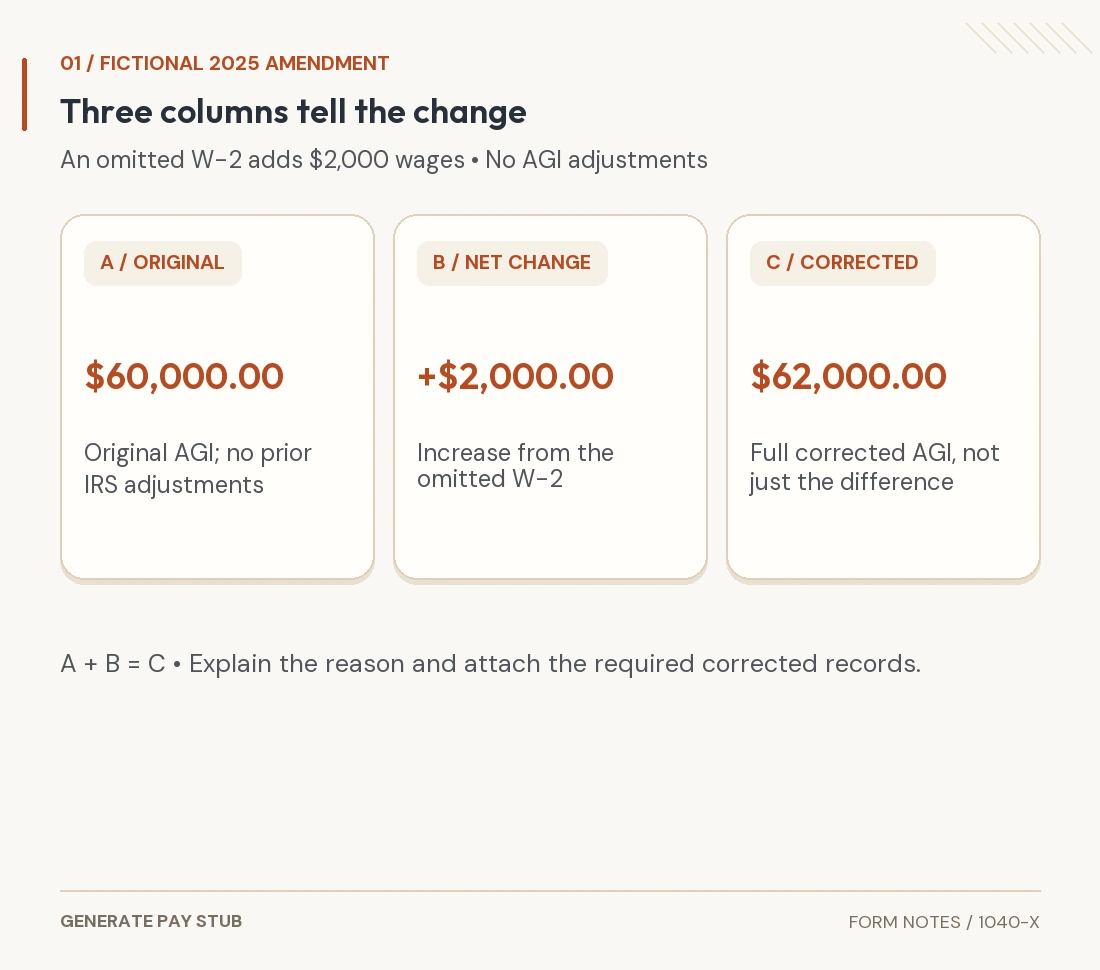
Column A is the baseline, Column B is the net change and Column C is the corrected total. When a return was previously changed, the baseline must reflect those earlier adjustments rather than reverting to the first filed figures.
The Form 1040-X instructions explain increases and decreases and the relationship between the columns. A positive increase is added to A; a decrease reduces it. An unchanged entry has the same correct total as the baseline.
For example, if an unadjusted original AGI was $60,000 and an omitted W-2 adds $2,000 wages with no other AGI changes, Column C becomes $62,000. The $2,000 difference belongs in B; it is not the full corrected income.

What does a checked omitted-W-2 amendment look like?
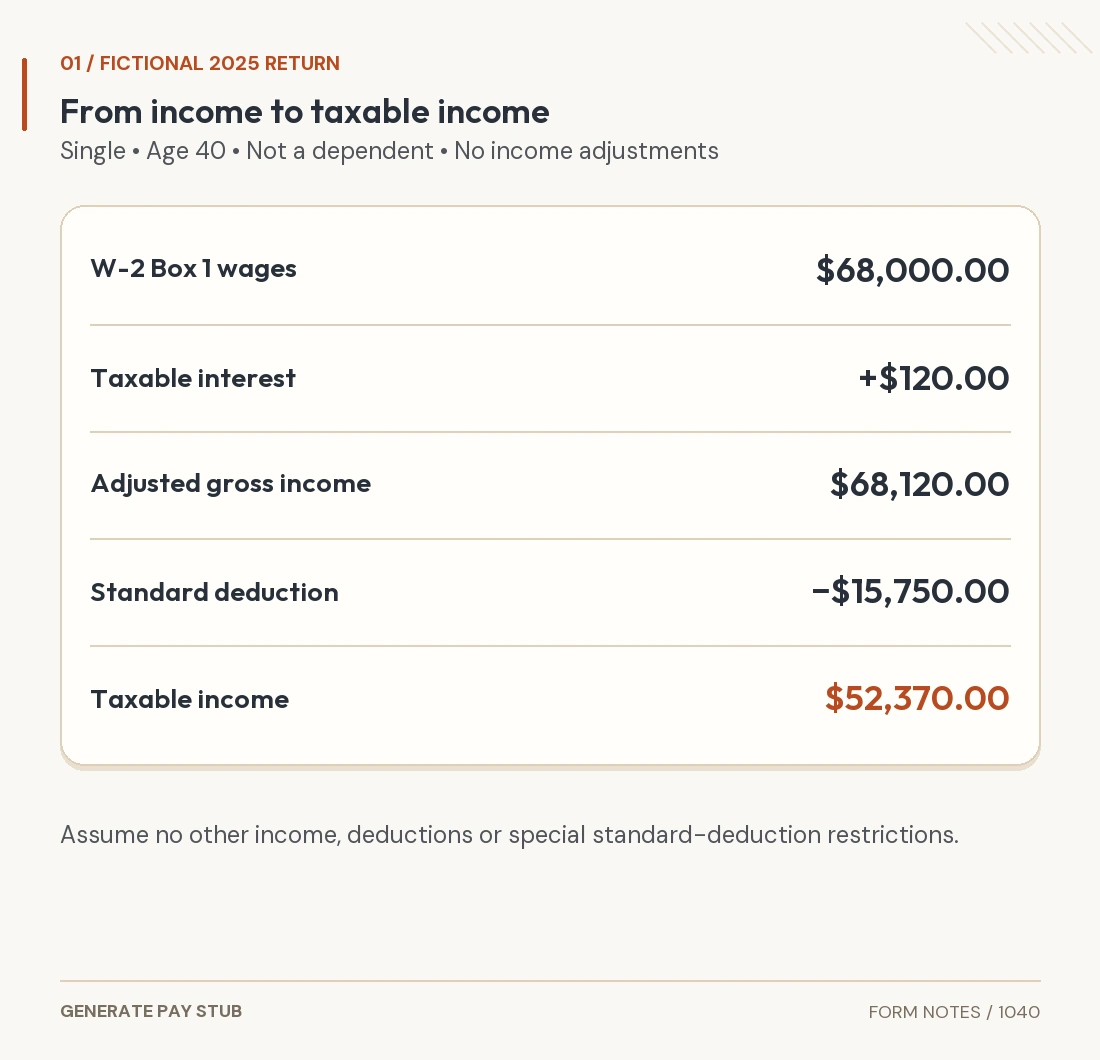
Recalculate both tax and payments before deciding the result. Assume a fictional 2025 taxpayer files Single, is age 40, is not blind or claimable as a dependent, and has no dependents.
The original return reported $60,000 W-2 wages and $5,800 federal income-tax withholding. A later W-2 adds $2,000 wages and $200 federal withholding. There is no other income, adjustment, credit, additional tax, itemization, QBI deduction or Schedule 1-A deduction. The ordinary 2025 standard deduction is $15,750.
The 2025 Form 1040 instructions supply the deduction and Tax Table used here. Taxable income was $60,000 − $15,750 = $44,250; it becomes $62,000 − $15,750 = $46,250.
In the Single column of the Tax Table on printed page 73, the $44,250–under-$44,300 row gives $5,075 tax. The $46,250–under-$46,300 row gives $5,315. These are actual table amounts, not a substitute calculation using exact taxable income and ordinary brackets.
| Item | A: baseline | B: net change | C: corrected |
|---|---|---|---|
| AGI, Line 1 | $60,000.00 | +$2,000.00 | $62,000.00 |
| Standard deduction, Line 2 | $15,750.00 | $0.00 | $15,750.00 |
| Taxable income, Line 5 | $44,250.00 | +$2,000.00 | $46,250.00 |
| Income tax, Line 6 | $5,075.00 | +$240.00 | $5,315.00 |
| Total tax, Line 11 | $5,075.00 | +$240.00 | $5,315.00 |
| Federal withholding, Line 12 | $5,800.00 | +$200.00 | $6,000.00 |
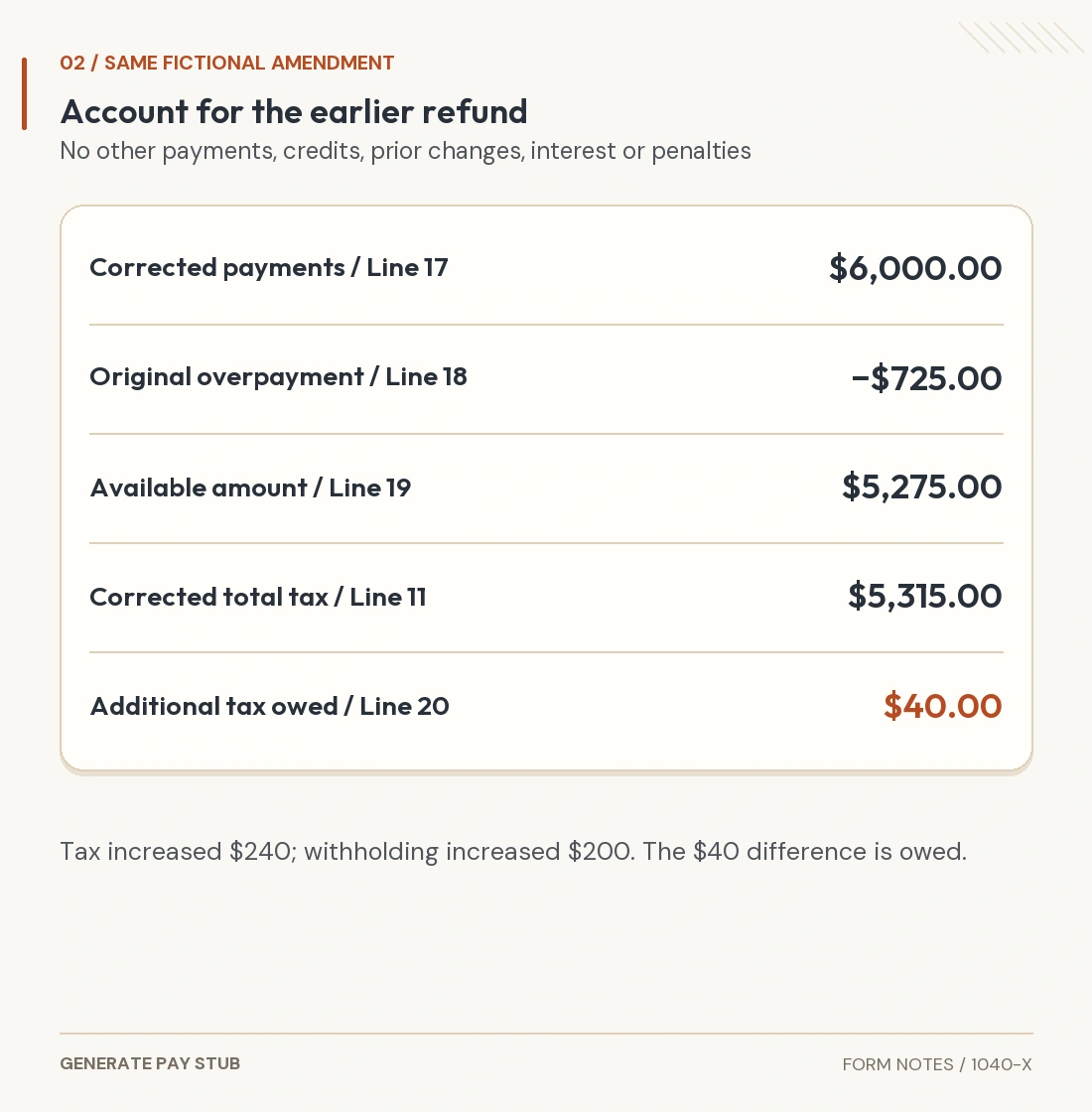
The original overpayment was $5,800 − $5,075 = $725. Assume it was all refunded, with no interest, offset, applied credit or later adjustment. The corrected return's $6,000 withholding minus $5,315 tax would show a $685 overpayment if considered in isolation—but the taxpayer already received $725.
Why does the original refund change the amendment balance?
The amendment must account for the original overpayment. Entering the corrected payments without that reconciliation can make an old refund appear available a second time.
For this example, Form 1040-X Line 17 total payments is $6,000. Line 18 original overpayment is $725, leaving $5,275 on Line 19. Corrected total tax is $5,315, so Line 20 shows $40 additional tax owed.

The original-overpayment entry follows the instructions even if that refund has not yet arrived. Do not replace it with zero merely because a bank deposit is pending. Interest received on a refund is also a separate matter.
If a prior overpayment was applied to next year's estimated tax, review the election rules rather than reversing it casually. If Line 19 is negative, follow the special amount-owed calculation. Those cases are outside this simple refunded-in-full illustration.
What should the Part II explanation say?
Explain the source, affected items and resulting changes in plain language. “Correcting an error” alone gives a reviewer little to connect with the numbers.
For the fictional case, an original explanation could read:
A 2025 Form W-2 was omitted from the filed return. The attached W-2 adds $2,000 of wages and $200 of federal income-tax withholding. AGI and taxable income each increase by $2,000. Using the 2025 Single Tax Table, income tax increases from $5,075 to $5,315. Filing status and the $15,750 standard deduction are unchanged. After accounting for the original $725 overpayment, the amendment shows $40 additional tax.
This explanation does not replace the required W-2, corrected main return or calculations. For multiple changes, identify each one and reconcile the combined effect. Use an additional statement if needed instead of compressing important facts into unreadably small text.
If dependent information changes, follow the complete amended dependent-list instructions rather than listing only the added person. Review eligibility and any identification or issuance-date rules before changing a credit.
Which deadline and filing-status rules require special care?
A refund claim has a time limit, and the filing date is not the only issue. The general rule is the later of three years after the original return was filed or two years after the tax was paid. Separate lookback limits can restrict the refundable amount, and exceptions can apply.
Do not calculate a personal deadline from the tax year alone. Early-filed returns, extensions, disaster relief, carrybacks and other special facts can change the analysis. Check the full instructions when a deadline or payment history is uncertain.
Filing status also has restrictions. Generally, switching from married filing jointly to married filing separately is not permitted once the original deadline has passed. Other changes still require their actual eligibility conditions; choosing a different box does not establish head-of-household status or a qualifying dependent.
Correcting a return is different from obtaining a new extension to file it. Nor does an amended-return draft pause the accrual of interest on unpaid tax.
How are preparation, filing, payment and refund tracking different?
Treat them as separate steps and keep evidence for each. The IRS amended-return FAQ describes electronic filing through participating tax software for supported tax periods and cases, as well as situations requiring paper.
A document-builder PDF is not an electronic transmission. For paper filing, follow the current address and attachment instructions and complete required signatures. A joint amendment normally needs both spouses' signatures. For electronic filing, follow the provider's authorization and submission process.
If tax is owed, arrange the appropriate payment separately. IRS Topic 308 says not to enter interest or penalties on Form 1040-X; those are adjusted separately. The $40 example therefore is additional tax only, not a promise of the complete amount ultimately payable.
Refund delivery differs too: qualifying electronically filed amendments can request direct deposit, while the paper original has no bank-account fields. Do not add invented banking fields to a paper form.
The FAQ links the IRS status tool and current processing information. Keep submission confirmation and a complete copy, then use the official status process. Preparing or mailing a document does not guarantee a specific refund date.
How do you review a Form 1040-X from the document tool?
Use completed corrected-return calculations as inputs. The Form 1040-X overview links to the 1040-X builder. It uses the December 2025 continuous-use original and currently offers 2025 and 2026 return-year selections.
Choose the year already filed, not the amendment's preparation year. A selectable year is not evidence that its original return has been filed. Reconcile baseline amounts, corrected totals, tax methods, payments and the prior overpayment before reviewing the two-page preview.
The builder calculates differences from your entries; it does not calculate every underlying tax from AGI or determine eligibility for changed credits. Keep the corrected main return, new or changed schedules and supporting statements ready. Complete any remaining required signatures before filing.
The W-2 box-review guide can help identify which wage statement figures changed. If the source W-2 itself is wrong, resolve the employer's correction process rather than silently changing its numbers in the amendment.
General U.S. tax information. The fictional example assumes the specified Single-filer facts and no prior adjustments, other taxes, credits, interest or penalties. Complex or time-sensitive amendments need the complete instructions and appropriate professional help.