A business generally files IRS/FinCEN Form 8300 when it receives more than $10,000 of qualifying cash in one transaction or related transactions. The ordinary deadline is 15 days after the receipt that triggers reporting. First classify the payment, connect related receipts and establish the correct date; then prepare the report.
This guide uses a fictional 2026 sale to explain cash aggregation, form entries, electronic filing, customer statements and records. The current IRS original is the December 2023 revision, used for transactions after 2023.
Does every payment over $10,000 require Form 8300?
No. The payment must meet the business, cash and transaction rules. The IRS current reporting overview describes the more-than-$10,000 test. Exactly $10,000 does not cross that ordinary threshold by itself.
A business receipt can qualify even before services are performed. A person's occasional sale of their own personal property outside a trade or business is different. Financial-institution, casino and other special reporting rules can also change the required form.
Transactions with the payer or their agent within 24 hours are related. They can also be related across a longer interval when the recipient knows or has reason to know they are connected. Splitting a single purchase into smaller receipts does not remove the reporting obligation.
What counts as cash for Form 8300?
Currency counts, but payment instruments need their own classification. Publication 1544's cash definitions distinguish these common cases:
| Payment | General treatment for this review |
|---|---|
| U.S. or foreign currency | Qualifying cash; translate foreign currency to U.S. dollars |
| Check drawn on the payer’s own account | Not cash for Form 8300 |
| Cashier’s check, bank draft, money order or traveler’s check of $10,000 or less | Can count in a designated reporting transaction or known reporting-avoidance situation; exceptions apply |
| Such an instrument with face value above $10,000 | Not cash under this monetary-instrument definition |
Designated transactions include specified retail consumer-durable, collectible, travel and entertainment sales. Exceptions for documented bank-loan proceeds and certain payment plans require their own conditions. A label such as “bank check” is not enough to classify the payment.
Do not infer that a payment excluded from this cash definition is excluded from business income or other recordkeeping rules. Form 8300 reporting and income-tax recognition answer different questions.
When does a series of smaller cash payments become reportable?
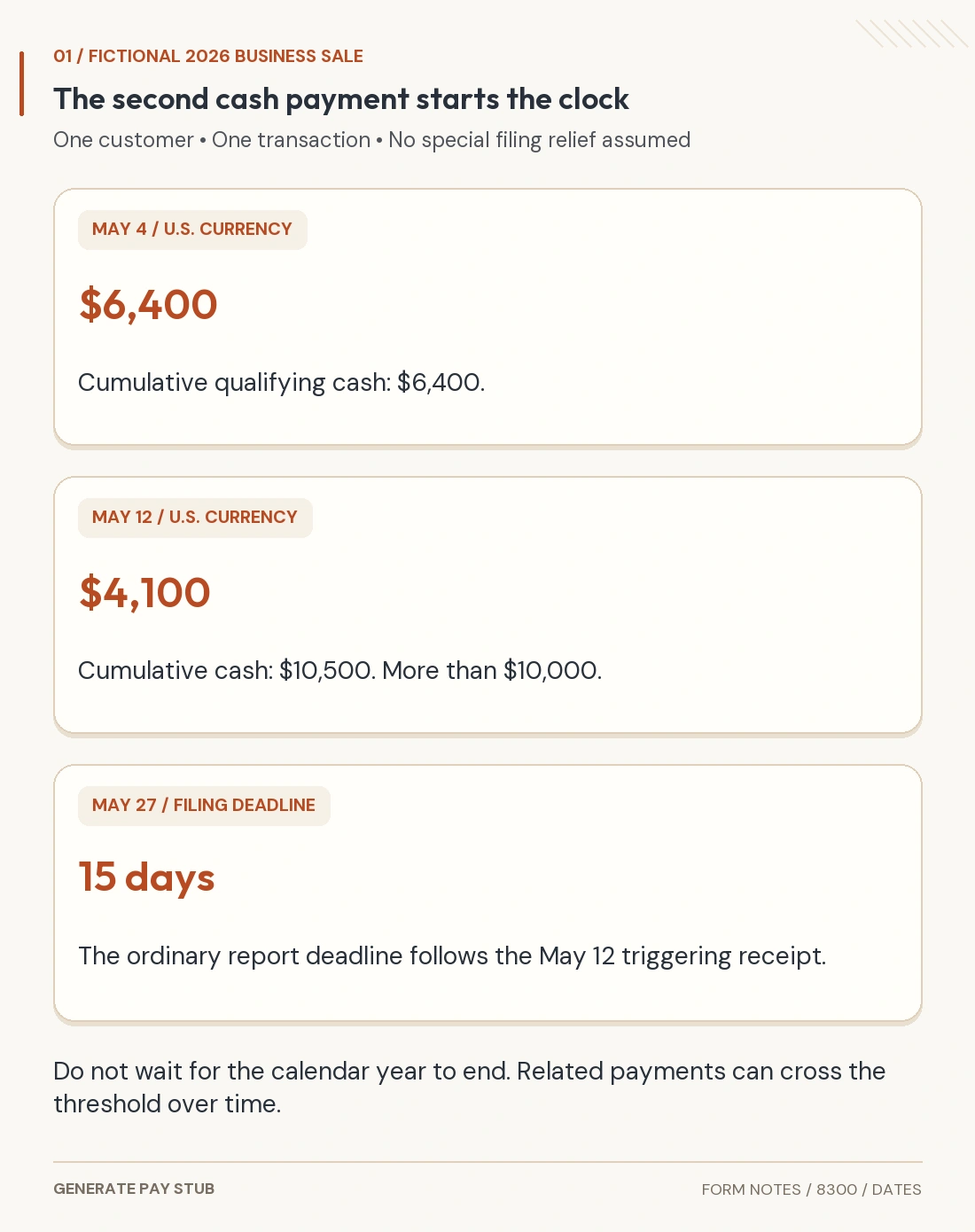
Track the connected receipts cumulatively. Assume fictional business Meadow Workshop sells one item to one customer for a total agreed price of $13,000. All parties and the transaction are in the United States, the sale is in its ordinary business, and no special exception or relief applies.
| Date | Payment method | Receipt | Qualifying cash to date |
|---|---|---|---|
| May 4, 2026 | U.S. currency | $6,400.00 | $6,400.00 |
| May 12, 2026 | U.S. currency | $4,100.00 | $10,500.00 |
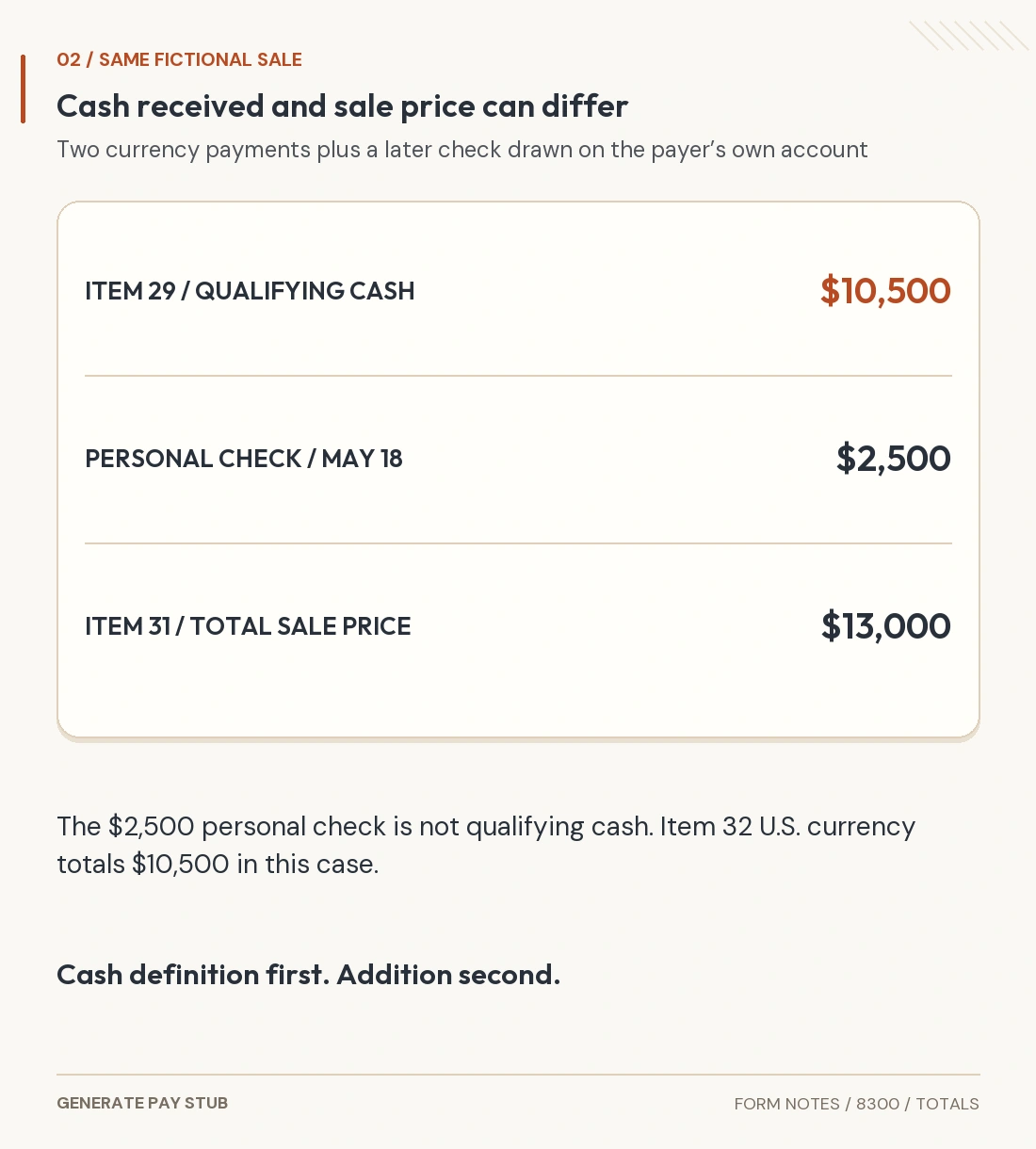
| May 18, 2026 | Payer’s personal check | $2,500.00 | $10,500.00 |
The May 12 payment causes qualifying cash to exceed $10,000: $6,400 + $4,100 = $10,500. The later personal check brings total payment to $13,000 but does not increase qualifying cash.
May 12 plus 15 days is May 27, 2026, a Wednesday. Under the assumed ordinary rules, that is the report deadline. It is a historical worked example, not a new deadline for today's transactions.

The IRS reference guide explains aggregation over a 12-month period. After a report, additional cash can trigger another report when the applicable new accumulation exceeds $10,000. Combining additional payments received before a report is due must not postpone the earliest applicable deadline.
How do those receipts map to the actual form?
Keep cash, total price and payer identities distinct. On the original two-page Form 8300, Part I identifies the individual delivering cash; Part II addresses the person on whose behalf the transaction occurred. They may be different.
For our single-customer example, Item 28 uses the May 12 triggering receipt date. Item 29 reports $10,500 cash, Item 30 indicates multiple payments, and Item 31 reports the different $13,000 total price. Item 32's U.S. currency component is $10,500; do not insert the $2,500 personal check into a cash-instrument category.

Record the specific goods or services, cash breakdown, applicable instrument issuers and serial numbers, business details and authorized official. Identify additional people using the required continuation information rather than squeezing several names into one person's field.
Use accepted identification to verify the actual cash payer. A missing identifier calls for the applicable solicitation, exception and explanation procedure; it is not a reason to invent a number or wait indefinitely to file.
Do you file Form 8300 through IRIS?
Form 8300 uses FinCEN's BSA E-Filing route, not the ordinary 1099 IRIS workflow. The current form instructions direct electronic filing and explain when it is mandatory.
The ten-return test counts the applicable other information returns required for the calendar year; Forms 8300 themselves are excluded from that count. For example, five W-2s plus five covered 1099s reach ten. The requirement does not depend on having ten cash reports.
Permitted paper filing, granted hardship waivers and religious exemptions have specific rules. Weekend or legal-holiday deadlines ordinarily move to the next business day. File late reports using the required method and late notation; lateness is not cured by downloading a PDF.
Retain each filed report for five years. Save the completed report as well as the electronic confirmation: an acknowledgment alone does not preserve the report's contents. Associate those records with receipts and the transaction explanation.
Is filing the report the final step?
A required report generally also creates an annual named-person statement duty. The IRS overview specifies the following January 31, subject to applicable weekend and holiday rules. The statement identifies the business and contact, aggregate reportable cash and the fact that information was furnished to the IRS.
Use the applicable annual reportable amount rather than assuming the $13,000 sale price in our example is the statement amount. Protect sensitive identifiers. Voluntary suspicious-transaction reports have separate confidentiality and statement rules; do not disclose that a report was marked suspicious. For required reports, the statement must not reveal that designation.
How does the cash-report builder fit into preparation?
Bring the reviewed ledger and authorized identity records into the workspace. See the Form 8300 overview and cash-transaction report tool.
The reviewed builder organizes the triggering date, cash recipient, people delivering funds, on-behalf-of parties, cash categories and comments. It uses the two-page December 2023 original for supported 2025 and 2026 transaction records. Review both pages and any required additional-person attachments.
The PDF purchase does not file with IRS or FinCEN, prepare annual statements or authenticate the underlying identification. Select the required filing route independently and keep evidence of submission. For ordinary business receipt organization, an invoice and payment ledger can help, but does not replace the cash report.
General U.S. federal reporting information reviewed November 6, 2026. The cash-sale example is fictional and assumes ordinary domestic business reporting, no special filing relief and no additional receipts.