The Hawaii paycheck calculator estimates federal taxes, FICA and HW-4 state withholding, but its reviewed annual result excludes Temporary Disability Insurance and prepaid health-care premiums. Treat the displayed net as incomplete for those deductions until you check the employer’s actual coverage and premium records.
Our fictional 2026 salary example uses $81,600 and two HW-4 allowances. It produces $382.34 monthly Hawaii withholding and $5,137.29 cash remaining before the excluded premiums and any unentered deductions. This guide explains both the arithmetic and the missing information.
Match HW-4 rather than copying federal W-4 dollars
The official HW-4 instructions use withholding allowances and a state status election. Head of Household uses the Single withholding treatment, with the form addressing an additional allowance. Employees with multiple jobs or working spouses must coordinate their total allowances rather than repeat the full count at every job.
The Hawaii paycheck calculator offers the Single/Head of Household/higher Single-rate group and Married, a regular allowance count and an additional per-payment amount. Select the group and count supported by the actual certificate.
Two allowances in this example are assumed from a valid HW-4. They are not a universal answer for a Single worker. Federal credits and adjustments belong in the separate federal controls.
Enter $81,600 annual salary for twelve payments
Choose 2026 and Monthly; annual gross of $81,600 becomes $6,800 per modeled payment. For federal purposes use Single, leave the multiple-jobs control off and enter no W-4 dollar adjustment.
Choose the Hawaii Single group, two regular allowances and zero extra withholding. The first test supplies neither a local-tax cash amount nor a miscellaneous deduction.
The scenario assumes ordinary wages, one employer for the full year, residence and services in Hawaii, and identical gross, federal, FICA and state wage bases. Benefit-related exclusions and special compensation are outside these assumptions.
Before using the number for a budget, identify which deductions the model calculates, which cash amounts you supplied and which programs remain excluded. Those three categories should not be combined into an unexplained “taxes” total.
Follow the HW-4 annualized wage-base calculation
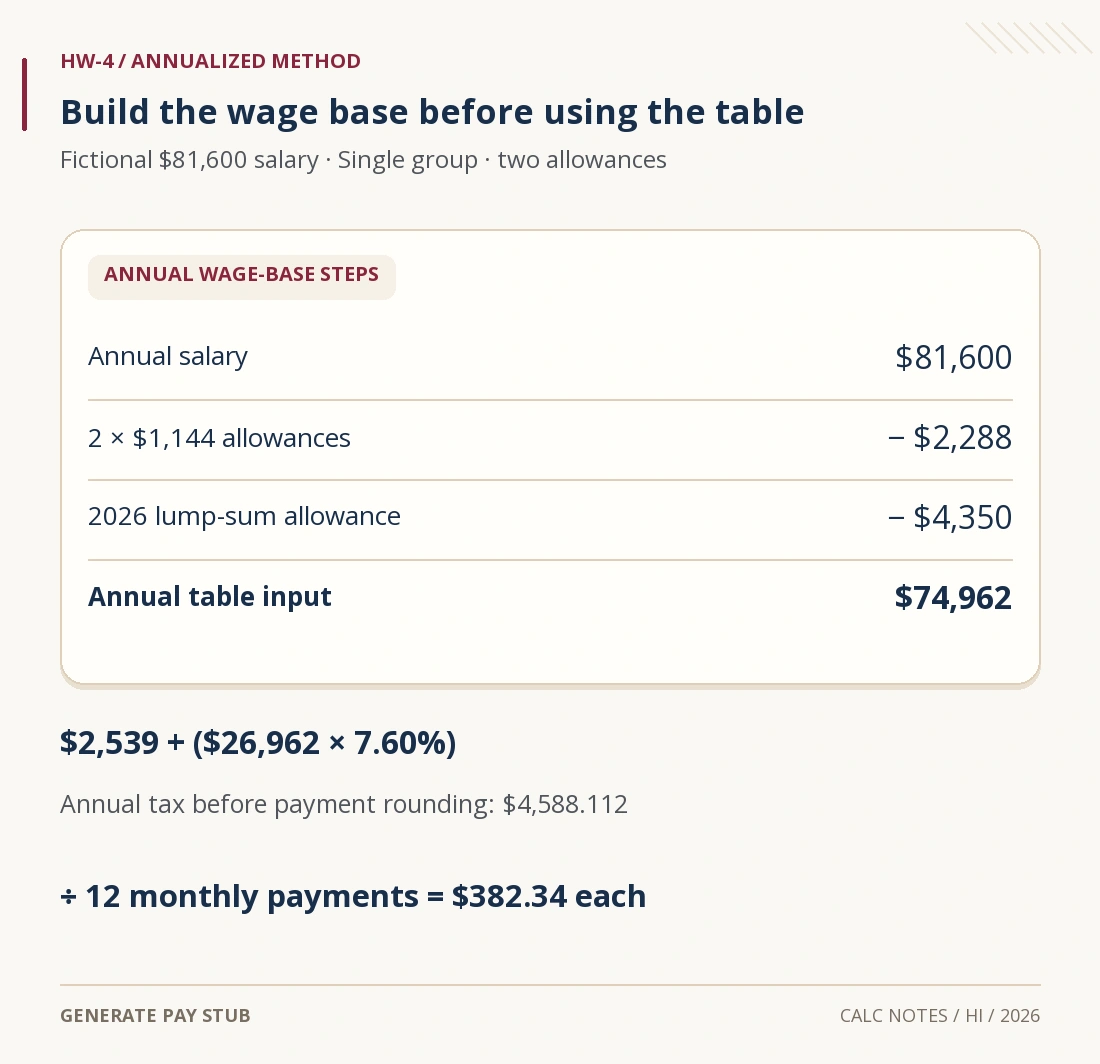
Booklet A’s appendix for withholding beginning January 1, 2026 supplies the annualized employer method. Its filename and cover revision say 2025, but the appendix expressly identifies the 2026 effective period. The method uses $1,144 per regular allowance plus a $4,350 extra lump-sum withholding allowance.
For our invented salary, $81,600 − (2 × $1,144) − $4,350 = $74,962 annual table input. The Single band at this amount is $2,539 plus 7.60% of the excess over $48,000.
That gives $2,539 + ($26,962 × 7.60%) = $4,588.112 annual tax before period rounding. Divide by twelve to obtain $382.342666… and round to $382.34 per month.

The phrase “lump-sum allowance” here names a subtraction in the ordinary withholding formula. It does not mean this employee received a separate lump-sum payment. Keep it distinct from the elected additional withholding dollars, which increase the amount taken from each check.
Twelve rounded deductions total $4,588.08. The small difference from the unrounded annual formula comes from rounding each payment, not from another allowance.
Reconcile the tax-only annual projection
| Calculated item | Annual projection |
|---|---|
| Salary used in this example | $81,600.00 |
| Federal income tax withholding | $9,122.04 |
| Hawaii income tax withholding | $4,588.08 |
| Employee Social Security | $5,059.20 |
| Employee Medicare | $1,183.20 |
| Cash after calculated taxes | $61,647.48 |
At payment level: $6,800 − $760.17 federal − $382.34 Hawaii − $421.60 Social Security − $98.60 Medicare = $5,137.29. No TDI or health premium has been subtracted from that figure.
Review TDI and prepaid health care outside this annual estimate
The state’s 2026 contribution notice limits an eligible employee’s TDI share to half the premium, no more than 0.5% of weekly wages and no more than $7.50 for a week. The employer may bear the cost instead. An annual salary average cannot establish the actual weekly premium deduction.
The June 2026 prepaid health-care guidance requires the employer to pay at least half the premium; the employee’s ordinary share is also capped at 1.5% of monthly wages. Added dependent coverage can be treated differently.
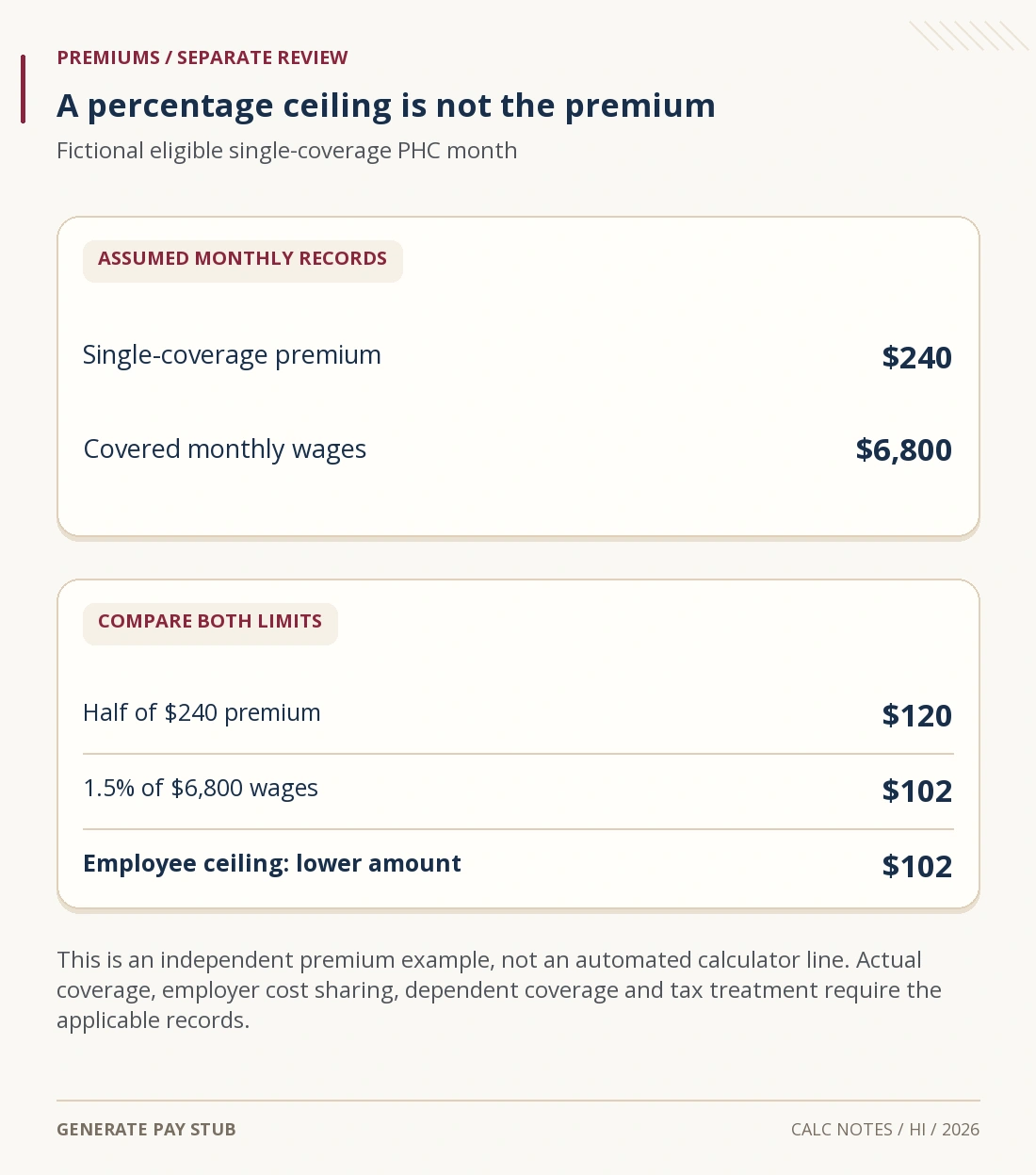
Consider a separate fictional eligible single-coverage month: premium $240 and covered wages $6,800. Half the premium is $120; 1.5% of wages is $102. The lower limit is $102, leaving at least $138 of this premium to the employer. Actual employee cost can be lower if the employer pays more.

The reviewed calculator output expressly lists TDI and prepaid health care as excluded. It does not collect the necessary week-by-week or month-by-month premium allocations. Do not interpret the exclusion as proof that the employee owes nothing, or that the employer lacks a coverage obligation.
Also verify tax treatment. A benefit withheld through a qualifying pre-tax arrangement may change one or more taxable wage bases; subtracting its cash cost alone does not reproduce that effect.
Use an already-known cash deduction carefully
A second controlled tool run supplied $1,200 in the annual “other deductions” cash field, representing an unrelated, already-known post-tax deduction of $100 per month. All tax lines stayed the same; projected annual cash became $60,447.48, or $5,037.29 monthly.
This demonstrates how the cash input works. The tool did not calculate that $1,200, validate any premium, or turn it into a tax exclusion. Do not enter a guessed TDI or PHC amount and describe the result as an automated benefits calculation.
For checking how a real benefit changes a statement, see the deduction tax-treatment guide. The known annual local field works similarly: it accepts your amount rather than identifying a locality and calculating its tax.
Check the withholding method and the actual payroll history
Booklet A permits more than one employer-withholding approach. A wage-table amount may differ from this annualized formula, so confirm the method before treating a difference as an error.
The model repeats one year’s selected setup. It does not reconstruct a midyear hire, several jobs, fluctuating benefits, changed HW-4 elections or nonresident apportionment. Special certificates and disability-related tax treatment require their applicable instructions.
The calculator overview explains the broader input workflow. These tools provide estimates, not signed certificates, filed returns or evidence that wages were actually paid.
Hawaii paycheck calculator questions
Does the displayed net include all Hawaii benefits?
No. The reviewed annual output excludes TDI and prepaid health-care premiums.
Is the $4,350 allowance subtracted every month?
No. It is an annual subtraction before the table result is divided into payments.
Can I treat the 1.5% health-care limit as an automatic premium?
No. Compare the permitted wage-based limit with the applicable premium share and actual employer arrangement.
Will changing HW-4 also change federal W-4?
No. The tool maintains separate state and federal inputs, as do the underlying certificates.
Hawaii 2026 withholding and premium sources, current controls and both live runs reviewed November 6, 2026. Every worked employee example is fictional.