The Indiana paycheck calculator computes the state withholding line from WH-4 exemption categories; it does not automatically compute county income tax. A take-home estimate with no local amount entered can therefore omit an important Indiana deduction.
This guide checks a fictional $75,600 salary paid semimonthly. Two line 5 exemptions and one line 6 additional dependent exemption produce $88.62 state withholding per payment. We then add a separately known county cash amount to show what changes—and what does not.
Understand the county-tax boundary before using net pay
The Indiana paycheck calculator has state exemption controls and a general annual local-withholding cash field. It does not ask for a county name, select a county rate or compute county liability.
The DOR’s current rate guidance confirms the 2.95% state rate for 2026 and warns that county rates can change in January or October. A current state rate does not establish the correct county rate.
The October 1, 2026 Departmental Notice #1 generally uses January 1 residence for an Indiana resident’s county assignment; for an out-of-state resident with an Indiana principal workplace on that date, the employment county is relevant. Rate effective dates and special cases still need review.
A move during the year should not be treated as an automatic reason to substitute the new home county in every calculation. Confirm county status, the rate applicable to the pay date and any exception with payroll records and the current notice.
Map the four WH-4 categories without double-counting
The official WH-4 certificate and instructions distinguish line 5’s total from the additional claims on lines 6–8. Line 5 adds the earlier entries, including qualifying dependent and age/blindness exemptions; the calculator label “personal exemptions” does not mean only the employee’s own one.
Line 6 is an additional exemption for qualifying dependent children, not every possible dependent. Line 7 concerns first-time qualifying claims; prior eligibility can disqualify a claim even if nobody actually claimed it. Line 8 is the additional adopted-child category. Follow each condition instead of placing every child in all fields.
The current notice assigns annual values of $1,000 to each line 5 claim, $1,500 to each line 6 claim, $1,500 to each qualifying line 7 claim and $3,000 to each line 8 claim. These reduce the withholding wage base; they are not dollar-for-dollar credits against the calculated tax.
The tool uses counts from a supported certificate. It does not determine dependency, adoption or first-time eligibility, and a test run does not submit a WH-4 to the employer.
Build a $3,150 semimonthly salary test
Select 2026, enter $75,600 annual gross and use Semimonthly. That models 24 payments of $3,150, rather than 26 biweekly payments.
Assume a valid WH-4 with line 5 total two, line 6 count one, and zero on lines 7 and 8. The fictional employee and one qualifying child explain the line 5 total; the child also supports line 6 but was already eligible in an earlier year and is not adopted.
Federal status is Single with the multiple-jobs setting off and all federal dollar adjustments zero. The federal credit input is deliberately held at zero for this test; the state child-related counts do not automatically populate federal W-4 credits.
Assume full-year ordinary wages with one employer, Indiana residence and work, and no differences between gross and the relevant tax wage bases. The first run leaves local and other annual cash inputs empty. This isolates the calculated taxes rather than claiming the worker has no county obligation.
Calculate the $88.62 state deduction using period constants
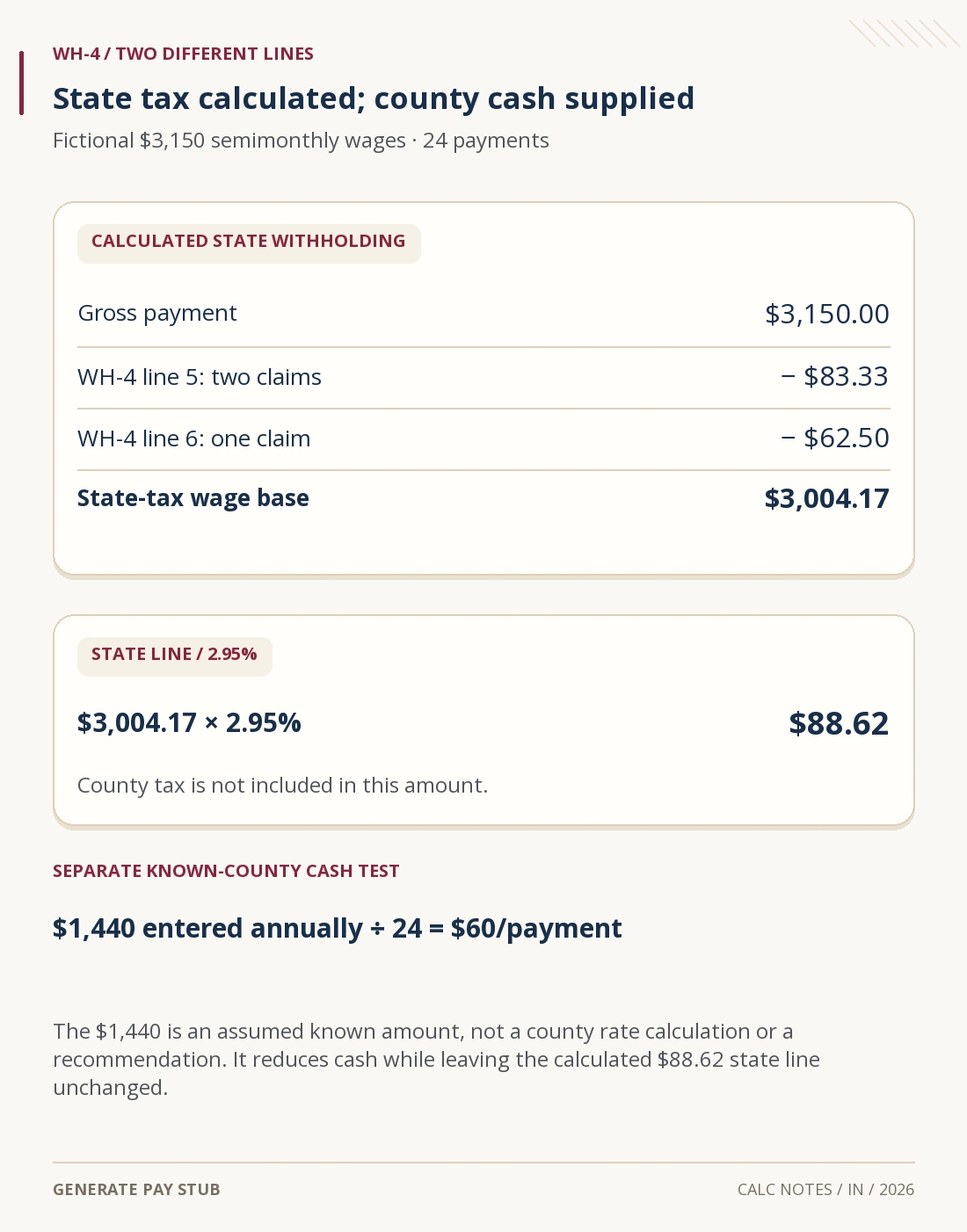
For 24 payments, the line 5 category gives (2 × $1,000) ÷ 24, rounded to $83.33 per payment. The line 6 category gives $1,500 ÷ 24 = $62.50. The remaining two categories contribute zero in this case.
Subtract the category amounts: $3,150 − $83.33 − $62.50 = $3,004.17. Applying 2.95% gives $88.623015, rounded to $88.62 state withholding.

Round each exemption category’s period deduction before combining them. Multiplying a rounded one-claim constant by the number of claims can produce a different cent result than rounding the category total, especially at other counts or frequencies.
Compare a known county cash amount without inventing a rate
The second run enters $1,440 annually in the local field. This is an assumed already-known payroll amount for illustration. It is not calculated from a named county, and it should not be read as a recommended amount for this salary.
| Result line | No local amount entered | Known $1,440 annual local |
|---|---|---|
| Calculated state tax per payment | $88.62 | $88.62 |
| Entered local cash per payment | $0.00 | $60.00 |
| Estimated cash per payment | $2,495.32 | $2,435.32 |
| Estimated annual cash | $59,887.68 | $58,447.68 |
The $60 difference is exactly $1,440 ÷ 24. It changes cash remaining but leaves the state, federal and FICA calculations unchanged. A blank local field means no amount was supplied; it does not mean the calculator found no county tax.
Reconcile the projection including the known local amount
| Included amount | Yearly result |
|---|---|
| Annual earnings | $75,600.00 |
| Federal withholding | $7,801.92 |
| Calculated Indiana state withholding | $2,126.88 |
| Social Security employee share | $4,687.20 |
| Medicare employee share | $1,096.32 |
| Separately entered local cash | $1,440.00 |
| Cash after these amounts | $58,447.68 |
Per payment, $3,150 − $325.08 federal − $88.62 state − $195.30 Social Security − $45.68 Medicare − $60 local = $2,435.32. The annual totals add the payment-level rounded deductions.
No benefit premium or other unentered deduction is included. See the gross-to-net reconciliation guide before treating this estimate as a complete cash budget.
Identify facts outside the ordinary state calculation
This state method covers regular supported payment schedules. The notice treats nonperiodic payments differently, so the illustrated exemption approach should not be carried into a standalone bonus calculation.
The reviewed state controls do not include WH-4 extra state or extra county withholding fields. A generic local or other cash input cannot be described as a full implementation of those certificate lines.
Nonresident waivers, reciprocity, military situations, changing work locations and actual year-to-date adjustments require separate guidance. Likewise, an insurance or retirement cash subtraction does not necessarily reproduce a pre-tax wage adjustment.
Federal elections remain separate; the federal withholding walkthrough explains its dollar fields. This estimate does not establish final return liability, file a certificate or generate proof of wages.
Indiana paycheck calculator questions
Is the state result the full Indiana income-tax deduction?
No. The $88.62 sample state line does not include county tax.
Should every dependent be entered in all four fields?
No. Transfer the appropriate WH-4 line totals, applying each category’s conditions.
Does a new address automatically change this year’s county?
Do not assume so. Check the January 1 county-status rules, exceptions and pay-date rate guidance.
Does the local field calculate tax from my county?
No. It distributes an annual cash amount you already know across the modeled payments.
Indiana 2026 state method, current October notice, certificate categories and two live estimates reviewed November 6, 2026. All employee facts and county cash amounts are fictional.