Use a Medicare tax calculator to check two employee amounts: regular Medicare at 1.45% of covered wages, and an additional 0.9% on wages the employer pays above $200,000 during the calendar year. When a payment crosses that trigger, regular Medicare still applies to the full covered payment; only its above-trigger portion gets the extra withholding.
The free Generate Pay Stub tool can test one payment or an annual wage amount. This 2026 walkthrough checks a threshold-crossing payment and explains why the payroll result can differ from the Additional Medicare Tax ultimately calculated on a joint return.
Enter current and earlier Medicare wages in the right places
Open the free Medicare tax calculator and choose the tax year. Both 2025 and 2026 are currently supported. Select one-paycheck mode for an individual payment and enter that payment’s Medicare-covered wages.
The earlier YTD field concerns Medicare wages already paid to this employee by the same employer in the chosen year. Leave out the current payment, a spouse’s wages and compensation from unrelated employers. A payroll merger or successor-employer situation can require a different review; the tool does not decide the legal employer relationship.
Use the Medicare wage base, which may differ from gross wages or Social Security wages. Do not copy a capped Social Security YTD amount into the Medicare field. IRS Topic 751 confirms that Medicare has no annual wage ceiling, unlike Social Security. Our taxable-wage guide explains how separate wage bases can appear on the same statement.
Check an $8,400 payment after $196,800 of earlier wages
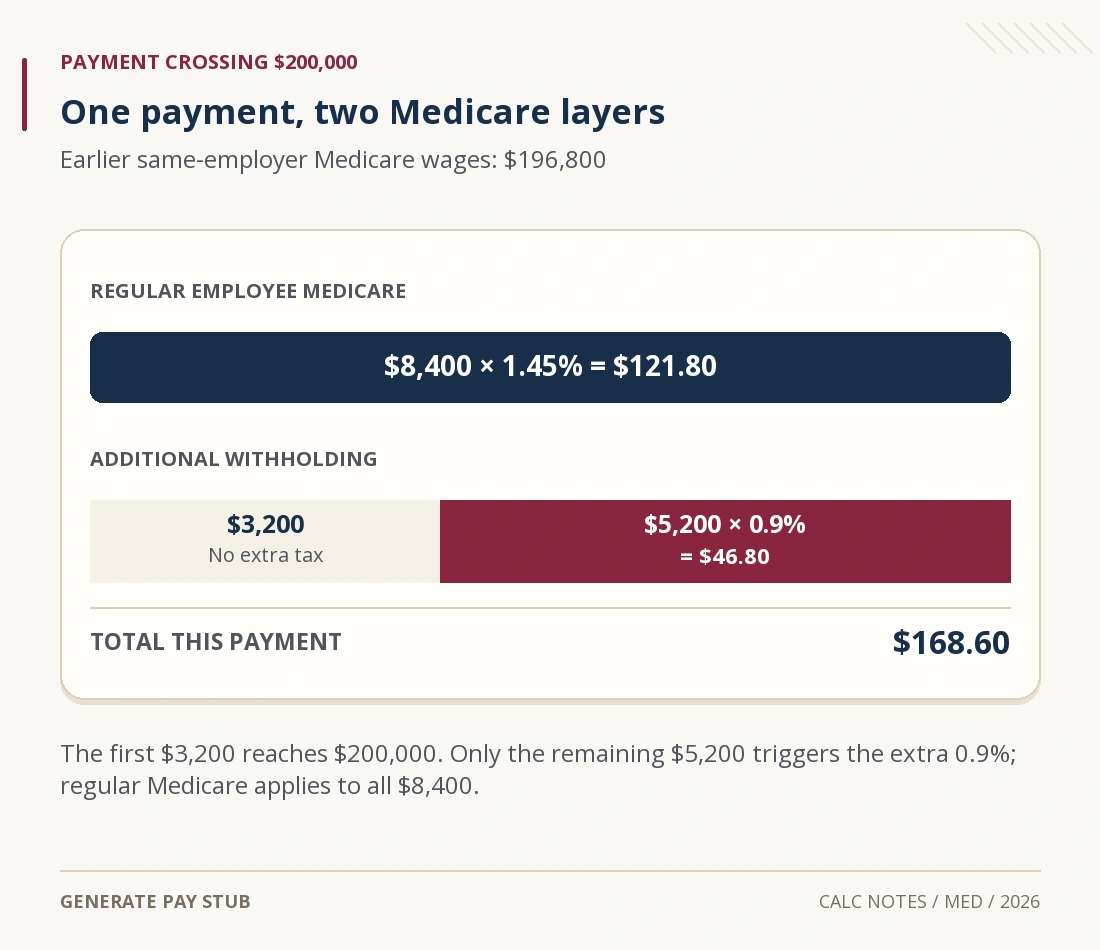
Assume an ordinary employee with $196,800 of earlier Medicare wages from one employer during 2026. The next covered payment is $8,400. Enter $8,400 as current wages and $196,800 as prior YTD Medicare wages.
The first $3,200 of the payment brings that employer’s annual total to $200,000. The remaining $5,200 takes it to $205,200. Under the employer rule in 2026 IRS Publication 15, the extra withholding starts in this crossing payment and applies to that $5,200 excess.
| Component | Wages used | Rate | Employee amount |
|---|---|---|---|
| Regular Medicare | $8,400.00 | 1.45% | $121.80 |
| Additional Medicare withholding | $5,200.00 | 0.90% | $46.80 |
| Combined Medicare deduction | — | — | $168.60 |

The independent arithmetic is $8,400 × 0.0145 = $121.80 and $5,200 × 0.009 = $46.80. Their sum is $168.60, matching the checked live result. Applying 2.35% to the whole crossing payment would give $197.40 and overstate this payment’s deduction by $28.80.
The employer’s $200,000 trigger applies regardless of the employee’s filing status. A joint filer should not enter $250,000 as a payroll trigger, and a separate filer should not enter $125,000. Those amounts belong to a different calculation discussed below.
Test the following payment or a different employer
For another $8,400 payment after the employer’s Medicare wages have reached $205,200, enter that updated prior amount. The entire new payment is beyond the employer trigger: $121.80 regular Medicare plus $75.60 additional withholding equals $197.40. The live tool was checked for both components.
For an unrelated new employer’s first $8,400 payment, use zero prior wages with that employer. The checked result is $121.80 regular Medicare and zero additional withholding. Carrying $205,200 from the old employer into the new employer’s field would incorrectly trigger the extra amount immediately.
Publication 15 explains that qualifying successor arrangements can count predecessor wages. If your employer changed because of an acquisition or payroll reorganization, confirm the applicable treatment instead of assuming either a universal reset or a universal carryover.
What does the annual calculator result mean?
In annual mode, enter the full-year Medicare-covered wage amount for the employer being modeled. A 2026 input of $240,000 produces:
- Regular employee Medicare: $240,000 × 1.45% = $3,480.
- Additional employer withholding: ($240,000 − $200,000) × 0.9% = $360.
- Combined annual employee reference amount: $3,840.
This is an annual reference under the tool’s employer-based assumptions. It does not recreate the exact timing and rounding of every actual check. A $320 monthly average of $3,840 is not a prediction that each month will contain $320 of Medicare withholding.
The result excludes federal income tax, state withholding, Social Security, benefits and other deductions. To explore combined take-home pay, choose the relevant state from the paycheck calculator directory.
Why can payroll withholding differ from Additional Medicare Tax on a return?
The employer examines its payments to one employee. The return calculation uses the applicable filing threshold and broader wage or income facts. The IRS Additional Medicare Tax guidance lists $250,000 for married filing jointly, $125,000 for married filing separately and $200,000 for the other listed statuses.
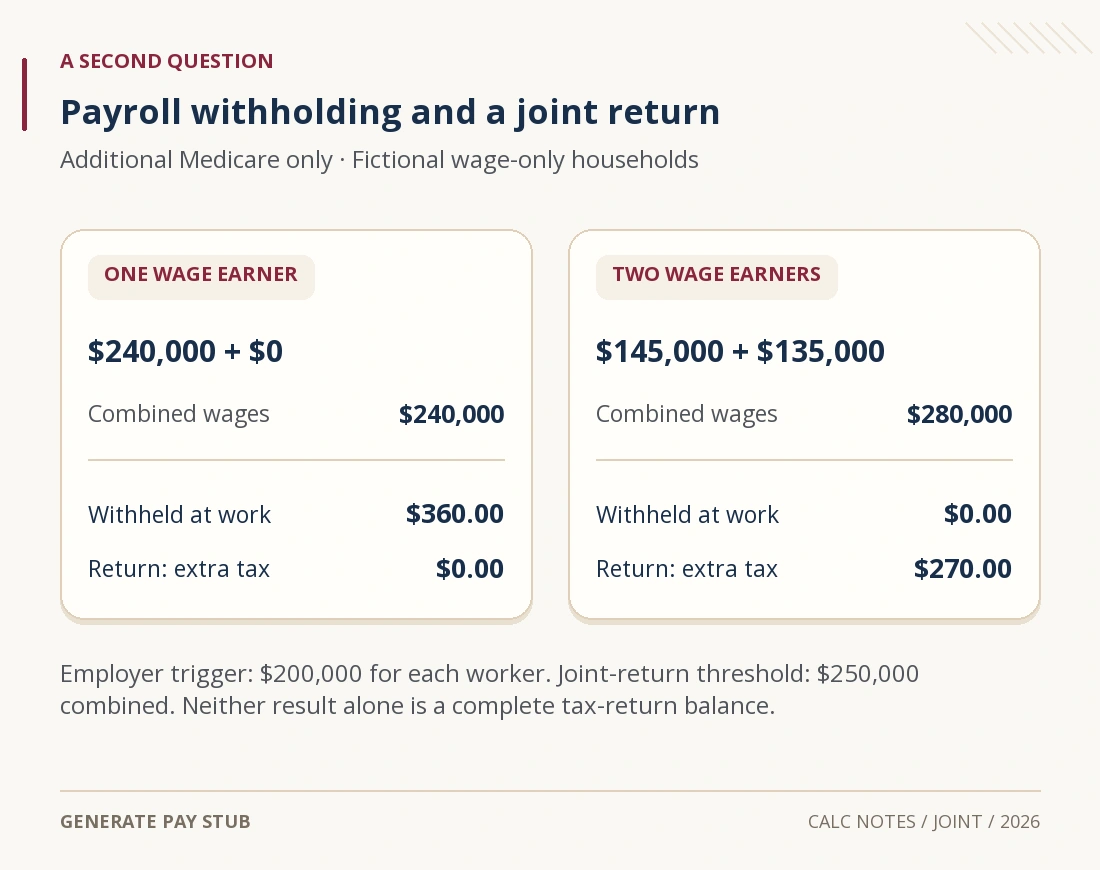
Consider two fictional 2026 joint-filing households with only ordinary Medicare wages, no self-employment income and no RRTA compensation:
- One earner with $240,000: the employer withholds $360 of Additional Medicare Tax, as in the annual tool example. Joint wages are below $250,000, so the wage-only Additional Medicare liability is $0. The withheld amount is credited through the return; this does not establish the household’s overall refund.
- Two earners with $145,000 and $135,000: neither employer reaches $200,000, so neither withholds the additional 0.9% under these facts. Combined wages are $280,000, creating ($280,000 − $250,000) × 0.9% = $270 of wage-only Additional Medicare liability.

The focused calculator does not collect a spouse’s income or calculate these joint-return outcomes. Form 8959 is the official reconciliation form. The IRS Form 8959 page links the current revision; when reviewed for this guide, the published instructions were labeled 2025 and also included a 2026 withholding-planning section. Consult the applicable filing-year edition when preparing a return.
Do not ask an employer to stop required additional withholding merely because you expect a joint-return threshold to eliminate liability. Conversely, someone anticipating a shortfall may need additional income tax withholding through Form W-4 or estimated payments. The IRS guidance explains that an employee cannot request voluntary extra withholding specifically designated as Additional Medicare Tax.
Use payroll records to investigate a difference
Compare current Medicare wages, earlier same-employer Medicare wages and both tax components. If the YTD wage amount has been copied from a different tax base, correct that before evaluating the deduction. Keep the current payment out of the prior field to avoid counting it twice.
At year end, regular Medicare and Additional Medicare withholding are reported together in W-2 box 6. The currently posted Form 8959 instructions describe that reconciliation. The tool does not correct a W-2 or determine whether a payroll adjustment is appropriate. Our Medicare pay-stub article provides a separate record-checking workflow.
Medicare calculator questions
Does Medicare stop when Social Security stops?
No. They use separate rules. The absence of further Social Security withholding after its wage ceiling does not create a Medicare ceiling.
Does the employer match the additional 0.9%?
No. Regular Medicare generally has an employer share, but Additional Medicare Tax is an employee tax without an employer match.
Why does the tool not ask for my joint filing status?
It models the employer withholding trigger, which is $200,000 for every filing status. A joint-return liability estimate would require additional information outside this tool.
Can the result cover self-employment or railroad retirement tax?
This walkthrough covers ordinary employee Medicare wages. Self-employment and RRTA coordination can require separate calculations; do not treat this payroll result as a completed Form 8959.
Official guidance and six live calculations checked November 6, 2026. Worked examples apply to the fictional 2026 wage scenarios stated in each section.