A reduced or zero pay stub during temporary leave does not, by itself, establish the income a mortgage lender may use. The review needs the income before leave, the documented leave payments and the expected return to work. Under Fannie Mae’s framework, the first mortgage payment date also matters. In a permitted case, eligible liquid funds remaining after transaction commitments can support a temporary income bridge.
Reviewed November 21, 2026. This guide uses Fannie Mae’s current conventional-loan framework, including its temporary-leave topic dated March 4, 2026. It is not a rule for every FHA, VA, USDA, portfolio or other loan. The lender must verify its applicable program, current requirements and the rest of the application. All amounts and 2027 dates below are fictional illustrations, not approval predictions.
Temporary leave is a different review from furlough or job loss
Fannie Mae’s Temporary Leave Income topic addresses short employee-initiated absences, including parental leave or short-term medical disability. It excludes employer-initiated furloughs and layoffs from this temporary-leave route, even when a return is expected. An old full-pay statement therefore needs context, not silent reuse as evidence that nothing changed.
Tell the lender which income supports the application and ask for the appropriate documentation list. If the situation is job loss or unemployment instead, start with the after-job-loss records guide; it does not create a temporary-leave mortgage qualification. If the question is uneven overtime or commissions while still working, the variable-income mortgage guide addresses that different calculation.
A useful packet explains both the low check and the continuing job
For the temporary-leave review, Fannie Mae calls for support for pre-leave and leave income, the borrower’s written return intent, employer or authorized leave-administrator documentation of the expected return, and employment verification. Standard income-history and continuance conditions still apply. The packet should let the lender trace those facts without guessing from one deposit.
| Question | Possible supporting record | What to clarify |
|---|---|---|
| What was the regular income? | Pre-leave pay statements and the applicable employer income information | Separate recurring qualifying pay from a one-time amount. |
| What is paid during leave? | Leave-payment schedule, benefit statement or employer/administrator record | Amount, frequency and duration; identify each payer. |
| When will work and normal income resume? | Employer or authorized leave-administrator correspondence | Distinguish return to work from the date regular income resumes. |
| Are funds available for the bridge? | Lender-accepted asset verification and transaction figures | Which funds are eligible and what must be excluded. |
This is an organizing aid, not a substitute for the lender’s document requirements. Keep original records intact, label payment dates and explain gaps. If a leave benefit arrives separately from payroll, identify it separately before combining income. A single bank transaction may omit the earnings period or gross benefit amount; the pay-stub versus bank-statement comparison explains the evidentiary difference.
Ask the employer to correct an inaccurate statement rather than replacing it with a higher figure. A document generator cannot verify continuing employment or turn an unsupported return date into employer evidence. For a missing official statement, request it through the issuer’s payroll or former-employee process.
Which dates affect the income calculation?
Fannie Mae’s DU Borrower Information job aid distinguishes returning by the first mortgage payment from returning later. In the first case, regular employment income can be considered. In the later-return case, the starting income is the lesser of leave income or regular income; the permitted reserve supplement is a separate step.
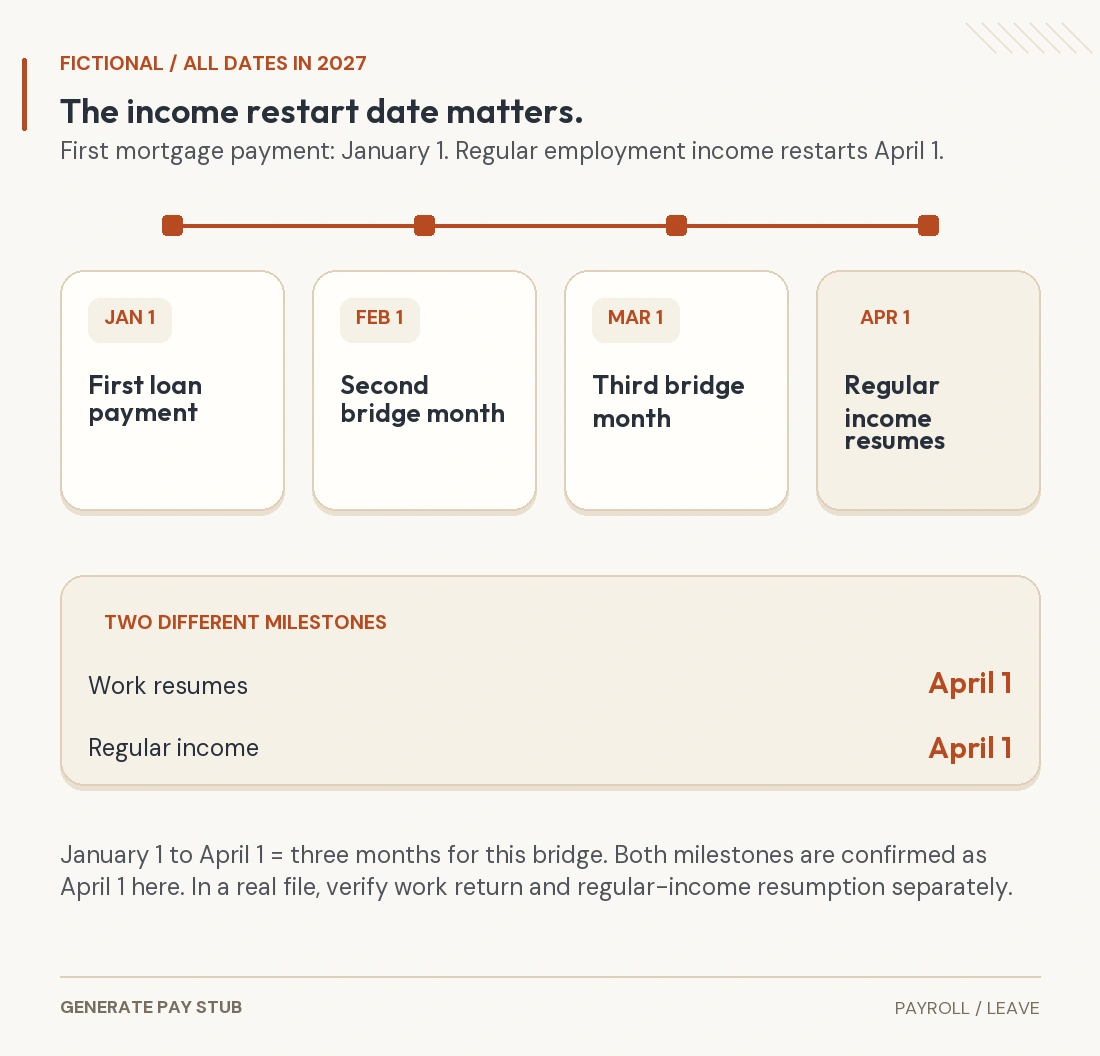
For that supplement, the Selling Guide measures from the first loan payment date to resumption of regular employment income, rounding a fractional month up. Do not start that divisor with the date you began leave or closed the loan. Ask the lender to reconcile different dates shown in employer and payment records.

A reserve-bridge example with every dollar assigned once
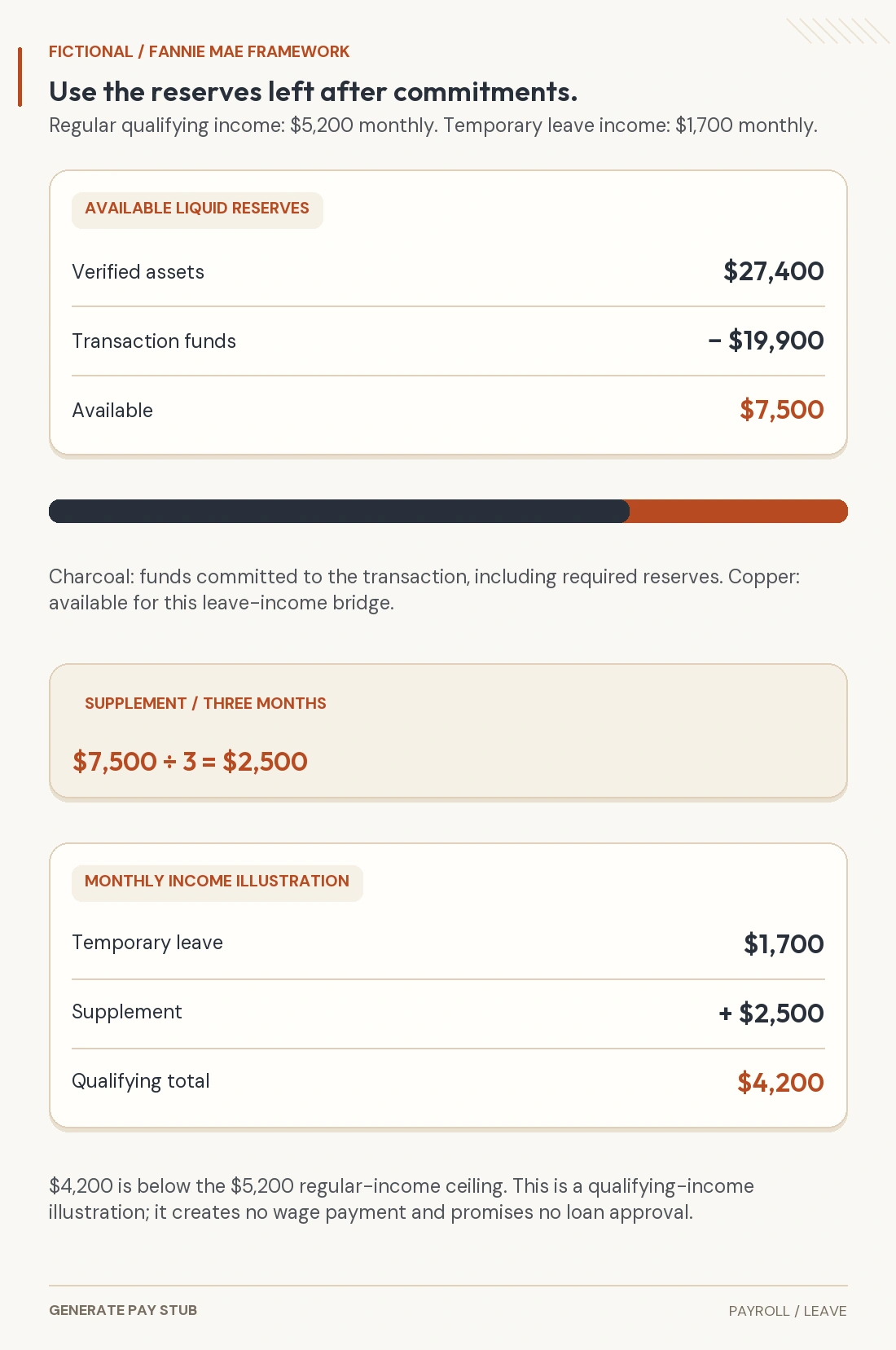
Assume the lender has accepted $5,200 monthly regular qualifying employment income before leave and $1,700 monthly temporary leave income covering the illustrated bridge. The first mortgage payment is January 1, 2027. The documented return to work and resumption of regular employment income are April 1, 2027. The three-month interval is exact, so no fractional-month rounding is needed.
Step 1: identify funds actually left for this purpose
The lender verifies $27,400 of eligible liquid assets. In this fictional file, $19,900 is committed to the transaction, including the down payment, closing costs, required debt payoff, escrows and any minimum required reserves. That leaves $27,400 − $19,900 = $7,500 available for the leave-income supplement.
The minimum-reserve topic describes eligible liquid or near-liquid assets and restrictions. Not every account balance is usable: access, vesting and source matter. A required reserve is also not the same thing as an extra amount available for this supplement. Have the lender assign each commitment before doing the subtraction.
| Input or calculation | Result |
|---|---|
| Regular qualifying income per month | $5,200 |
| Temporary leave income per month | $1,700 |
| Verified eligible liquid assets | $27,400 |
| Transaction commitments, including required reserves | − $19,900 |
| Available liquid funds | $7,500 |
| Bridge interval | 3 months |
| Monthly reserve supplement: $7,500 ÷ 3 | $2,500 |
| Leave income plus supplement: $1,700 + $2,500 | $4,200 |
Step 2: calculate the monthly amount and check the ceiling
The $7,500 divided by three months yields a $2,500 monthly supplement. Adding $1,700 of accepted leave income gives $4,200 monthly qualifying income in this illustration. The result is below the supplied $5,200 regular-income ceiling. It is an underwriting calculation, not a new $2,500 employer wage or a deposit the lender promises to pay.

The total cannot exceed regular employment income under this route. As a separate sensitivity check, suppose available funds were $12,000 instead. Dividing by the same three months gives $4,000; adding $1,700 produces $5,700 before the ceiling. The applicable maximum remains $5,200. More liquid funds do not create an unlimited monthly-income figure.
Four totals that can mislead the review
- The latest net deposit: it may be lower because of withholding or deductions, and it may omit a separate benefit payment. Identify the income category before choosing the amount.
- An old full-pay statement: it documents earlier earnings, but does not establish current leave payments or a return date by itself.
- The entire savings balance: funds already required for closing or minimum reserves cannot be silently reused in the supplement.
- Leave income plus full regular income: do not stack both as if they were simultaneously recurring without the program’s documented treatment.
If a bonus or overtime component is part of the claimed regular income, its eligibility still needs review. The arithmetic here assumes the $5,200 amount has already been established; it does not decide which variable earnings qualify. Our gross monthly income guide explains why a conversion from one check is not the same as lender acceptance.
Income verification should not become a request for family plans
The Selling Guide says a lender must not ask about intended future leave when the borrower is not currently on temporary leave. Separately, the CFPB explains limits on questions about children and dependents: certain financial questions may be asked consistently, but questions about childbearing intentions are prohibited. It also addresses protection against pregnancy and familial-status discrimination.
That does not eliminate legitimate income and employment verification. Ask what financial fact a requested record is intended to establish and use the lender’s secure submission process. Keep medical details out of an ordinary payroll explanation unless the appropriate authorized process actually requires them. Preserve communications if you believe an improper question or adverse treatment occurred.
The CFPB’s mortgage-discrimination guidance describes protections and complaint options. A complaint outcome or a loan approval cannot be determined from this fictional income calculation.
Common temporary-leave mortgage questions
Does a zero earnings statement make qualifying income zero?
It is a reason to explain the period and obtain the other records, not to decide the whole file from that one page. The applicable loan program, return timing, documented payments and any permitted supplement determine the income review.
Can the reserve supplement appear as wages on my pay stub?
No. It is a calculation using the borrower’s verified financial resources under an underwriting framework. It does not belong in employer earnings merely to make an application’s income field larger.
Can my own return-to-work note replace employer confirmation?
The borrower’s return intent and the employer or authorized administrator’s return documentation are different evidence. Provide the requested records; do not present a self-written statement as an employer-issued confirmation.
Will the same example work for another mortgage program?
Confirm that program’s requirements with the lender. Ask it to show the income category, relevant dates, asset exclusions, divisor and resulting amount it actually uses. Keep this illustration separate from any final approval or affordability decision.