A Washington paycheck estimate for 2026 can show zero state income tax withholding while still deducting Washington Paid Leave and WA Cares contributions. Those programs use different rates and wage-limit rules. Federal withholding, Social Security and Medicare remain separate deductions.
This guide uses the free Washington paycheck calculator to examine a fictional $195,000 salary paid monthly. The useful question is not just “What is my average take-home pay?” It is also “Which deductions change once my employer has paid me more than an annual wage cap?” The last modeled payment provides a clear answer.
Choose the right Washington assumptions
Open the Washington paycheck calculator. Select 2026, $195,000 annual gross wages and Monthly. That schedule produces 12 payments of $16,250 gross. Choose Single for federal withholding, with the multiple-jobs checkbox off and the W-4 dollar adjustments at zero. Leave known annual local withholding and other cash deductions at zero for this controlled example.
Use the standard employee treatment for the supported Washington programs. The scenario assumes covered ordinary wages, one employer for the entire year, Washington residence and work, no tips, no pre-tax benefits and no approved contribution exemption. It does not determine whether a particular worker meets those conditions.
The Washington Department of Revenue’s income-tax FAQ distinguishes the current position from the income tax scheduled to begin in 2028. This example concerns 2026 wage withholding; its zero state-income-tax line should not be read as a claim about every future year or every Washington tax.
The calculator builds a full-year projection. It is not an input screen for reconstructing a single irregular payment using an employee’s entire actual payroll history. The period-by-period comparison below comes from the same checked annual scenario.
Separate the total Paid Leave premium from your share
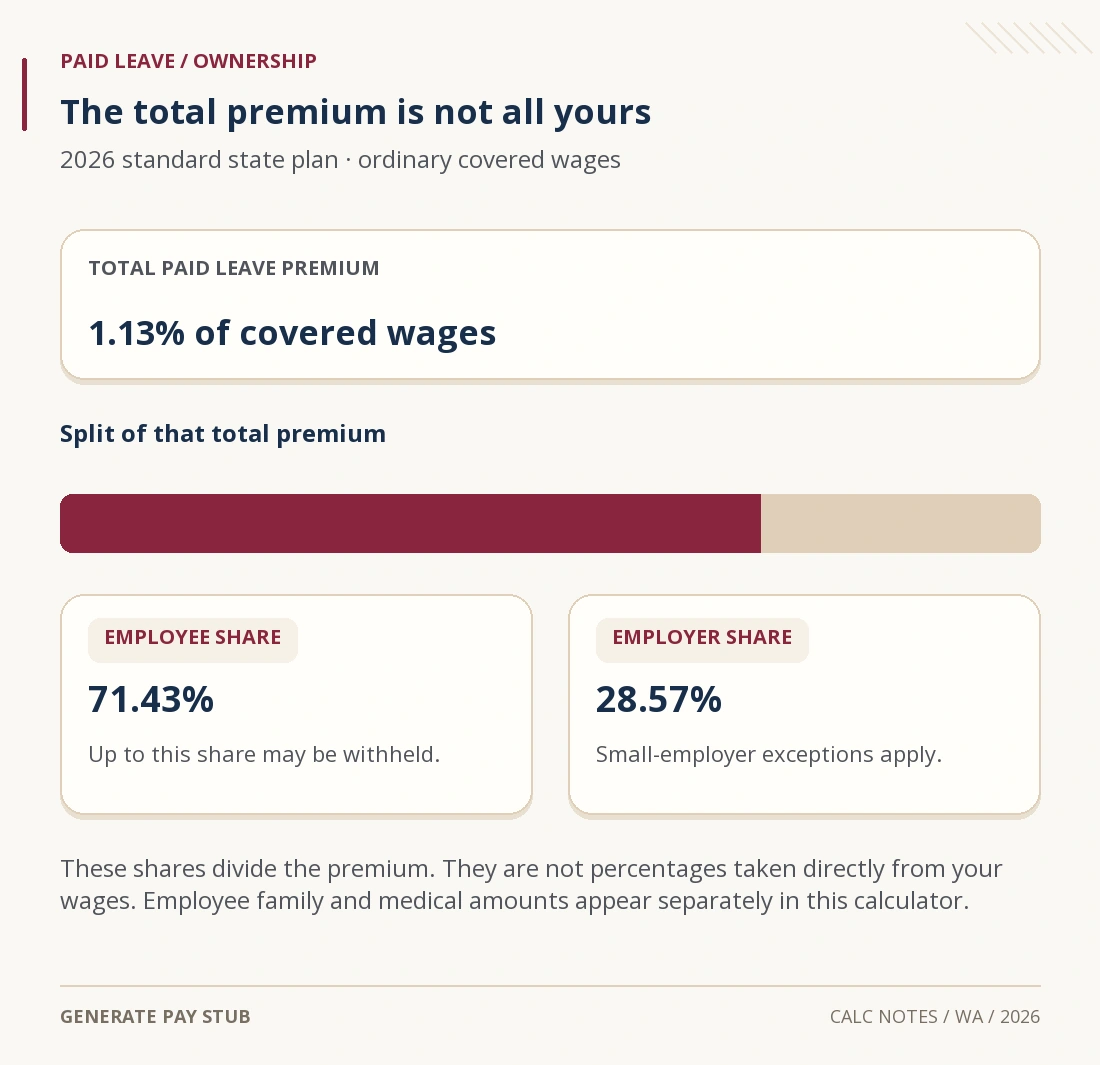
The state’s 2026 premium estimator guidance specifies a 1.13% total Paid Leave premium on covered gross wages, excluding tips, up to $184,500. Employees pay up to 71.43% of that premium; the employer portion is 28.57%. Applying the entire 1.13% as an employee deduction would overstate the standard employee amount.

The official small-business guidance explains that employers averaging fewer than 50 employees generally do not owe the employer share. That exception does not automatically remove the employee portion. An employer can also choose to cover an employee’s portion itself.
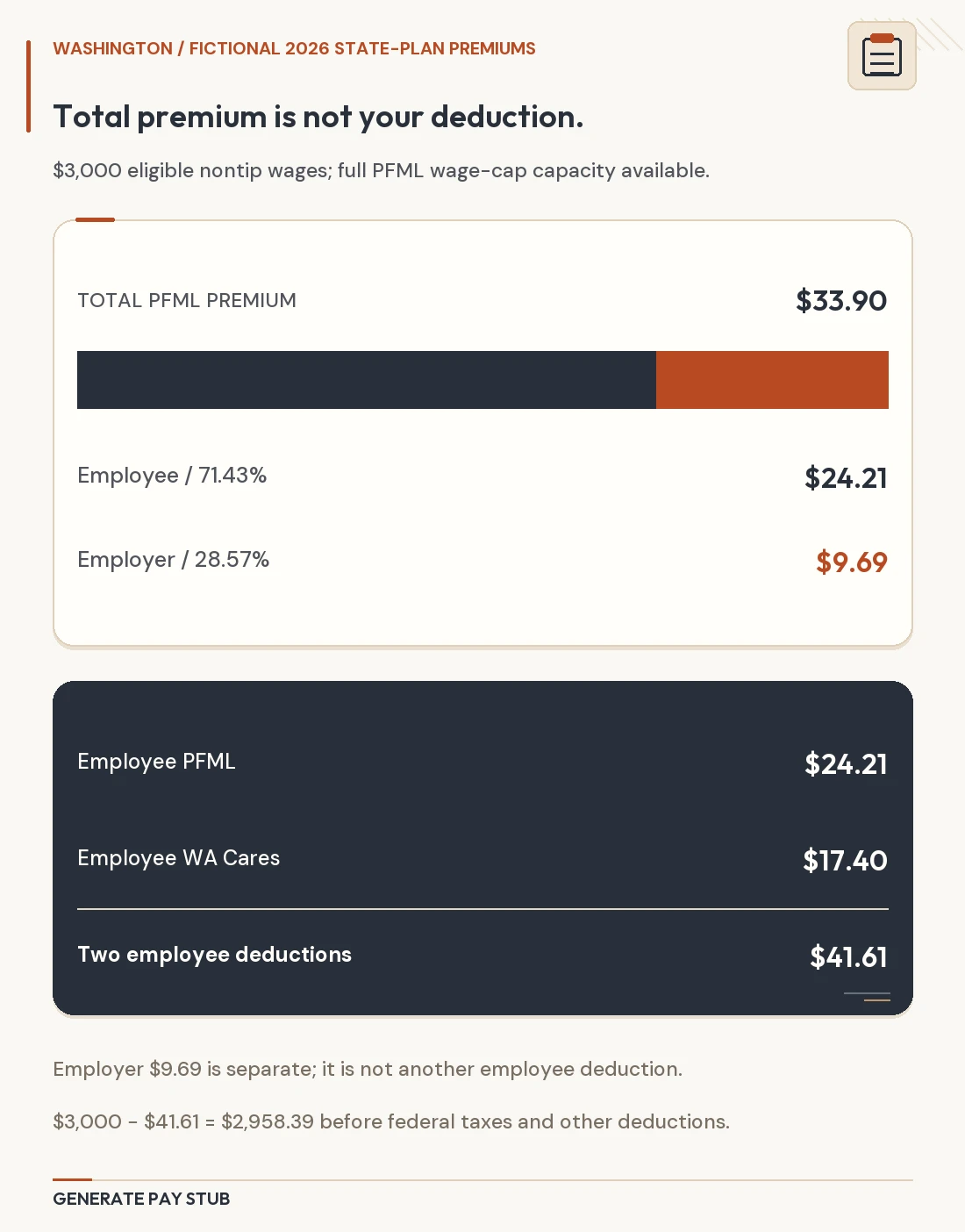
The calculator reports the employee’s Paid Leave family and medical contributions as two lines. Their rounded per-payment amounts are added in this walkthrough. Do not add an employer premium line to those employee deductions when trying to explain take-home pay.
WA Cares funds a different program. Its official explanation gives a 0.58% employee contribution, subject to the applicable coverage rules. The WA Cares FAQ expressly says its contribution wage base is not limited by the Social Security taxable maximum.
Check the annual projection without treating it as twelve identical net payments
The checked run returns these annual totals. All cash deductions entered by the user are zero, and the excluded workers’ compensation amount remains outside the net estimate.
| Component | Annual amount |
|---|---|
| Gross wages | $195,000.00 |
| Federal income tax withholding | $35,534.04 |
| Washington income tax withholding | $0.00 |
| Employee Social Security | $11,439.00 |
| Employee Medicare | $2,827.56 |
| Paid Leave: employee family line | $1,001.98 |
| Paid Leave: employee medical line | $487.19 |
| WA Cares | $1,131.00 |
| Estimated net before excluded L&I and benefits | $142,579.23 |
Divide the annual net by 12 and the rounded average is $11,881.60. That average is useful for a broad comparison, but it is not the actual net amount of each modeled payment. Eleven payments are $11,820.29 and the final payment is $12,556.04, before any excluded or unentered deductions.
Period rounding matters. Medicare is $16,250 × 1.45% = $235.625, rounded to $235.63 for each payment. Twelve such amounts total $2,827.56. Multiplying the annual gross by 1.45% instead gives $2,827.50; that six-cent difference comes from the sequence of rounding, not a different Medicare rate.
Inspect the final payment as the wage caps are reached
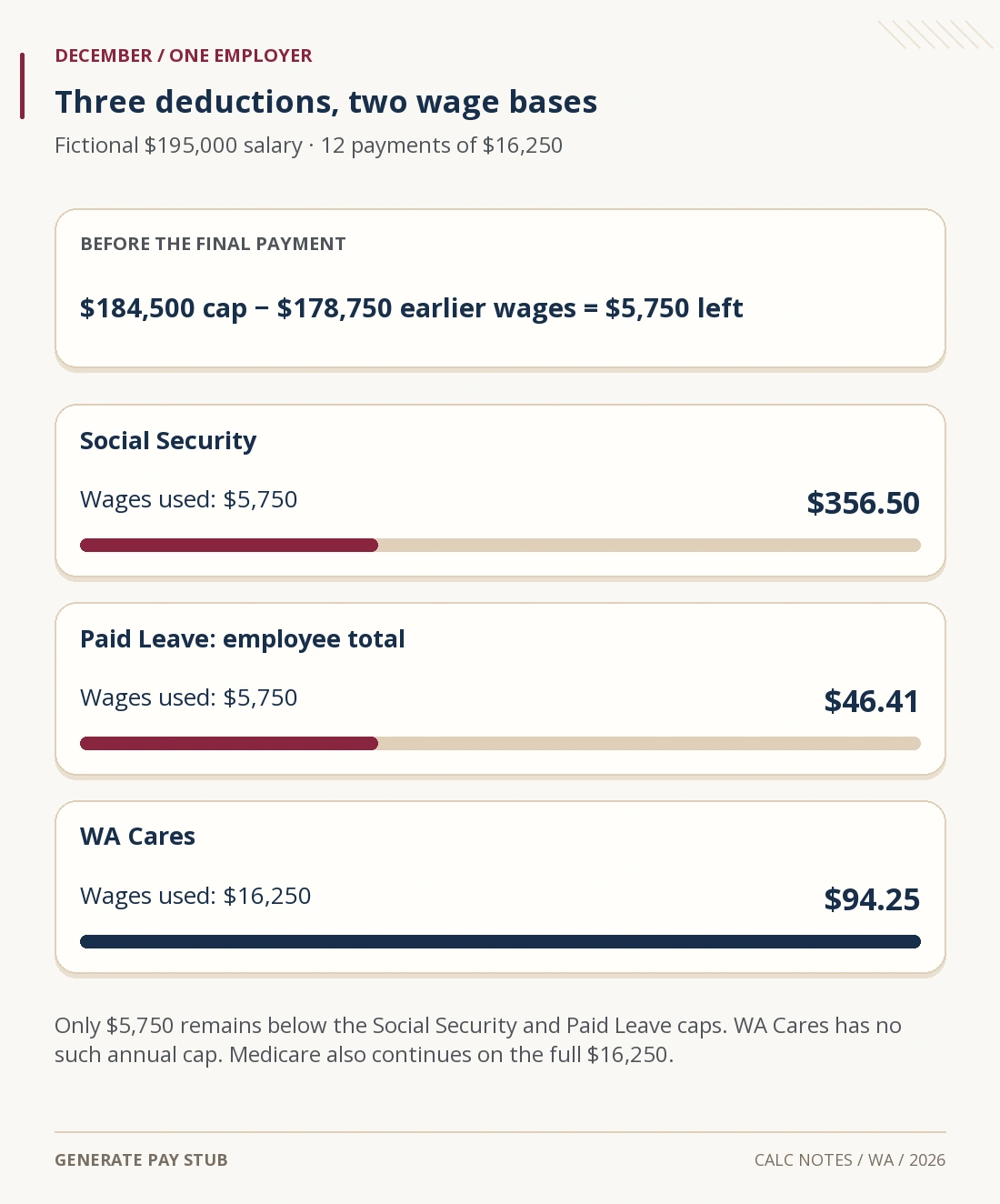
After eleven equal payments, the employer has paid $178,750. The remaining wages below the $184,500 limit are $5,750. Only that amount is subject to the last payment’s Social Security and standard Paid Leave deductions in this example.

| Line | First payment | Final payment |
|---|---|---|
| Gross pay | $16,250.00 | $16,250.00 |
| Federal income tax withholding | $2,961.17 | $2,961.17 |
| Social Security | $1,007.50 | $356.50 |
| Medicare | $235.63 | $235.63 |
| Paid Leave: family | $88.25 | $31.23 |
| Paid Leave: medical | $42.91 | $15.18 |
| WA Cares | $94.25 | $94.25 |
| Estimated net pay | $11,820.29 | $12,556.04 |
The final Social Security amount is $5,750 × 6.2% = $356.50. Paid Leave’s two employee lines total $46.41 for that payment. WA Cares remains $16,250 × 0.58% = $94.25 because its wage base continues beyond the capped amount.
The change in net is $735.75. That equals the $651 drop in Social Security plus the $84.75 drop in the two Paid Leave deductions. Federal withholding and Medicare do not change in this controlled comparison. See the Social Security calculator example for a separate check crossing the cap.
The sample’s $195,000 wages do not cross the employer’s $200,000 Additional Medicare withholding trigger. A higher wage scenario would need that separate test; the Medicare calculator walkthrough explains why employer withholding and final household tax liability can differ.
Account for the L&I amount the calculator excludes
The reviewed result explicitly excludes “WA L&I employee workers’ compensation.” Excluded means the estimate has not calculated that deduction; it does not establish that the correct amount is zero.
The L&I employer guide describes employee deductions using the authorized payroll deduction rate from the employer’s rate notice and actual hours or units worked. A statewide percentage of annual salary cannot supply that employer-specific information.
For a real pay comparison, obtain the employee deduction rate and hours from payroll, then establish the cash amount actually withheld. A known annual amount can be included in the calculator’s other-deductions field as a cash adjustment. That field does not calculate an L&I rate, establish deductibility or change taxable wage bases.
The same discipline applies to retirement, insurance and other benefit deductions. A deduction that changes federal or program wages cannot be modeled faithfully merely by subtracting its cash amount after tax.
Handle coverage and exemption choices with supporting records
Keep standard treatment when it matches the worker’s actual coverage. Do not switch a program off simply because a smaller deduction produces a preferred net result. Paid Leave and WA Cares have separate coverage rules; an exemption or alternative arrangement for one does not automatically decide the other.
The WA Cares employer instructions describe the employee providing an approved exemption letter to the employer. An assumption chosen on this website does not create that approval or change an employer’s payroll records.
An employer-paid selection can help compare a known arrangement’s employee cash deduction. The tool does not settle any additional tax treatment or gross-up that arrangement may require. Voluntary plans, self-employment elections, cross-border work and special coverage cases deserve their own review before using a standard wage projection.
Washington paycheck calculator questions
Does a small employer mean no Paid Leave deduction?
No. The small-employer exception concerns the employer share. Check whether the employee portion is being withheld or paid on the employee’s behalf.
Why does WA Cares continue after Social Security stops?
The two deductions follow different wage-limit rules. Reaching the Social Security maximum does not create a WA Cares cap.
Does this estimate calculate my Washington unemployment tax?
The displayed employee projection should not be treated as an employer payroll-cost calculation. Employer taxes and premiums are a separate budgeting question.
Which result should I compare with my bank deposit?
Compare a particular payment using its covered wages and actual deductions. Do not assume the annual-average result matches a month in which a wage cap changes withholding.
2026 Washington references and the live calculator checked November 6, 2026. Figures are fictional estimates, with excluded L&I and unentered benefit deductions called out explicitly.