If your employer overpaid your paycheck, first verify the error and obtain a written reconciliation before repaying it. The excess gross wages, the extra cash deposited, the tax corrections and the balance still owed can be different amounts. The employer’s ability to take money from a future paycheck also depends on the applicable wage law; a payroll error does not create an unlimited deduction right.
This U.S. guide was reviewed October 26, 2026. It addresses ordinary employee wage overpayments, current federal payroll reporting guidance and selected state examples. It does not decide whether a disputed payment is legally owed. All numbers are fictional, and the examples separate recovery accounting from legal authorization.
How do you confirm that a paycheck was actually overpaid?
Match the payment to the wages earned before assuming the larger deposit is a mistake. Compare the statement’s pay period, pay date, hours, rate, bonus, reimbursements, tax withholding, benefit deductions and net payment. A legitimate retroactive increase, a reimbursement or a deduction that ended can increase take-home pay without creating an overpayment.
Ask payroll to identify the exact transaction and cause. A duplicate bank transfer is not necessarily a duplicate wage entry. A payroll record that counted wages twice is not necessarily evidence that the bank delivered two payments. A wrong hourly rate, an extra salary installment and a bonus subject to a separate repayment agreement also need different reconciliations.
Keep the original statement, the bank transaction identifiers and the corrected explanation together. Our direct-deposit guide helps separate payment allocation from bank settlement, while the retroactive-pay guide explains legitimate later wage adjustments. Use an established payroll contact to verify recovery instructions rather than sending money solely because an unfamiliar message requests it.
Why is the extra gross pay different from the extra deposit?
Gross wages include amounts withheld before cash reaches the employee. Consider a fictional $600 wage error paid and fully corrected in the same calendar year. Assume all $600 was subject to employee Social Security at 6.2% and Medicare at 1.45%, with the full Social Security wage base available and no Additional Medicare Tax. The federal income tax attributed to the error is an assumed $90 from payroll’s actual reconciliation, not a rate recommendation. There are no state taxes, benefits or other adjustments.
| Component | How established | Amount |
|---|---|---|
| Excess gross wages | Verified wage error | $600.00 |
| Federal income tax on the error | Assumed reconciled amount | $90.00 |
| Employee Social Security | $600 × 6.2% | $37.20 |
| Employee Medicare | $600 × 1.45% | $8.70 |
| Total employee taxes | $90 + $37.20 + $8.70 | $135.90 |
| Extra employee cash | $600 − $135.90 | $464.10 |
In a fully coordinated same-year correction, payroll might document $464.10 returned by the employee and $135.90 of associated employee-tax corrections, together resolving the $600 gross error. That outcome assumes the taxes are actually corrected and credited as described. It is not permission to choose a net repayment independently or to recover both $600 cash and the same $135.90 again without accounting for the employee’s tax amounts.

The example uses employee taxes only. Employer payroll taxes are separate from the cash originally deposited into the employee’s account. Likewise, a tax rate, wage cap, benefit election or state rule can change the actual settlement. Use the original transaction’s wage bases, not the percentages from an unrelated paycheck.
How does repayment in the same calendar year affect payroll?
A repayment of wages paid in error in the current year can be corrected within that year’s wage and tax records. 2026 IRS Publication 15, Wage Repayments, distinguishes this from an earlier-year repayment and explains corrections for an earlier quarter in the same year. Payroll must use the proper correction procedure, including any required employee reimbursement or documentation.
Ask which payment is being reversed or corrected, when the repayment is recognized, and how current and YTD fields will change. If the error arose in an already filed quarter, an internal pay-stub edit may not complete the employer’s tax reporting. The April 2026 Form 941-X instructions govern the employer’s correction process and employee-share refund or consent requirements.
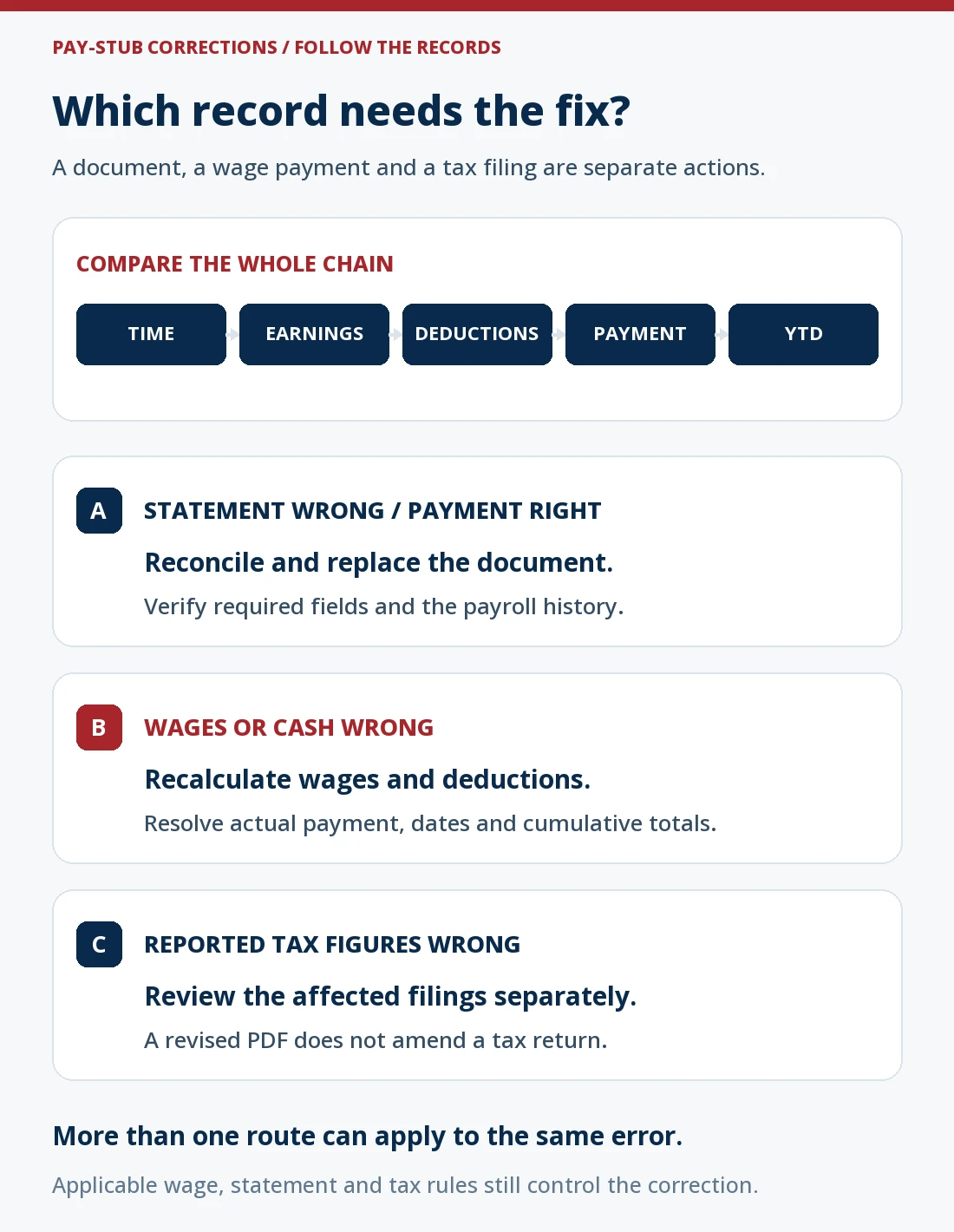
Do not confuse a genuine wage repayment with an administrative reporting error. If a return transposed a number but the employee was paid correctly, the reporting correction does not itself establish a debt. Conversely, an actual cash repayment requires a receipt and a traceable payroll entry; a corrected PDF alone does not establish that money was returned.
Why is repaying last year’s wages more complicated?
Crossing December 31 changes the federal treatment even if the pay period or error is recent. The 2026 W-2 reporting instructions, Repayments, describe earlier-year wage repayments as gross repayments. They direct corrections to Social Security and Medicare wages and taxes, while leaving prior-year W-2 box 1 wages and box 2 federal withholding unchanged for this kind of repayment. Additional Medicare Tax has a separate individual-return procedure.
A repayment made in 2026 for wages received in 2025 should not simply reduce the employee’s 2026 wages. Distinguish that situation from a genuine error in what was originally reported. Request the appropriate W-2c and a statement of the repayment year and amounts. Keep any employee Social Security and Medicare reimbursement separately identified; it should not disappear inside an unexplained demand for money.
For potential individual income-tax relief, the currently available IRS Publication 525 repayment discussion is the 2025 edition. It explains possible repayment-year deduction or credit treatment for qualifying repayments over $3,000, including the claim-of-right condition, and the restriction on miscellaneous itemized deductions for smaller wage repayments. It does not promise every repayment creates a refund. Use the applicable repayment-year return instructions and obtain advice for the actual facts; this guide does not assign a future tax form line.
| Question | Same-year wage repayment | Earlier-year wage repayment |
|---|---|---|
| Which wages are involved? | Error paid and repaid in the same calendar year | Error paid in one calendar year and repaid in a later one |
| Can current-year wages absorb the correction? | Use the proper same-year correction procedure | Do not offset prior-year repayment against current-year wages |
| What about federal income tax? | Associated withholding correction may be available under the current-year rules | Prior-year wages and actual withholding generally stay in boxes 1 and 2 |
| What should the employee retain? | Corrected payroll detail, cash receipt and tax-credit reconciliation | Repayment statement, relevant W-2c and employee-tax refund records |
If the employer will not refund overcollected employee Social Security or Medicare tax, Publication 525 describes requesting an employer statement and considering a claim using Form 843. Eligibility, documentation and limitations periods still apply. Do not seek the same employee-tax refund from both the employer and IRS. An ordinary income-tax repayment claim and an Additional Medicare Tax correction are separate questions.
Can the employer take the overpayment from the next paycheck?
Check the state recovery rules before accepting an automatic deduction. The existence of a valid repayment obligation and the legality of a particular wage deduction are separate issues. Relevant rules may address the kind of error, notice, consent, dispute procedure, recovery limits and final pay. A signed agreement is not a universal exception to wage protection.
For example, New York’s Part 195, section 195-5.1 (private employers covered by the regulation), addresses mathematical or clerical overpayments. It limits covered overpayments to those made in the eight weeks before the required notice, permits recovery over a period of up to six years from the original overpayment, and requires notice and a dispute process. The periodic recovery rule differs depending on whether the entire overpayment fits within the next payment’s net wages. Where it does not, the regulation imposes a 12.5%-of-gross limit and a state minimum-wage protection. Read the entire provision before applying either branch.
California’s DLSE deduction guidance describes restrictions on offsets, including past salary advances paid in error and balloon deductions at separation. Do not import New York’s recovery procedure into California or assume written consent makes every offset lawful. Public employees, collective agreements, court orders and other jurisdictions may require different analysis.
The arithmetic below assumes a lawful, reviewed repayment arrangement. It does not establish one. An employer should explain the applicable authority and procedure before reducing wages. If the employee disputes the alleged debt or the method of recovery, keep that dispute separate from the accurate recording of current wages.
How should an installment repayment appear on a pay stub?
Separate the current paycheck from the repayment balance. Consider a different fictional arrangement: the parties have already reconciled a recoverable cash balance of $500 and established five lawful $100 installments. No interest or fees apply, and tax corrections are handled separately. This $500 balance is not the $600 gross-error example above.
After installments one through five, the balance is $400, $300, $200, $100 and zero. A repayment ledger should show the opening balance, payment date, current recovery, any separate credit, cumulative recovery and closing balance. A running YTD payroll deduction may be useful, but it should not be mistaken for a fresh debt each payday.

For one illustrative current paycheck, assume $2,000 gross earnings, $350 total employee taxes, $100 benefit deductions and a $100 after-tax repayment. Net pay is $2,000 − $350 − $100 − $100 = $1,450. Current gross remains $2,000 in this after-tax collection example. If payroll instead performs a valid same-year wage reversal, its presentation and taxable-wage effects differ; do not apply both methods to the same dollars.
Our net-pay guide explains the cash reconciliation, and the pre-tax versus post-tax guide explains why a debt repayment is not automatically a qualifying tax deduction. The installment amount itself does not determine its tax treatment.
Which documents should you receive after repaying an overpayment?
- The original error calculation: payment dates, hours or rates involved, gross error and cash actually delivered.
- The recovery explanation: applicable procedure, notice, agreed or authorized method, installment amounts and dispute contact.
- The settlement ledger: cash receipts, payroll deductions, tax reimbursements or credits, and the final zero balance.
- The reporting explanation: corrected pay statements, relevant year and wage bases, any W-2c, and separate employer tax-return corrections where required.
Compare corrected YTD fields against the transaction detail rather than subtracting one bank payment from every wage base. Our YTD reconciliation guide explains cumulative totals. The pay-stub versus W-2 guide helps identify why wages and tax fields need separate checks.
What if you disagree, leave the job, or have already repaid?
Request the calculation in writing and respond through the stated dispute procedure. Identify whether the disagreement concerns the original entitlement, the gross-to-net calculation, the tax credits, an installment already paid or the legality of a proposed deduction. Provide records rather than accepting an unexplained running balance.
Leaving the employer does not itself resolve the accounting, and it does not automatically authorize taking the full balance from final pay. An outside demand can involve different legal procedures from payroll deductions. Obtain state labor-agency or appropriate professional guidance when the repayment is disputed, crosses years, or involves a substantial amount.
If you already made a bank transfer, obtain a receipt and ensure payroll has not also deducted that installment. Ask for written confirmation when the balance reaches zero and check the following paycheck for an unintended continuing deduction. The pay-stub correction guide helps document discrepancies. Generate Pay Stub can present verified figures; it cannot determine a disputed debt, authorize recovery or file an employer’s tax corrections.