Retroactive pay on a pay stub usually corrects compensation for an earlier period after a rate, salary, or other pay input changes. Check which work dates the adjustment covers, what was already paid, and whether overtime must be recalculated. The added gross amount is not necessarily the deposit, and the year the work occurred is not automatically the W-2 reporting year.
This U.S. payroll guide was reviewed October 22, 2026. It focuses on ordinary rate adjustments and covered nonexempt overtime, then distinguishes tax reporting and statutory back-pay awards. All examples are fictional. Federal payroll tax guidance comes from the current 2026 IRS employer guide; contracts, state wage rules and specialized compensation arrangements require their own facts.
What is retroactive pay, and how is it different from back pay?
Read the transaction behind RETRO, RATE ADJ, BACK PAY, or a similar employer-specific code. A delayed raise implementation can create the difference between the old rate paid and the new rate due. Missing hours can instead require payment for hours that never entered the original calculation. A bonus allocated to earlier workweeks presents another calculation. They should not all be computed as hours multiplied by one rate difference.
Payroll teams often use “retro pay” for a prior-period adjustment and “back pay” more broadly for unpaid compensation. These labels are not a universal legal classification. The DOL back-pay explanation describes recovery of the difference between wages paid and wages required. A court award, settlement, collective agreement or ordinary administrative correction can require different records and treatment.
Also distinguish an extra payment from a document replacement. Reissuing a statement to fix a spelling error does not necessarily pay another dollar. Conversely, a correct revised PDF does not prove a wage shortfall was paid. Our pay-stub correction guide separates those steps.
Which records should you compare before calculating retro pay?
Rebuild the original obligation before subtracting the original payment. Collect the approved rate or salary notice, effective date, workweek boundaries, actual hours, original earning lines, prior adjustments and payment history. The date a raise was approved can differ from its effective work date and the date payroll implements it.
- Effective period: which work dates, earnings categories or employees does the adjustment cover?
- Original amount: what gross compensation was actually calculated and paid for those dates?
- Correct amount: which rates, overtime rules, differentials or other compensation apply?
- Prior corrections: was part of this difference already included in another payroll?
- Payment date: when will the remaining adjustment actually be paid, and by which method?
If a rate changes inside a period, divide the affected work correctly instead of applying the new rate to every hour on the statement. Do not turn an earlier missed hour into a current-week hour merely to get it through payroll. Our two-rate statement guide explains the distinct earnings lines.
How do you calculate retroactive hourly pay with overtime?
Calculate the correct earnings for each workweek and subtract what that workweek already received. In this fictional example, a covered nonexempt employee’s rate rises retroactively from $24 to $26 for two workweeks. Week A contains 42 actual hours; Week B contains 38. There are no bonuses, differentials, paid leave, daily overtime, special agreements or other regular-rate components. Ordinary federal time-and-a-half applies after 40 hours in each workweek.
| Workweek | Originally paid | Correct earnings | Difference |
|---|---|---|---|
| A: 40 regular + 2 overtime hours | $1,032.00 | $1,118.00 | $86.00 |
| B: 38 regular hours | $912.00 | $988.00 | $76.00 |
| Two-week totals | $1,944.00 | $2,106.00 | $162.00 |
Week A originally paid 40 × $24 + 2 × $36 = $1,032. Its corrected amount is 40 × $26 + 2 × $39 = $1,118. Week B changes from 38 × $24 = $912 to 38 × $26 = $988. Therefore, the remaining gross adjustment is $86 + $76 = $162, assuming no earlier adjustment was paid.

An equivalent cross-check uses 80 total worked hours × $2 = $160 of base-rate increase, plus 2 overtime hours × $1 additional half-rate = $2. Together they produce $162. Do not add another $6 after using this $160 route: the base-rate increase for those two overtime hours is already inside $160.
For salaried employees, the appropriate increase depends on what the salary covers and the applicable overtime method; dividing an annual raise by an arbitrary number of checks is not always sufficient. Preserve the actual payroll calendar and agreement. The salary-versus-hourly guide explains why salary status alone does not resolve exemption or overtime.
Why does retroactive pay require a regular-rate review?
A retroactive rate increase can also increase the overtime rate for the affected work. 29 CFR 778.303 explains this principle and the allocation of lump-sum retroactive increases to the periods they cover. Its continuing rule is distinct from any newly announced 2026 dollar limit.
The DOL overtime fact sheet explains that the ordinary test uses the workweek, not a two-week average. In the example,42 plus 38 does not become two 40-hour weeks. The rate difference on an overtime hour is $3, even though the ordinary hourly increase is $2.
A retroactive bonus, commission, or shift adjustment can require a different allocation and regular-rate calculation. Check the compensation’s character, exclusions and the weeks it covers. A lump sum does not avoid overtime merely because it appears on a later check. See our bonus, commission and shift-pay guides for those separate inputs.
State daily overtime, contractual premiums, prevailing-wage work and special federal methods may change the analysis. Do not apply this single-rate example to a tipped worker’s reduced cash wage or a fluctuating-workweek arrangement without reviewing the applicable rules. Nor does a raise agreement necessarily settle whether an earlier wage violation occurred.
Is retroactive pay taxed at a special higher rate?
Withholding can differ from the employee’s final income tax. Publication 15 lists retroactive pay increases among supplemental wages. For qualifying separately identified supplemental wages at or below the annual $1 million threshold, payroll may use the permitted 22% federal method when its conditions are satisfied, including income tax withheld from regular wages in the current or preceding calendar year. The aggregate method is another route; unspecified combined payments and other circumstances have their own rules.
Amounts above the applicable $1 million supplemental-wage threshold follow mandatory 37% federal withholding on the excess, with common-control rules considered. These are withholding procedures, not a universal retro-pay tax bracket. Social Security, Medicare, benefits, garnishments and state/local items require separate review.
Apply an explicitly assumed eligible 22% method to the separate $162 adjustment. Assume full Social Security wage base remaining, no Additional Medicare threshold crossing, no other deductions, and no state/local tax. Round the individual employee tax amounts to cents for this illustration.
| Item | Calculation | Amount |
|---|---|---|
| Retroactive gross | Verified workweek difference | $162.00 |
| Federal income tax withheld | $162 × 22% | $35.64 |
| Social Security tax | $162 × 6.2%, rounded | $10.04 |
| Medicare tax | $162 × 1.45%, rounded | $2.35 |
| Total employee taxes | $35.64 + $10.04 + $2.35 | $48.03 |
| Net adjustment paid | $162 − $48.03 | $113.97 |
A payment of $113.97 therefore does not mean payroll omitted $48.03 of earned wages. Conversely, assuming $162 will arrive in the bank would ignore withholding. Actual payroll can produce rounding differences or use another permitted method. Compare the actual employee tax lines, not employer tax costs. The rounding guide and net-pay explanation help reconcile those details.
Does retro pay belong to the work year or payment year?
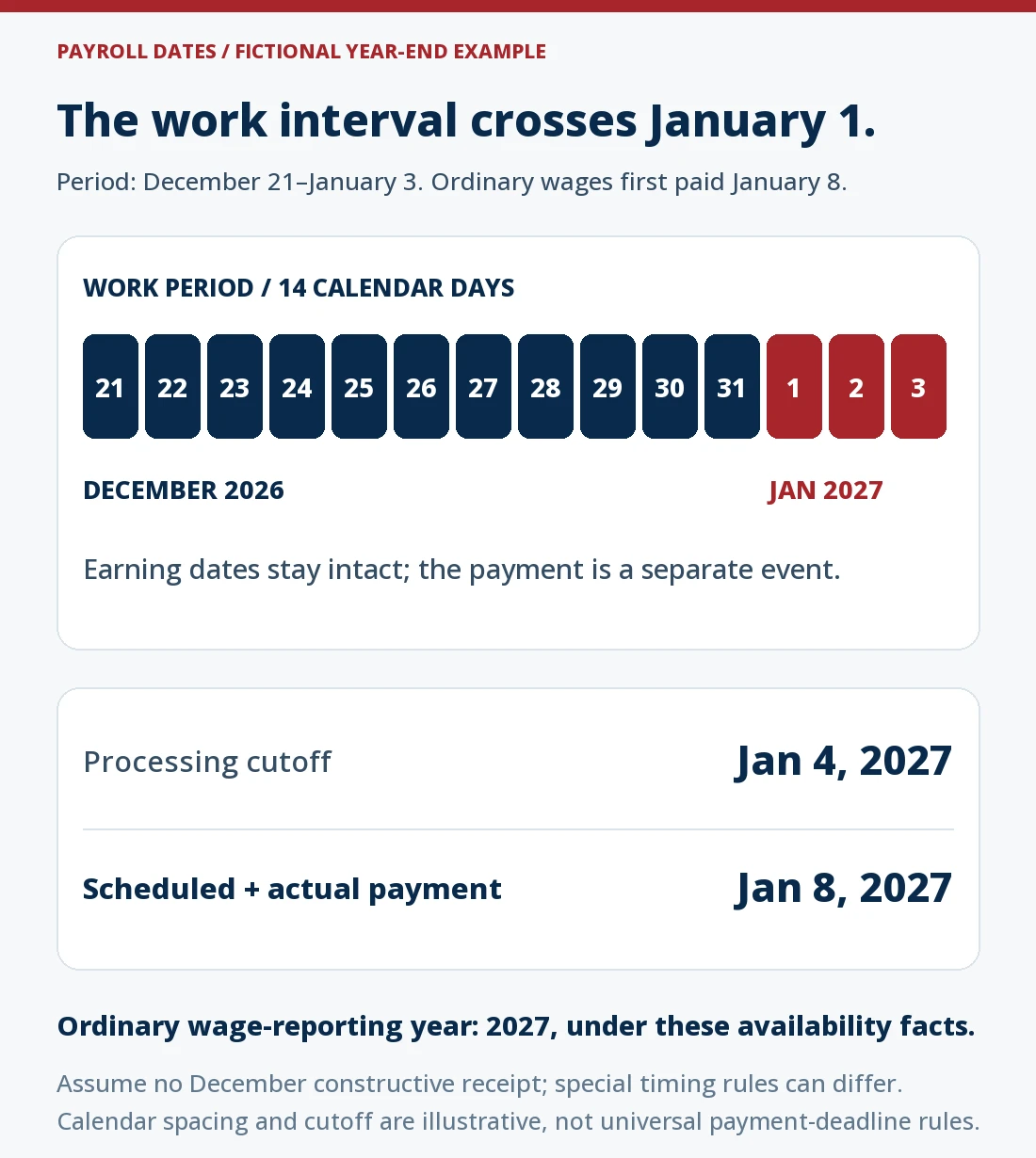
For ordinary federal wage reporting, back pay is generally reported in the year paid. The 2026 Publication 15-A back-pay section explains this rule and the special SSA reporting issue for back pay under a statute.
Suppose an ordinary wage adjustment for December 2025 work is actually paid in January 2026. Under the stated ordinary facts, it enters 2026 wage reporting, not a replacement 2025 W-2 merely because the work occurred then. The old work dates still matter for the rate and overtime calculation. If wages were already paid in 2025 but omitted from reporting, that is a different correction question.

Publication 957 describes special reporting for statutory back-pay awards, including circumstances in which SSA allocates earnings for coverage or benefit purposes. Do not confuse that allocation with ordinary income-tax W-2 reporting. Its historical example wage caps are not 2026 limits.
Settlements can include wages and other components such as interest, penalties, damages or fees. Their reporting requires the actual award and current rules; the word BACKPAY does not turn every component into ordinary wage income. Keep settlement documents separate from a routine delayed-raise calculation.
How should current pay, YTD totals and replacement payments reconcile?
A new current payment should update the corresponding cumulative figures once. If payroll adds the $162 adjustment to a later regular payroll, distinguish the regular earnings from the retro line. Verify that the current gross totals both correctly and that YTD wages, taxes and relevant deductions reflect the payment.
Hours on a retro line may identify hours being repriced, not additional hours worked in the new workweek. Repeating 80 affected hours as 80 new current hours would distort records. Ask whether the quantity is reference information, the adjustment is amount-only, or separate lines identify rate and premium corrections.
If the payment file fails, a replacement should be linked to the original payment status. Do not count an original and replacement as two separate wage obligations. If an earlier correction already paid $50 of the same gross difference, the remaining gross is $112, assuming that payment was correctly classified. Withholding and cumulative totals must follow the actual combined history. Our direct-deposit troubleshooting guide covers the payment side.
What should you ask payroll when the retro line looks wrong?
- Specify the affected work. Give the effective rate date and workweek records, not just a desired bank deposit.
- Request the comparison. Ask for original earnings, corrected earnings, previous adjustments and the remaining difference by workweek.
- Check overtime and related inputs. Include affected bonuses, differentials and any applicable state or specialized rules.
- Separate gross from withholding. Identify the federal method and actual employee tax/benefit deductions.
- Confirm the payment and reporting year. Distinguish newly paid wages, previously paid but misreported wages, and statutory awards.
- Preserve the history. Keep the original record, adjustment calculation, payment confirmation, revised statement and any annual reporting correction.
For an unresolved legal wage issue, use the responsible labor agency and applicable time limits rather than assuming a payroll code settles the claim. The Wage and Hour Division complaint guidance describes the federal process; state wage claims may address obligations outside federal minimum-wage and overtime coverage.
When preparing a statement with Generate Pay Stub, use the verified adjustment and real payment history. A document cannot authorize a raise, recover unpaid wages, or establish a payroll tax method by itself. Keep the evidence organized with the source-record checklist.