Schedule SE calculates Social Security and Medicare tax on eligible net self-employment earnings. Begin with the person's relevant business results, follow the net-earnings calculation and account for Social Security wages already earned. The familiar 15.3% rate is not a universal percentage of gross receipts.
This schedule has two important outputs: self-employment tax that goes to the tax side of the return, and a separate eligible adjustment for one-half of that tax. The adjustment does not halve the tax being charged.
2025 Schedule SE, reviewed November 5, 2026. The linked builder currently provides the final 2025 original. The first fictional example assumes one ordinary individual sole proprietor, $48,000 eligible Schedule C profit, no wages, no other businesses, no optional methods, no approved exemption and no Additional Medicare Tax.
What does Schedule SE calculate, and what does it leave out?
Schedule SE calculates the ordinary self-employment Social Security and Medicare tax. The IRS self-employment-tax overview distinguishes this tax from other taxes a self-employed individual may owe.
The standard combined rate is 15.3%: 12.4% Social Security plus 2.9% Medicare. The Social Security portion has a year-specific ceiling, while the ordinary Medicare portion has no comparable earnings cap.
Federal income tax remains a separate calculation. Additional Medicare Tax, where applicable, is calculated separately on Form 8959. Estimated payments are a payment process, not another expense that automatically reduces Schedule SE earnings.
A payment statement, invoice or contractor pay stub is also different from this tax schedule. Those documents may help organize accurate records; they do not determine whether every receipt is subject to the same tax.
Who generally needs to file Schedule SE?
The ordinary filing rule is based on net earnings, with important exceptions. IRS Topic 554 describes the usual $400 net-earnings threshold. It is not a $400 gross-sales threshold or an income-reporting exemption for all smaller receipts.
The 2025 Schedule SE instructions also have a separate rule for qualifying church employees with at least $108.28 of church employee income. Ministerial income has its own treatment and is not interchangeable with that category.
Age and already receiving Social Security or Medicare benefits do not by themselves remove otherwise applicable SE tax. Approved exemptions or an applicable international agreement require their specific rules and evidence.
Filing a joint return does not merge spouses into one Schedule SE. Each person with relevant self-employment earnings generally prepares their own calculation. Within one person's calculation, eligible results from multiple businesses can need to be combined.
Which records should you collect before entering figures?
Collect completed business results and the person's wage records. The IRS Schedule C and SE FAQ explains the connection between business reporting and self-employment tax.
- Schedule C net results and relevant adjustments.
- Schedule F results and eligible farm-partnership amounts.
- Relevant K-1 statements and partner-specific SE treatment.
- W-2 Social Security wages and tips, plus applicable railroad compensation.
- Relevant unreported-tip or misclassified-worker wage calculations.
- Approved exemption, community-income or other special-case records.
- Optional-method eligibility history, if considering an optional method.
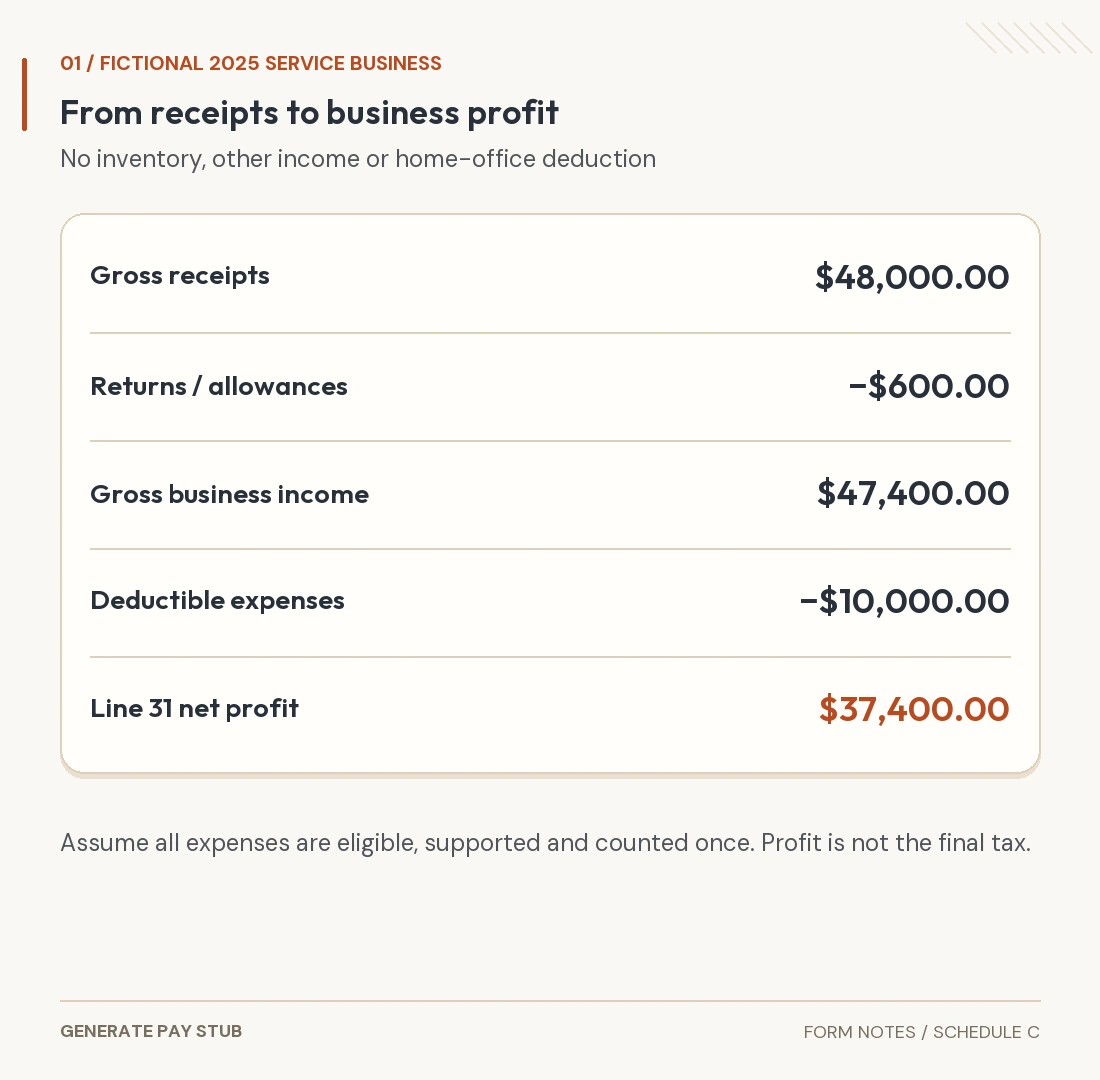
Keep the source calculations alongside the draft. Do not replace a reviewed business profit with the total of bank deposits or amounts withdrawn for personal use. Our Schedule C example and Schedule F example show how income and expenses produce the starting result.
Use the correct individual identity throughout. A spouse's wage record is not a substitute for your own when determining your remaining Social Security ceiling.
How is Schedule SE calculated? A checked 2025 example
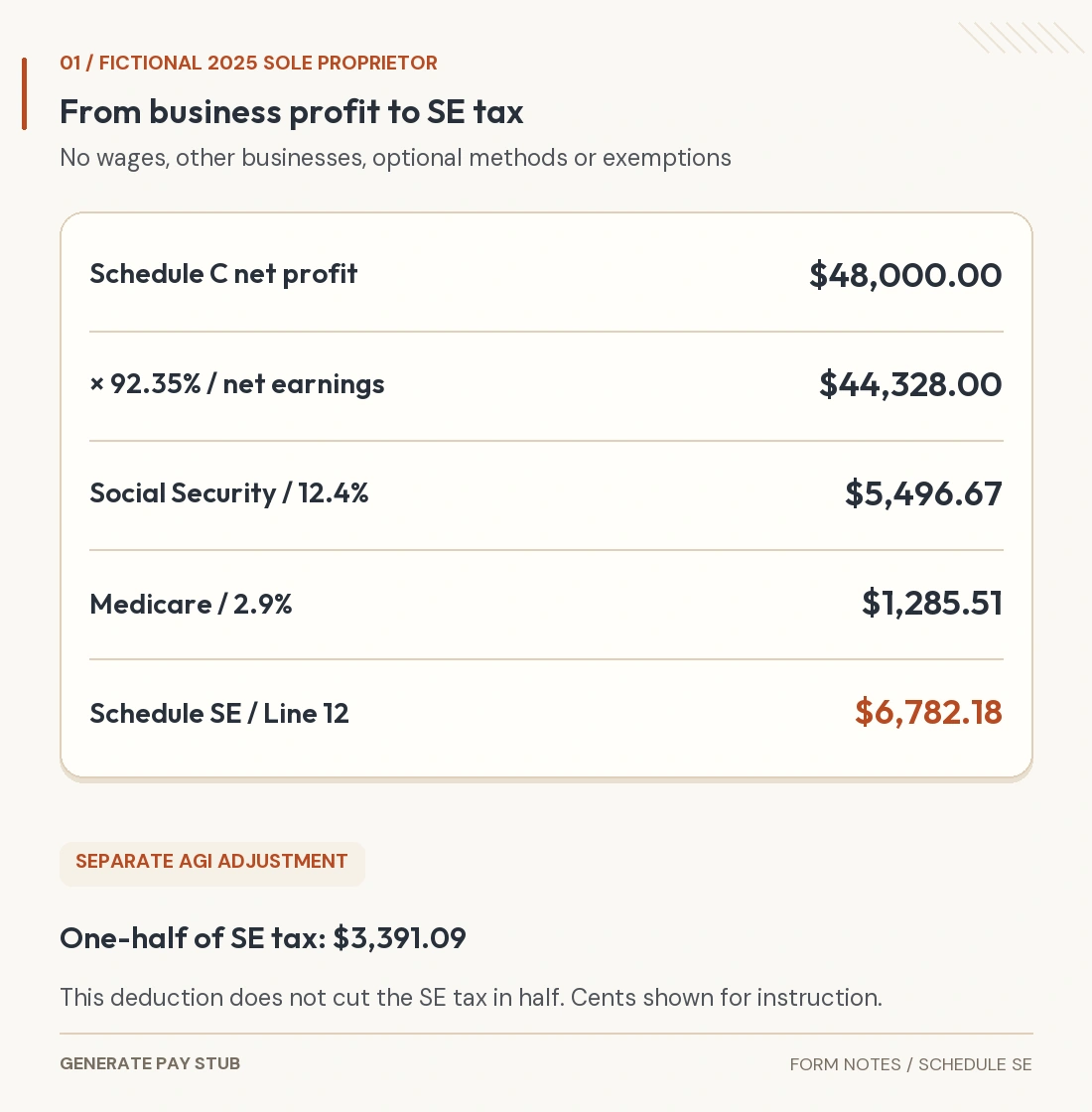
Apply the earnings adjustment before the component taxes. On the 2025 original Schedule SE, ordinary positive profit is multiplied by 92.35% in the net-earnings step.
Assume the fictional proprietor's eligible profit is $48,000. Multiplying $48,000 by 0.9235 produces $44,328 of net earnings for this simplified case. There are no wages using the Social Security ceiling and no other adjustments.
| Step | Calculation | Amount |
|---|---|---|
| Eligible business profit | Given reviewed Schedule C result | $48,000.00 |
| Net SE earnings | $48,000 × 92.35% | $44,328.00 |
| Social Security component | $44,328 × 12.4% | $5,496.67 |
| Medicare component | $44,328 × 2.9% | $1,285.51 |
| Schedule SE tax | $5,496.67 + $1,285.51 | $6,782.18 |
| Separate half-tax adjustment | $6,782.18 × 50% | $3,391.09 |

Multiplying the $48,000 profit directly by 15.3% would give $7,344, which does not follow this ordinary net-earnings calculation. Applying the rate to gross customer receipts would be still further removed from the correct starting point.
Do not subtract the half-tax adjustment from the Schedule C profit and then repeat this same calculation. Its destination is separate, as explained below.
How do W-2 wages affect the Social Security part?
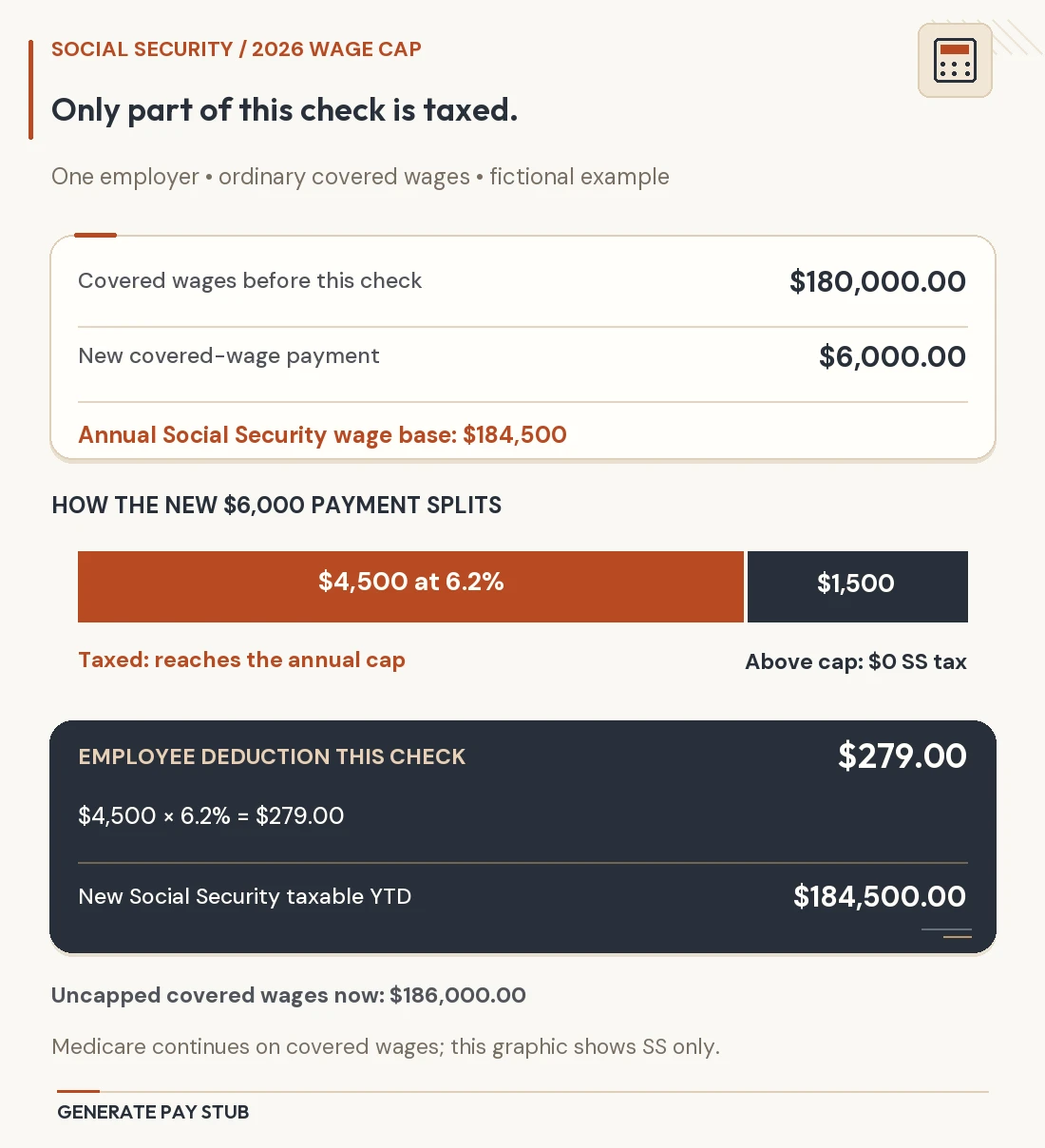
The person's covered wages use part of the combined annual Social Security ceiling. The SSA contribution-and-benefit-base table lists $176,100 for 2025. Use that year's amount, not a later year's ceiling.
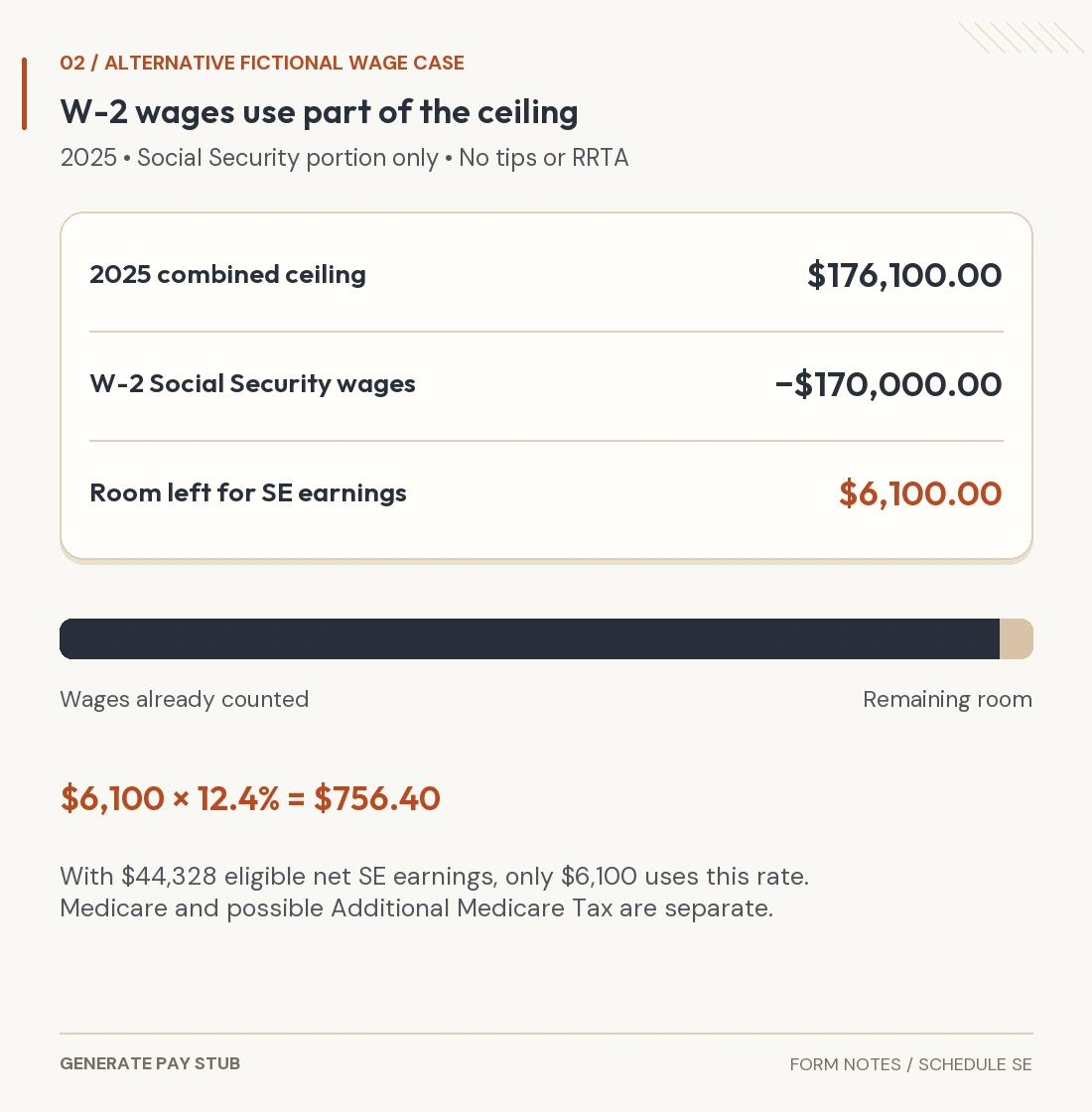
Consider an alternative fictional case with $170,000 of W-2 Social Security wages, no tips or railroad amounts, and the same $44,328 eligible net SE earnings. Remaining Social Security room is $176,100 − $170,000 = $6,100. The SE Social Security component uses the smaller of $44,328 and $6,100, producing $6,100 × 12.4% = $756.40.

This is a Social Security illustration only. The Medicare component still considers the applicable net SE earnings without that ceiling. The total facts may also require Form 8959; the diagram does not state the complete tax for this alternative case.
For a person whose relevant wages already reach the ceiling, the SE Social Security component can be zero while Medicare remains payable. Review all wage categories required on the original form rather than using W-2 Box 1 as a substitute for Social Security wages.
What does the deduction for one-half of SE tax actually do?
It is a separate adjustment to income, not a credit that halves the SE tax. The 2025 form sends Line 12 SE tax to Schedule 2, Line 4. Where applicable, Line 13's one-half amount goes to Schedule 1, Line 15.
In the first example, SE tax remains $6,782.18, and the separate adjustment is $3,391.09. How that adjustment changes income tax depends on the rest of the return; it does not produce a fixed dollar-for-dollar refund.
The Schedule 1 guide explains how adjustments enter AGI. Form 1040-SS has different routing, including the instruction to skip this deduction line on Schedule SE.
Which cases need a separate review?
Additional Medicare Tax
This is outside Schedule SE's ordinary tax total. The 2025 Form 8959 instructions explain the 0.9% additional tax and filing-status thresholds. Medicare wages and SE income interact in that calculation, with spouses combined where required for a joint return.
Do not add a guessed extra percentage to Schedule SE or assume the ordinary Social Security ceiling eliminates it. The Schedule 1 half-tax adjustment does not include a deduction for Additional Medicare Tax.
Partners, statutory employees and special earnings
Check the category before including a profit amount. Partnership SE treatment depends on the applicable rules, not simply a cash distribution. Statutory-employee Schedule C income generally is not included as ordinary SE profit. Notary fees, ministers, certain conservation payments and community-income cases can have special treatment.
Exemptions and international coverage
An application or personal belief is not the same as an approved exemption. Follow the instructions for approved Forms 4029 or 4361 and any applicable social-security agreement. Keep the supporting approval or coverage evidence and exclude only the earnings properly covered.
What are the optional methods on page 2?
Optional methods are conditional earnings calculations, not unrestricted tax-saving choices. They can affect tax, benefit credits and other return items.
Either of two defined 2025 farm tests can qualify: gross income no higher than $10,860, or net profit under $7,840. The nonfarm option requires net nonfarm profit below $7,840 and below 72.189% of defined gross nonfarm income, with at least $400 actual net SE earnings in two of the three preceding years. The nonfarm method is limited to five tax years. The two methods share the $7,240 maximum optional-earnings amount.
Use the complete page 2 instructions and defined amounts to test eligibility. An optional method can matter even with a small profit or loss, but selecting a box without that review does not establish that it applies.
How do you prepare and finish Schedule SE?
Enter the individual's eligible earnings and wage records, then check the two outputs and attachments. The Schedule SE overview opens the Schedule SE builder, currently offering the final 2025 edition.
It provides ordinary farm and nonfarm inputs, wage categories and conditional special-case or optional-method entries. Review the original two pages against the supporting schedules. An accepted input is not a determination of worker status, exemption or optional-method eligibility.
The main return, supporting explanations and any Form 8959 remain separate. Schedule SE has no separate taxpayer signature line. Preparing the PDF does not file the return or pay the tax.
For current-year payment planning, the 2026 Form 1040-ES guide explains estimates and timing. Do not apply this article's 2025 ceiling automatically to a 2026 estimate. Ordinary 2025 filing dates have passed at this review, so use the appropriate late, amended or relief procedure where relevant.
General U.S. tax information. Cents are retained for educational arithmetic. The first example excludes wage-cap interaction and special cases; the alternative diagram isolates the Social Security component only.